What Is Field Sales? Eye-Catcher
26
.
05
.
14

What Is Field Sales? An Explanation of Roles, Differences from Inside Sales, and Required Skills

Even as digitalization advances, in-person sales—where representatives visit customers directly—remain the primary channel for many companies. However, this is also a department prone to organizational challenges such as employee turnover and retention issues, as well as difficulties in meeting targets when performance is evaluated solely based on the volume of activities.

This article provides a systematic overview of field sales, covering everything from its basic definition and how it differs from other sales styles to KPI design and the necessary skills.

Table of Contents

What Is Field Sales?

Field sales is a sales approach that involves visiting customers directly to conduct face-to-face business meetings.

Basic Definitions and Job Responsibilities

Field sales refers to sales activities in which representatives visit customers' offices or job sites to conduct face-to-face consultations, make proposals, and close deals.

The primary responsibilities range widely from securing appointments and planning visits to conducting on-site business negotiations and providing follow-up after closing deals.

The mode of transportation—whether on foot, by bicycle, by car, or by train—varies depending on the area and the product or service. Even today, when digital tools are increasingly used, the fundamental structure of sales meetings centered around in-person visits has not changed significantly.

Position within THE MODEL

In modern B2B sales, a division of labor involving marketing, inside sales, field sales, and customer success has become widespread.

THE MODEL's B2B Sales Structure

In this structure, the field sales team takes leads that have been qualified by the inside sales team and is responsible for converting them into orders through actual sales meetings.

By having each process function as an independent specialized team, productivity within each team improves, and the organization’s overall revenue generation cycle becomes more efficient.

The Background Behind the Current Reassessment of Field Sales

While remote work and online business meetings expanded rapidly during the COVID-19 pandemic, this trend is not moving in a single direction. According to the Ministry of Internal Affairs and Communications’ “2024 White Paper on Information and Communications,” the telework adoption rate stood at 49.9% in 2023, a 1.8-point decrease from the previous year, confirming a shift back toward in-person interactions.

Source: Ministry of Internal Affairs and Communications, 2024 White Paper on Information and Communications

The Difference Between Field Sales and Inside Sales

Field sales involves in-person visits, while inside sales is conducted remotely; their roles, KPIs, and suitable products differ.

Differences in Location and Methods of Activity

While field sales involves visiting customers directly at their locations, inside sales involves reaching out to customers from the office using the phone, email, and web conferencing tools.

Differences in where sales activities take place directly translate into differences in travel costs and the number of contacts made per day. Because field sales involve travel time for each visit, the structure inherently limits the number of prospects that can be approached compared to inside sales.

Role and KPI Comparison Table

Criteria for comparisonField SalesInside Sales
LocationClient site (visit)In-office (non-face-to-face)
Main methodsIn-person meetings and demosPhone, email, and web conferencing
Key KPIsNumber of visits, closing rate, average deal valueNumber of calls, conversion rate, number of lead nurturing activities
Suitable productsHigh-value B2B deals and those requiring complex proposalsItems that can be offered at mid-to-low price points and with standardized proposals
A Comparison of Field Sales and Inside Sales

According to international research, sales representatives spend only 33% of their workweek interacting with customers. For field sales representatives, much of the remaining time is spent commuting, handling administrative tasks, and preparing reports, making the limited time available for customer interaction even more pronounced.

The manager’s role is to monitor the quality of leads generated internally and the conversion rate to sales opportunities, and to identify where bottlenecks lie in the process. If there are “many leads but few closed deals,” the priority is on improving closing skills; if the “conversion rate is low,” the priority is on redesigning the lead qualification criteria.

The mainstream approach is collaboration, not an either/or choice

Rather than viewing it as a choice between field sales and inside sales, a hybrid model that combines the two is a more realistic approach.

By having inside sales teams establish contact via phone and email and then hand off promising leads to field sales, we can create a sales process that leverages the strengths of each team.

Relying on just one of these approaches carries the risk of losing leads or compromising the quality of your sales opportunities.

For more details on the sales strategy framework, please see the article below.

Related Articles >> 8 Sales Strategy Frameworks

The Benefits of Field Sales

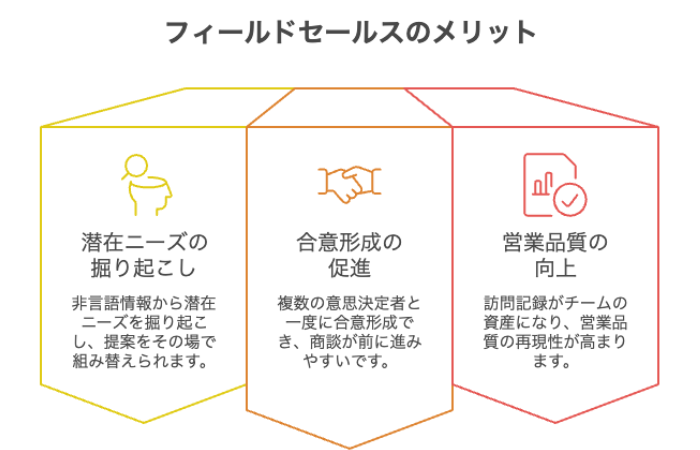
The strengths of field sales lie in its ability to gather information, support decision-making, and build organizational insights—all of which can only be achieved through face-to-face interaction. These three key benefits, which cannot be replicated through text or voice alone, represent a decisive advantage over other sales approaches.

Uncover latent needs from nonverbal cues and adapt proposals on the spot

You can discern a customer’s unspoken concerns from their facial expressions, tone of voice, eye movements, and the atmosphere in the office. It is precisely because you are face-to-face that you can sense the true concerns underlying a remark like “I don’t think this is right for us” and immediately adjust your approach—and this is what determines your closing rate.

During online meetings, all you can see is the person’s face on the screen, but during in-person visits, the physical environment itself serves as a source of information. Details such as how inventory is stacked, the state of the representative’s desk, and the atmosphere of the department—aspects of the workplace that the customer may not even be aware of—provide clues that help improve the accuracy of our proposals.

This makes it easier to reach an agreement with multiple decision-makers at once and move the negotiations forward

In high-value B2B transactions, multiple stakeholders—including purchasing managers, on-site supervisors, and executive management—are involved in the decision-making process. During an in-person visit, all of these stakeholders can gather in one place, address their respective concerns on the spot, and build consensus.

In online meetings, it’s often the case that you end up speaking with just one representative, which can easily lead to a situation where you keep hearing, “I’ll take that back to my team.”

log become a team asset, improving the consistency of sales quality

 log local insights, customer feedback, and agreed-upon terms from in-person meetings log, individual experience is transformed into organizational knowledge. This creates a handover framework that ensures the next representative can continue to deliver proposals of the same quality, even after the current representative transfers to another department or leaves the company.

According to insights gathered by the UPWARD editorial team through interviews with field sales representatives, teams that do not maintain log systematic log often rely on individual intuition to replicate successful deals, which tends to limit the organization’s ability to scale.

 Whether or not a company has a log system in place determines whether field sales can be transformed from an "individual skill" into an "organizational asset."

Potential Drawbacks and Countermeasures

Travel time and transportation costs are cost factors unique to field sales. According to international research, time spent interacting with customers accounts for only 33% of the workweek, and that figure may be even lower in field sales.

To address this challenge, optimizing visit plans to reduce travel time and increase the frequency of customer interactions is an effective approach.

We must also not overlook the challenges involved in visualizing behavioral data. log which representative visited which customer, how many times they visited, and what was discussed, we cannot replicate our results or facilitate team learning.

The first priority is to establish a system that makes log in the SFA/CRM a routine practice and transforms individual sales styles into organizational assets.

Products and Industries Suited for Field Sales

Field sales are typically used for products where building relationships is crucial for securing regular orders, as well as for high-value B2B businesses where decision-making takes time.

For industries such as pharmaceuticals, real estate, equipment and machinery manufacturing, and food sales representatives, as well as SaaS (enterprise-focused) services—where high-value transactions are common and evaluating physical products is crucial—face-to-face meetings are ideal, as they allow representatives to adapt flexibly and facilitate agreement-building.

Conversely, for low-priced, standardized products and services, a hybrid approach combining inside sales is the most efficient.

The 5-Step Field Sales Process

Here are the five steps of field sales and the key to success at each stage.

Step 1: Preparation and Research

How well you prepare before a visit determines the quality of the business meeting.

Understanding not only the customer’s industry, business size, and past interactions but also the decision-making structure—including who makes the final decisions and who holds influence—in advance is key to building trust from the very first visit.

The basic approach is to combine publicly available information, internal SFA/CRM data, past activity log, and case studies log to form hypotheses regarding the purpose of the visit and anticipated questions before the meeting.

Step 2: Securing Appointments and Optimizing Visit Schedules

One thing that’s often overlooked after securing an appointment is planning the visit.

By grouping multiple destinations into geographical clusters and optimizing travel routes, you can increase the number of daily visits while reducing travel time.

Since longer travel times reduce the amount of time available to interact with customers, route planning has a significant impact on sales productivity.

Selecting priority accounts is also crucial. Rather than visiting all customers with the same frequency, scoring them based on the stage of the sales process, contract size, and post-contact responses allows you to focus your resources effectively, thereby boosting productivity.

Step 3: Site Visit, Consultation, and Proposal

In face-to-face sales meetings, the process begins with carefully listening to the customer to understand their situation.

The flexibility to adjust proposals and messaging on the spot based on information gathered during the consultation maximizes the strengths of face-to-face interactions.

If you limit yourself to a one-sided product presentation, the sales discussion will proceed without you fully understanding the customer’s challenges.

Making a conscious effort to give customers time to speak and creating opportunities for the representative to focus solely on listening are essential for improving the accuracy of proposals.

Step 4: Closing

When closing a deal, identifying the decision-maker and establishing a process for reaching an agreement are key.

We support the evaluation process by identifying the key concerns of not only the point of contact but also budget approvers, technical evaluators, and final decision-makers, and by providing materials—such as proposal documents and case studies—that can be used to persuade internal stakeholders.

Don’t just leave it at “We’ll look into it”; instead, wrap up the meeting by clearly defining the next steps and a deadline—this will help increase your order conversion rate.

Step 5: Follow-up and Scheduling the Next Appointment

What you do immediately after a visit can make or break your next business meeting.

By sharing the meeting minutes and agreed-upon items with the client via email on the same day, along with a thank-you note, and confirming the next steps with both parties, you can reduce the risk of projects labeled "under consideration" stalling.

In addition, log the details of the visit, customer feedback, and identified issues log, this serves as a foundation for information sharing when the next person takes over the case or when a team of multiple people manages the project.

For more details on organizing log, please see the following article.

Related Articles >> What Is a Sales Daily Report?

Designing KPIs for Field Sales

Field sales teams can only achieve consistent results by managing both the quantity and quality of their activities through KPIs.

5 Key KPIs and What They Mean

As a general rule, field sales KPIs should be designed to measure both the quantity of activities and the quality and results of those activities.

If you focus on just one aspect, it becomes difficult to spot issues such as having a high number of visits but no sales, or a high conversion rate but a low total number of sales.

KPIWhat to MeasureWhy is this important?
Number of visitsAbsolute number of actionsUnderstand the volume of activities that form the foundation of our operations
Conversion rateConversion rate from visits to qualified leadsIndicates the quality of the prospects and the accuracy of the initial visit
Conversion rateConversion rate from sales meetings to ordersReflects the ability to make proposals and close deals
Average revenue per customerAverage order valueAssessing the depth of the proposal and the presence of upsells
Lead timeNumber of days from initial contact to order placementUsed to improve the efficiency of the sales process and identify challenges
Field Sales KPIs

The Relationship Between the Number of Visits and the Conversion Rate

If your sole goal is to increase the number of visits, you may end up spending more time on low-priority customers, which can result in a lower closing rate and a decline in the number of orders received.

To resolve this issue, it is effective to assign priority scores to each prospect and allocate sales resources based on the likelihood of closing the deal, the size of the customer, and the stage of the sales process.

For field sales representatives on a route, it’s a good idea to set specific targets, such as “visiting S-rank customers three times a month.”

To maintain both the volume and quality of your activities, you must first establish clear criteria for deciding which locations to visit.

The accuracy of prioritized prospect selection depends on the historical activity data stored in the SFA system. It is crucial to establish a cycle in which you analyze which combinations of customer attributes, contact frequency, and proposal content are most likely to lead to a deal, and then incorporate those insights into your visit planning.

Preventing Reliance on Individual Expertise log Data log

For KPIs to be effective, it is essential that activity data log accurately.

According to insights gathered by the UPWARD editorial team through interviews with field sales representatives, in many cases, travel time, post-meeting reports, and SFA data entry combined account for 30% to 40% of a sales representative’s daily working hours—time spent on tasks other than direct customer engagement.

Unless we reduce log, data accumulation will not progress, and meaningful analysis of KPIs will not be possible.

UPWARD is a sales support tool designed specifically for field sales that leverages location data and a map-based UI to provide comprehensive support—from planning visits log.

It also integrates with CRM systems such as Salesforce, allowing you to leverage your existing sales management infrastructure while reducing log. As activity data accumulates, customer data becomes more transparent, and a cycle of continuous improvement begins across the entire team.

Download a free set of 3 documents

A full overview of the benefits and best practices of the introduction of the system

Download a free set of 3 documents

Four Essential Skills for Field Sales

Field sales is a sales role that requires both advanced interpersonal skills and the ability to manage one’s own work independently.

Listening skills and on-site problem-solving abilities

During a sales visit, you receive real-time nonverbal cues—such as facial expressions, tone of voice, the office atmosphere, and the client’s reactions. The ability to interpret this information instantly and adjust the angle, order, and emphasis of your proposals on the spot is a skill unique to field sales.

During online meetings, all you can see is the person’s face on the screen, but in person, everything from scribbles on a whiteboard and piles of inventory to the way the representative makes eye contact with people serves as a clue.

Logical thinking and quantitative analysis skills

The ability to quickly organize information during face-to-face interactions and convey it in a way that is easy for customers to understand is a fundamental skill in field sales.

In addition, since building long-term relationships is crucial, the ability to perform quantitative analysis—by regularly reviewing your own activity data, analyzing which actions lead to results, and implementing the PDCA cycle—is also a key factor in determining your success in field sales.

The habit of basing your next actions on data rather than intuition enhances individual consistency and facilitates the sharing of insights within the team.

Planning Visits and Time Management

The ability to plan sales visits has a direct impact on maximizing results within limited working hours. Carefully designing which customers to visit, in what order, and on what weekly cycle allows you to balance travel efficiency with customer coverage.

In practice, it is also essential to have your own criteria for selecting priority customers and the flexibility to adjust your plans as circumstances change.

In addition, there are an increasing number of cases where organizations can improve productivity through the use of tools for planning and time management. Please take a look at the following examples for reference.

Related Case Studies >> See which customers to visit on a map and submit reports before you forget | UPWARD Case Study (Toyota Corolla Akita Co., Ltd.)

Communication skills and adaptability

Even within the same company, the topics of interest and the level of conversation differ among customer service representatives, engineers, and management.

The ability to adapt your communication style, choice of words, and the information you present based on the other party’s position, expertise, and the stage of the negotiation is particularly important in large-scale projects involving multiple stakeholders.

While this skill is developed through repeated visits, consciously reflecting on each visit can significantly accelerate your growth.

It is also important to build an organization that does not rely solely on the individual skills of field sales representatives.

Field sales is a role where performance is clearly measured by revenue, making it arguably the star of the sales department. While top performers enjoy high recognition and compensation, it’s also true that some field sales reps struggle to meet their targets, leading to a widening gap in performance. From an organizational perspective, it is not appropriate to blame individuals for failing to meet their targets.

Once you understand the nature of field sales, you need to work on improving your skills and utilizing tools to reduce the sales workload so that you can focus on actions that drive results.

At UPWARD, we provide sales support tools specifically designed for field sales. We offer a variety of features—such as log and route planning—to reduce the workload for field sales representatives.

We also have industry-specific expertise, so if you’re struggling to improve your field sales results, please feel free to contact us.

summary

Field sales is a sales activity that functions effectively as a team only when it has a well-defined structure and system in place. Specifically, it is practical to establish these elements in the following order.

  • 1. Develop log (to reduce the burden of data entry into the SFA first)
  • 2. Establish consistent criteria for prioritizing client visits across the team
  • 3. Monitor KPIs on a weekly basis in terms of both quantity and quality
  • 4. Provide feedback on the process rather than on numerical results

There are many examples of field sales organizations using UPWARD where this process is working effectively and delivering results.

Frequently Asked Questions (FAQ)

Q. Are both field sales and inside sales necessary?

This depends on the product’s price point, complexity, and the customer’s decision-making process. In high-value B2B transactions involving multiple stakeholders, a division of labor—where inside sales nurtures leads and field sales handles the actual deals—is effective. On the other hand, for products that allow for standardized proposals, the entire process can sometimes be handled solely by inside sales.

Q. Which metric should be the first to be set as a KPI for field sales?

We recommend starting with the number of visits and the conversion rate to sales opportunities. By simultaneously tracking the volume of activity (number of visits) and assessing its quality (conversion rate), it becomes easier to identify where the issues lie. Once you have accumulated enough data, it’s a good idea to add analysis of the closing rate and lead time.

Q. Is field sales effective in the age of remote work?

This is true. According to the Ministry of Internal Affairs and Communications’ “2024 White Paper on Information and Communications,” the adoption rate of telework has declined year-over-year, and demand for in-person business meetings is returning. For products that require high-value, complex proposals, online meetings alone have limitations when it comes to building relationships and supporting final decision-making; therefore, the value of in-person visits remains high.

Source: Ministry of Internal Affairs and Communications, 2024 White Paper on Information and Communications

Q. What is the difference between field sales and route sales?

Route sales involves regularly visiting existing customers, with the primary objectives being order taking, delivery, and relationship maintenance. Field sales is a broader concept that encompasses everything from new business development to deepening relationships with existing customers and upselling; route sales is one form of field sales. Differences often arise in the proportion of new business, the complexity of proposals, and how KPIs are set.

Q. What tool is most effective for managing field sales log?

Using an SFA system with log linked to location data is highly effective. By setting up an environment log on their mobile devices immediately after a visit, you can maintain data freshness while reducing the burden of data entry. UPWARD is a sales support tool for field sales that features a map-based UI and location-based functionality, and it also integrates with CRMs such as Salesforce.

Download a free set of 3 documents

A full overview of the benefits and best practices of the introduction of the system

Download a free set of 3 documents

If you have any questions, please feel free to contact us.

TEL: 03-6897-3683
*Open hours: 10:00-17:00 (except Saturdays, Sundays, national holidays, and year-end and New Year holidays)