The common trait among organizations with stagnant sales was log "sales log."
Recommended Documents
-
SUCCESS STORIES OF COMPANIES THAT HAVE ACHIEVED RESULTS WITH UPWARD
Click here to download the document
Pickup Articles
Table of Contents
Three Frameworks log to Drive Revenue, and How to Analyze Them to Strengthen Your Team
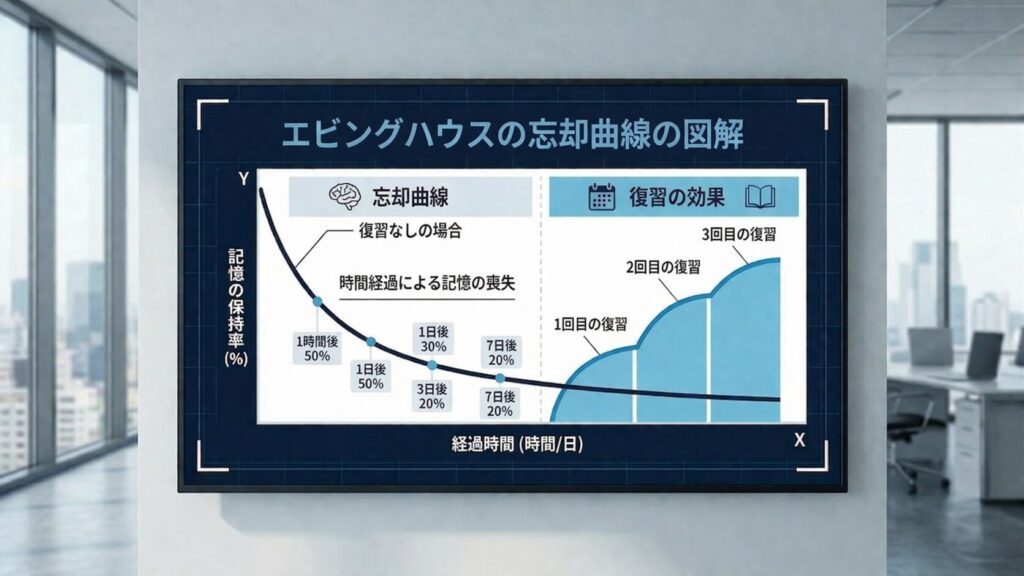
An hour after a business meeting ends, people have forgotten more than half of what was said. After a day has passed, they remember only about a quarter of it.
This reflects the nature of human memory, as illustrated by the “forgetting curve” published by German psychologist Ebbinghaus in 1885.

(※These figures are based on experiments using meaningless syllables and do not reflect the retention of meaningful business discussions; however, it is widely recognized that memories tend to fade rapidly over time.)
Even so, many sales teams still rely on the sales representative’s memory for the details of sales meetings. In fact, data shows that only 12.7% of sales representatives are able to enter customer and sales meeting information into their SFA system completely and accurately (Source: merinc “Japan-U.S. Comparison Report 2024”).
They have daily reports. They have SFA. But whether they can accurately recall “what the customer was concerned about during that meeting” before their next visit depends entirely on the representative.
Furthermore, according to a survey by Salesforce, Inc., sales representatives spend approximately 60% of their work time on non-sales activities ( log ). Even though they understand log, the reality is that they “don’t have time to do it.”
Sales forecasts are unpredictable. Coaching becomes too abstract. When top salespeople leave, customer relationships are reset—when you trace the root causes of these organizational challenges, you often find that the problem boils down to either “ log ” or “ log.”
This article is not about “how to write meeting minutes.” It’s about designing how to interpret log and determining their purpose.
I’ll introduce three frameworks for transforming log from a “mandatory reporting task” into a “tool for driving revenue.”
If you’re thinking, “I want to systematize log ” or “I’m struggling because log are all over the place,” please also take a look at our guide on creating a system log tailored to field sales (outside sales).
First, let’s check: What’s the current status of your team’s log?
Before considering log, please take a look at the current situation.
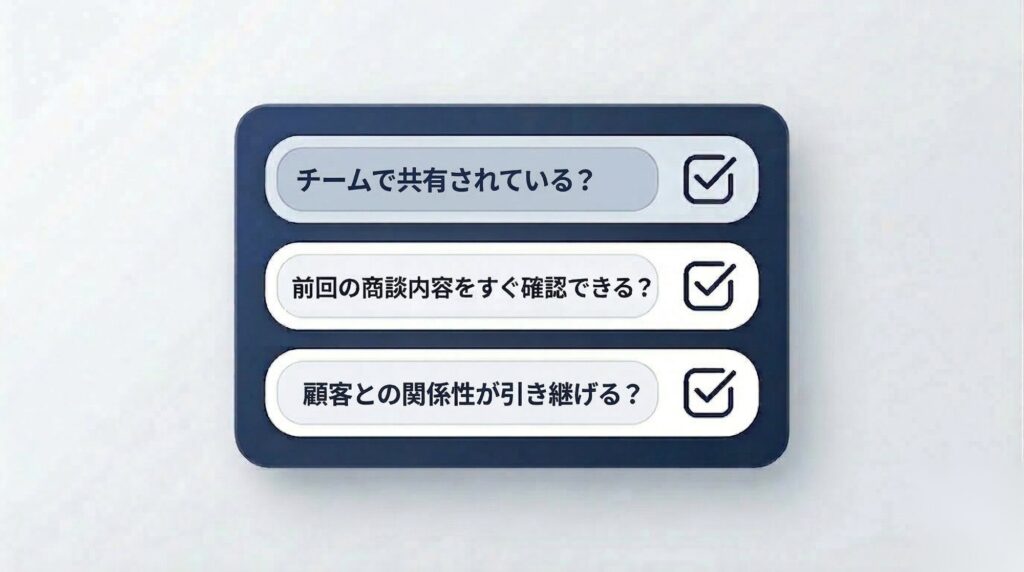
- Are notes and meeting minutes from business meetings shared with the team?
- Can you quickly review the details of the previous meeting before your next visit?
- Is the system set up so that customer relationships can be seamlessly transferred even if the assigned representative changes?

Organizations that have implemented all of these measures are well on their way to sales reform! On the other hand, there are likely quite a few organizations where log remain merely as individual staff notes—unshared and unused.
This isn’t due to negligence on the part of the sales representative . Immediately after a meeting, they drive straight to their next appointment. Even if they try to take notes while waiting at a traffic light, the details of the third meeting are already starting to fade. Once back at the office , they write their daily report and prepare for the next day. For field sales representatives, finding the time to write proper meeting minutes is an extremely difficult task.
That is precisely why it is crucial to plan in advance loglog. The minutes don’t have to be perfect. However, ensuring they can be interpreted in a way that drives revenue will steadily boost the entire team’s performance.
If you're a manager, feel free to start with Frames 2 and 3.
Start with the frame that best matches your role.
Frame 1: Determining the "Next Step" log (For Sales Representatives)
The Concept Behind This Framework
There is only one logwhylog: to decide what to do in the next meeting.
Every sales conversation contains clues that will help you determine your next steps.
What did the customer respond to? Where did the conversation stall? What were they concerned about? What were they looking for?
If you read this "log," you'll just think, "Oh, that's how it went," and leave it at that .
But if you read it "to decide your next move, " it becomes, "So, this is what I'll do next."
Before / After: What Changes When You Have log?
Before ( log ): There are no notes from the previous meeting. At the start of the visit, you end up asking the customer, “Where did we leave off last time?”
The customer thinks, “Does this salesperson not remember what we discussed last time?” and their trust in you takes a step backward.
After (with a 3-line note): Before the visit, review the 3-line note on your smartphone. Begin by saying, “Since you had concerns about costs last time, I’ve brought along an ROI estimate today.” The customer will feel that you’ve “really remembered,” and the conversation will start from a deeper level.
The difference comes down to just three lines of notes.

Questions to ask within this framework
log, try to get into the habit of asking yourself the following three questions.
- What is this customer most concerned about right now?
- What should I prepare before the next business meeting?
- What was agreed upon during this meeting, and what tasks were assigned?
Only when you can answer these three questions can you call it a " log."
Conversely, log these three log, you need to rewrite log.
Why does this lead to increased sales?
Customers open up to those who make them feel understood. A remark that builds on the context of your previous conversation, or a prepared response to a concern the customer had—it is these small, consistent efforts that build trust and increase conversion rates.
log provides those "clues" to the sales representative. Instead of relying on memory or intuition, you can recreate the conversation log.
Things You Can Start Doing Today
Try to get into the habit of jotting down the following three lines on the same day your business meeting ends.
- What the customer was concerned about (what they said and what I gathered from their facial expressions)
- Next steps (when and what to do )
- Things to prepare before the next business meeting
Just these three lines can make a world of difference in the quality of your preparation before your next visit. If you have a system where you can enter a three-line note on your smartphone while on the go and have it automatically synced to your SFA/CRM, log becomes much lower. For sales teams that spend a lot of time in the field, log complete log on the go is essential.
From here on, we’ll shift to the manager’s perspective. How can we leverage the sales meeting notes log team members to drive results for the entire team?
We’ll organize this using two frameworks.
Frame 2: Applying log (For Managers)
The Concept Behind This Framework
April is just around the corner. This is a time when many organizations welcome new members, whether they are recent graduates or employees transferred from other departments. Precisely because new members are joining the team at this time, it’s important for managers to reaffirm log: to gain a realistic understanding of the team’s current status.
In traditional management, the means of gauging a team’s status were limited. Weekly meetings, interviews with team members, and accompanying them on sales calls—all of these are time-consuming, and the information is filtered through the team members themselves. New members, in particular, are often not accustomed to articulating exactly “what the problem is,” and situations where it is difficult to grasp the true state of affairs based solely on verbal reports tend to increase.
log, you can directly review the details of the conversation with the customer. Even if the sales representative says, “Things are going well,” log may log that the customer has expressed concerns. Conversely, even in cases where a new team member feels a deal is “looking difficult,” the customer’s comments may reveal positive signs.
Instead of relying on sales reps’ reports, focus on the actual conversations with customers. That is the core of this framework . If there is a system in place where sales reps’ meeting notes, log on the spot, are reflected in real time on managers’ dashboards, you can start coaching without waiting for weekly reports.
Coaching new members requires even more "specificity" than coaching experienced staff. "Be more proactive" or "Build stronger relationships with customers"—abstract advice like this rarely gets through to new hires.
Coaching based on specific contexts is said to be approximately 50% more effective than general, abstract coaching (according to a survey by aCoach / Atomus). Furthermore, there are reports that teams receiving effective coaching saw a 27.9% increase in their closing rates.
Questions to ask within this framework
When reviewing log, try reading them with the following questions in mind.
- Which project or team member are you most interested in this week?
- Are multiple staff members running into similar obstacles?
- Are there any signs from customers that the staff member hasn’t noticed?
The key to forming a habit is to decide in advance where to spend your time.
log, coaching changes in this way
log, you can say this.
“During last week’s meeting with Company X, the client mentioned costs twice. Let’s work together on a response to that before our next visit.”
“ log this client’s log, they’ve been asking about what things will look like after implementation. This is a positive sign, so it might be a good idea to bring a concrete proposal next time.”
Managers who can say this do so precisely because they understand the details of the business negotiations. log, conversations like this simply wouldn’t be possible.
Simply making log — log are often confined to individual notes—accessible to the entire team can transform the quality of a manager’s coaching.

Why does this lead to increased sales?
The quality of a manager’s coaching depends on how specific they are.
Concrete feedback log changes the behavior of team members. For new members in particular, having a clear understanding of “what to improve and how” is key to determining the pace of their growth. This overall improvement across the team will translate into tangible results in sales figures six months to a year down the line.
Frame 3: Turning Winning Strategies log into Templates (For Managers)
The Concept Behind This Framework
Instead of looking log each sales log individually, analyzing log together reveals patterns.
There is a common pattern to every deal we close. Looking back, there are also common signs in the deals we lose. When you compare the deals handled by top salespeople with those handled by underperforming representatives, you can see that something is different.
The purpose of this framework is to articulate "the organization's winning strategies" log.
Questions to ask within this framework
When reviewing log on a monthly or quarterly basis, use the following questions as your guide.
- What’s the difference between deals we won and those we lost?
- Is there a common trait among top salespeople’s sales pitches that other salespeople don’t have?
- Were there any warning signs during the sales meeting before we lost the deal?
When trying to answer this question, it naturally becomes clear log.
The mindset of reading to find answers deepens your understanding of the data.
Example: Identifying Order Patterns
For example, here is one possible analysis:
Looking back at the last 10 orders, in 8 of them, the customer mentioned that they wanted to discuss the matter with other departments as well.
On the other hand, in the projects we lost, that comment was never made.

With this insight, “whether the customer expresses an interest in expanding the deal during the initial meeting” becomes a key indicator for assessing the likelihood of winning the order.
By sharing this with the entire team, all account managers will have a consistent standard for determining whether a deal is progressing smoothly.
log of client visits log, it becomes possible to analyze order patterns by region. Identifying regional characteristics—such as “In this area, customers are more interested in implementation support than in price”—can help optimize visit schedules and proposal content.
The Role of "Templates" in Training New Members
This framework is particularly important for organizations that will be welcoming new members in April.
New team members lack the experience to grasp what senior employees “instinctively understand.” A decision like, “This customer is getting ready to buy, so let’s close the deal this week,” may come naturally to veterans, but new members can’t see the rationale behind it.
However, if the sales pattern is clearly defined, you can say something like this: “In our team, when a customer asks about [X], that’s often a sign that we’re nearing the closing stage. So if that comes up in the next meeting, let’s be ready with a concrete proposal.”
The data supports this approach. According to a study by the Brandon Hall Group , organizations with excellent onboarding programs get new hires up to speed 3.4 months faster than those without such programs, and new hires’ productivity increases by 54%. Organizations that can pass down best practices as established procedures enable new members to get up to speed more quickly.
Why does this lead to increased sales?
In many organizations, the results achieved by top salespeople are attributed to the individual as a reflection of their personal ability.
However, in reality, at least part of those results should be reproducible.
By keeping accurate log, individual experience becomes a valuable asset for the team, leading to improved sales results.
How to Use the Three Frames
| Frame | Who | What for? | When |
|---|---|---|---|
| ① Decide on the next move | Field Representative | Improve the quality of your next sales meetings and proposals | When taking log / The day before the visit |
| ② Understanding the Team’s Current Situation | Manager | Making Coaching More Concrete · Developing New Members | Check in with the entire team on a weekly basis |
| ③ Convert the pattern into a mold | Manager | Articulating an organization’s winning formula | Monthly and Quarterly Reviews |
You can use each of the three frameworks independently. You don’t need to use all of them—just start with one.
Choose the framework that best matches your perspective, and try to keep it in mind log you read log next log.
When you change your "purpose for reading," what you see log will change.
In Conclusion: log Are Evolving from "Something to Write" to "Something to Use"
The purpose of log sales meeting log isn’t simply to write it down. It only becomes valuable when you actually use it.
Before feeling the pressure to “write proper meeting minutes,” decide “ log.”
Simply asking yourself that question will change log and how you read log.
- If you're the person in charge, use a three-line memo after the meeting to clarify your "next steps"
- As a manager, use log coaching to change your team’s behavior
- As an organization, we use log accumulated log to identify log and accelerate the onboarding process for new members.
As we prepare for the new organizational structure in April, we encourage you to use these three frameworks as a guide for reviewing log.
Why not streamline the process of "writing, sharing, and utilizing" log with a system?
UPWARD is an AI agent designed specifically for field sales. By integrating with Salesforce, it log sales representatives log intuitively log from their smartphones while on the go, with the data shared in real time across the entire team. By optimizing visit planning using location data and a map-based UI, and log, UPWARD supports the implementation of the three frameworks introduced in this article.
A full overview of the benefits and best practices of the introduction of the system
Download a free set of 3 documents