

Case Study|Toyota Corolla Akita Corp.
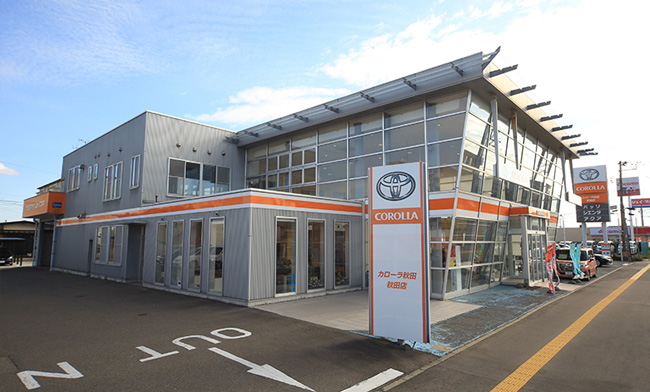
A turnaround from the dark cloud of dive sales. Visualization of customers by map and activities logto achieve both "offensive" and "defensive" sales
Recommended Documents
-

SUCCESS STORIES OF COMPANIES THAT HAVE ACHIEVED RESULTS WITH UPWARD
Click here to download the document

Company Name
Type of industry
Business Scale
Problem
Areas of Application
Head Office Location
URL

Table of Contents
Corporate sales had not been structured properly, and had become a "feeling-driven" business.
ーPlease tell us about your company's sales activities.
Yoshida: Toyota Corolla Akita is a dealership that sells, leases, and maintains Toyota vehicles in the Akita Prefecture area. We used to sell mainly to individual customers, but about two years ago we changed our policy to focus on corporate sales as well, and we are trying to increase the number of customers.
With Akita Prefecture's population in gradual decline, it is difficult to continue to grow our business with only individual customers. When we think about "how we can make it happen as a company," we believe that corporate sales have tremendous potential. The mission of the Corporate Sales Department is to increase the number of people in Akita Prefecture who use products related to us.

Mr. Goto: When focusing on corporate sales, I started by "earning with my feet. When we were out on the road doing sales activities, we would dive into companies we saw that "looked like they had potential.
However, it is not enough for us to only develop new business. We also need to follow up with customers we are already in charge of, and since we are a wholesaler, we also need to follow up with maintenance stores and motor stores on a daily basis. Even if we set a rule that we must visit at least one new customer a day, we may not have time to do so, or the time for the next appointment may come while we are still wondering where to visit. In the case of a corporation, it took 3 to 5 years to make a decision.
For corporate clients, there is a cycle of buying a new car every 3 to 5 years, and if you don't follow the "let's visit once a month" rule, your competitors will easily take it away from you. But since there was no efficient way to keep track of "who visited where, when, and by whom," I had to type up the daily report after returning to the office, output it to paper, file it, and so on, which was a lot of administrative hassle. And as a result, finding the information I was looking for in the file was also a challenge.
In addition, since I visited so many companies in one day, I often forgot what I had talked about after I returned to the office. Each staff member had only in his or her mind when he or she last visited a client and what they had talked about. Sometimes the client we were trying to sell to had already been visited by another staff member, and sometimes it was a client of another Toyota company. It was not efficient at all.
Yoshida: The core system used by the entire Toyota Group was designed for BtoC.... We wanted to operate corporate sales properly, but we couldn't make good use of the system and ended up leaving it to our staff with paper management.
So we decided to introduce UPWARD, which works with Salesforce to display customer information on a map and logof activities. I thought it would be more efficient than just going around visiting customers in the dark. We also hoped that by properly documenting our activities, we would be able to accumulate know-how. Even if we don't see results right now, we will be able to see something by accumulating customer information. With paper, it is not easy to refer to and analyze.
Maps show you where customers are to go, and you can report back before you forget.
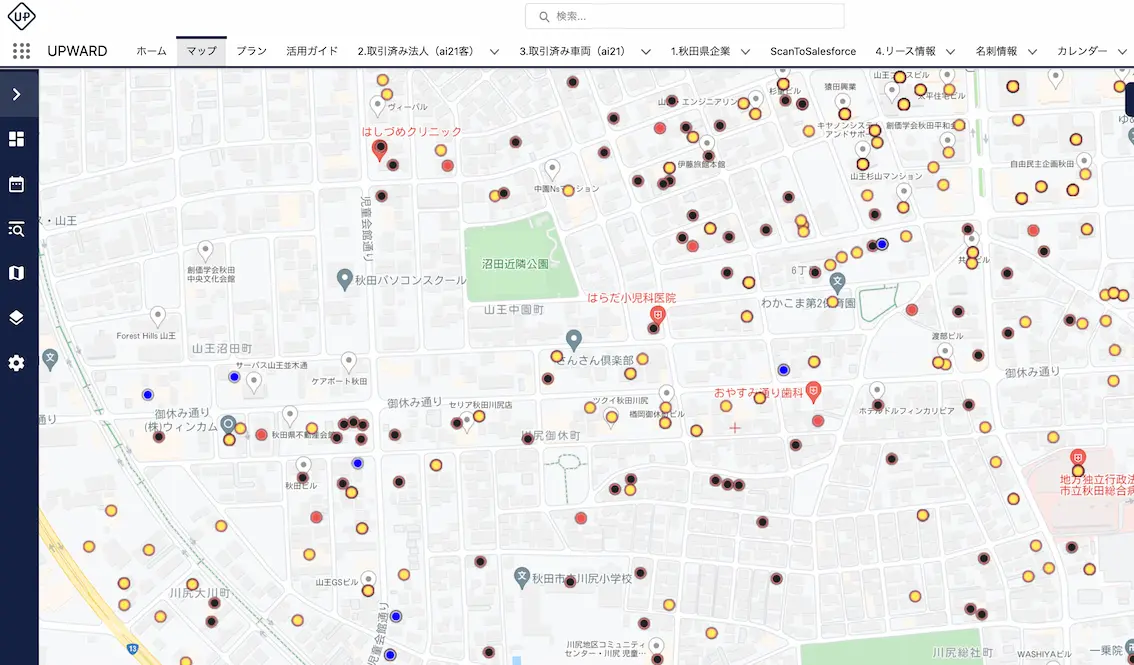
Mr. Goto: Since we introduced UPWARD, we have had information on companies in Akita Prefecture reflected on the map, so we can plan in advance to cultivate new business instead of jumping into the market. Companies we have not yet visited are indicated on the map with yellow circles, and we keep filling them in. I can see in advance where the companies are and what kind of companies they are, so it has become more efficient. It was very difficult to find companies while driving. It is most convenient to be able to decide where to go in advance.
Mr. Goto: Communication with new clients has also changed. Before, I used to jump in without knowing what kind of company it was, so I sometimes stumbled into a conversation, but now I can talk to them after having learned what kind of company it is beforehand, so it is easier to conduct business.
I can visit about six companies in a day, so I try to visit two every day to make new contacts. The remaining four visits are to follow up with existing customers, and the more time that has passed since my last visit, the larger the circle appears on the map, so I am immediately aware that I have to go there. Newly developed sites are often rotated in the vicinity. I feel that the coverage of existing customers and the number of new contacts has increased. Having a proper destination makes all the difference in my motivation.
Also, reporting on activities has become much easier. Based on location information, we can now properly leave the start and end times of activities on site, and reports after business meetings can be made immediately in the car before we forget. Business cards received can be read by Sansan's Scan to Salesforce to link accurate information with the results of activities.
I think this is a very good system, as it is much less wasteful than when we were managing them on paper.
Simplicity for long-lasting use. A system that is "built together" by sharing knowledge and ideas.
Yoshida: When introducing the system, I was conscious of keeping the operation simple. I don't like troublesome things, so I didn't want to create something that would be troublesome for the staff. I also thought that something that can be used for a long time is something like that, so I started with the minimum functions for both Salesforce and UPWARD. It didn't take us long to start operations.
First, let's make a plan on the map. Once we can do that, let's report on the spot after the visit. In this way, we increased the number of functions that could be used step by step. Then, as we used the system, people would ask, "Is it possible to do this? We are updating the system according to those requests.
Of course, we could have delivered the full package and said, "We've done this! But we must not lose the awareness of "Who is going to use it? But I knew that I mustn't lose the awareness of "Who is going to use it? Since the introduction of UPWARD, we have held monthly UPWARD study sessions, but I attended only the first one, and Goto-san has been in charge of the rest.
Mr. Goto: That's right. In the case of Akita Prefecture, we have a wide range of areas (northern, central, and southern parts of the prefecture), so we don't have many opportunities to see each other, so we use the meeting once a month as a place for communication. We have a lively discussion about what we don't understand about UPWARD and what we need to unify our opinions on.
The questions that come up are really just "little " things, but I don't want that to happen.
One good thing that has happened since we all started using the system and information has been accumulated is that we now know where it is useless to go. There are places where we have a long relationship with other companies, or there are obvious strong rejection reactions. Otherwise, when we put the place in the "next visit possible" status, the color changes from yellow to orange, so we can visit it again. The elimination of unnecessary revisits and the gradual increase in the number of orange colors have made a big difference in the psychological load.
I hope we can continue to convey the message that if we all use the system properly, sales will become much easier, and everyone will find it easier.

Mr. Yoshida: We need to make the accumulation of information on our own, not on an individual basis, but on an overall basis.
Incidentally, we are the only Toyota Group dealership using UPWARD, but now that things are going well for us, I am thinking that it would be good if we could share our know-how with other dealerships. It is difficult to be the first to raise a hand, but there is a kind of "you do it, you win" attitude to this kind of thing.
As for the actual effect, although the number of new acquisitions and the follow-up rate of existing customers are certainly sensory values, I think it will be a little while before they become apparent as numerical values. I am not sure that we were able to accurately capture the information when we were managing by paper, so I think that we will be able to say that the number has increased after one or two years of measurement under the same conditions while using UPWARD.
It may be perceived as being laid-back, but I don't think it is essential to measure the number of entries or to remind people to put in past data. It would be nice if we could create a system where everyone could enter the latest information naturally, without feeling like they are "forced" to do so. There are various ways to use the system, but basically, I would like to let the staff use the system freely, try using it continuously for a number of years, and see the results.

I want to make sales "easier".
ーWhat is the outlook for your future sales activities?
Mr. Goto: I hope that everyone, including companies in the same group, will make use of UPWARD to "raise the bar. It is important to share information verbally, but if we put all the information we have into the system, we can reduce waste. If we can say in advance, "This is the corporation I am in charge of," or "I have a long relationship with another company," log, I think it will make it easier and more efficient for each sales person to get around.
Yoshida: In any case, I would like to see more waste reduced and sales activities made easier. Although it has become very easy at this point, there are still some disjointed input leads when you talk to them.
If possible, I'd like to see sales go to a state where they only have to look here, and all the rest of the time is devoted to customer touchpoint. If the time spent on paperwork is reduced rapidly, what used to be six cases a day can be turned into seven. That's how much I want to build a system that people trust, saying, "If I only look here, I can concentrate on business meetings because there are no mistakes.
Thank you very much.




A full overview of the benefits and best practices of the introduction of the system
Download a free set of 3 documents