Many salespeople may be concerned that they are having difficulty closing deals in door-to-door sales, and would like to know the key to door-to-door sales. Unlike online sales, face-to-face sales meetings are conducted in person, so it is important to understand the unique selling tips and tricks of door-to-door sales. In this article, we will introduce a total of 20 tips for door-to-door sales by situation. By understanding the tips introduced in this article, you can minimize nervousness and unfamiliarity and approach business meetings with confidence.
20 Tips for Successful Door-to-Door Sales! A thorough step-by-step explanation
Recommended Documents
-
SUCCESS STORIES OF COMPANIES THAT HAVE ACHIEVED RESULTS WITH UPWARD
Click here to download the document
Pickup Articles
Table of Contents
What is door-to-door sales?

Door-to-door sales refers to a sales method in which a sales representative visits the office of a corporation or the home of an individual to propose, explain, and close a deal for a product or service. The advantages of door-to-door sales are that it is easier to communicate with customers face-to-face, it is easier to understand their needs and issues, and it is easier to build a relationship of trust with them. On the other hand, there are disadvantages such as the need to make appointments for business meetings and the cost of travel time.
What is the difference between door-to-door sales and dive sales?
One sales technique that is often confused with door-to-door sales is dive sales. The difference between the two is whether or not an appointment has been made in advance. If an appointment has been made in advance, it is defined as door-to-door sales, and if no appointment has been made in advance, it is defined as dive sales.
In the case of door-to-door sales, appointments are obtained in advance so that the client can conduct research in advance, understand their precise needs, and prepare proposals. Therefore, by preparing well in advance, business negotiations can proceed smoothly and it is easy to build a relationship of trust with the customer.
On the other hand, in the case of door-to-door sales, the possibility exists that a contract can be concluded quickly because the sales representative visits a company or individual's home without making an appointment in advance, but there is a high probability that the business meeting itself will be rejected. This is a disadvantage.
Preparation Tips for Successful Door-to-Door Sales

Now, we will begin to explain the tips for door-to-door sales by three situations: preparation in advance, during the sales visit, and after the sales visit.
Carefully conduct customer research
TO IMPROVE THE ACCURACY OF YOUR COMMUNICATION WITH CUSTOMERS AND PROPOSALS, CONDUCT THOROUGH CUSTOMER RESEARCH IN ADVANCE. YOU CAN CONDUCT SALES ACTIVITIES MORE EFFICIENTLY IF YOU HAVE A PRIOR UNDERSTANDING OF THE CUSTOMER'S INFORMATION AND WHAT ISSUES CAN BE SOLVED BY YOUR PRODUCTS AND SERVICES. IN PARTICULAR, IF THE CUSTOMER IS A CORPORATION, INFORMATION IS OFTEN OPENLY DISCLOSED ON THE WEBSITE. IN SUCH CASES, INPUT INFORMATION SUCH AS BUSINESS TYPE, BUSINESS CATEGORY, IR INFORMATION, PRESS RELEASES, ETC., BEFORE GOING INTO A BUSINESS MEETING.
Also, be careful with personal information when collecting customer information. Improperly obtaining or using personal information constitutes an invasion of privacy and can greatly undermine customer trust.
Prepare a talk script
A talk script is a script that summarizes in advance what you will say to the customer during sales activities. By preparing a talk script in advance, you can carefully and clearly communicate what you need to say to the customer. It will also minimize feelings of nervousness and impatience, allowing you to approach the business meeting calmly.
It is important not to memorize a talk script word for word. If you memorize a talk script word for word, when you forget the content during a business meeting, you will not only be unable to perform adequately due to impatience, but you will also make the customer distrust you.
Therefore, input mainly the phrases you most want to convey in your talk script, and flexibly adjust the rest of the content in the course of communication. Also, having a senior employee or supervisor correct your talk script will improve the accuracy of the content.
Role-playing (role-playing) to gain practice
Role-playing is a simulation exercise that simulates actual sales activities. Salespeople play the roles of customers and salespeople to practice the flow of business negotiations and customer service. Ropeplaying allows salespeople to grasp the flow of business negotiations and practice dealing with customers, leading to improved presentations. In addition, by practicing the ropelay and gaining practice, participants will be able to proceed with confidence in actual business negotiations.
Salespeople who are not getting results in door-to-door sales should ask a senior employee or supervisor to conduct a rope-play exercise. By receiving feedback from the senior employee or supervisor playing the role of the customer, you should be able to grasp the points that you are lacking.
get get dressed
In communicating with people face to face, being well groomed is the minimum etiquette for a working member of society. Dirty suits, sleeping habits, long nails, and bad breath can make others uncomfortable and give them a bad impression of you. When visiting a company, go to the restroom, look in the mirror, and make sure you are well groomed before going into a business meeting. By keeping your appearance neat and tidy, you will project an image of a business professional to your clients, which will have a positive impact on building trust and relationships.
Prepare ice-breaker stories.
Icebreaking is an activity to ease tension and facilitate communication between people who meet for the first time at a meeting or training session. If you suddenly introduce your product or service or make a proposal at the first sales visit, the customer will feel pressured to sell you the product. In order to gain trust and build a relationship with the customer, it is important to break the ice and relieve the tension in the room.
Icebreakers can include industry topics, current events, seasonal topics, weather, topical news, hobbies, etc. The lively chit-chat will encourage communication with the client and help to build rapport and gain trust. A word of caution: be careful not to enter too deeply into the customer's privacy with the momentum of a lively conversation.
Prepare a souvenir
By offering a souvenir to your customers, you can build a relationship with them. Be careful not to give expensive or short-lived souvenirs, as they may be a burden to the customer.
LEVERAGE MOBILE CRM TOOLS WITH MAP APPAND MAP FUNCTIONALITY
TO MAKE SALES VISITS MORE EFFICIENT, THE DISTANCE TO THE DESTINATION AND TRAVEL TIME MUST ALSO BE TAKEN INTO ACCOUNT; IF YOU MAKE SEVERAL SALES VISITS IN A DAY, YOU CAN USE MAPS APPOR A MOBILE CRM WITH MAP FUNCTIONALITY TO MAKE YOUR SALES VISITS MORE EFFICIENT.
The following article explains in detail how to use Google Maps to map your sales destinations. Google Maps explains how to map customer information on a map
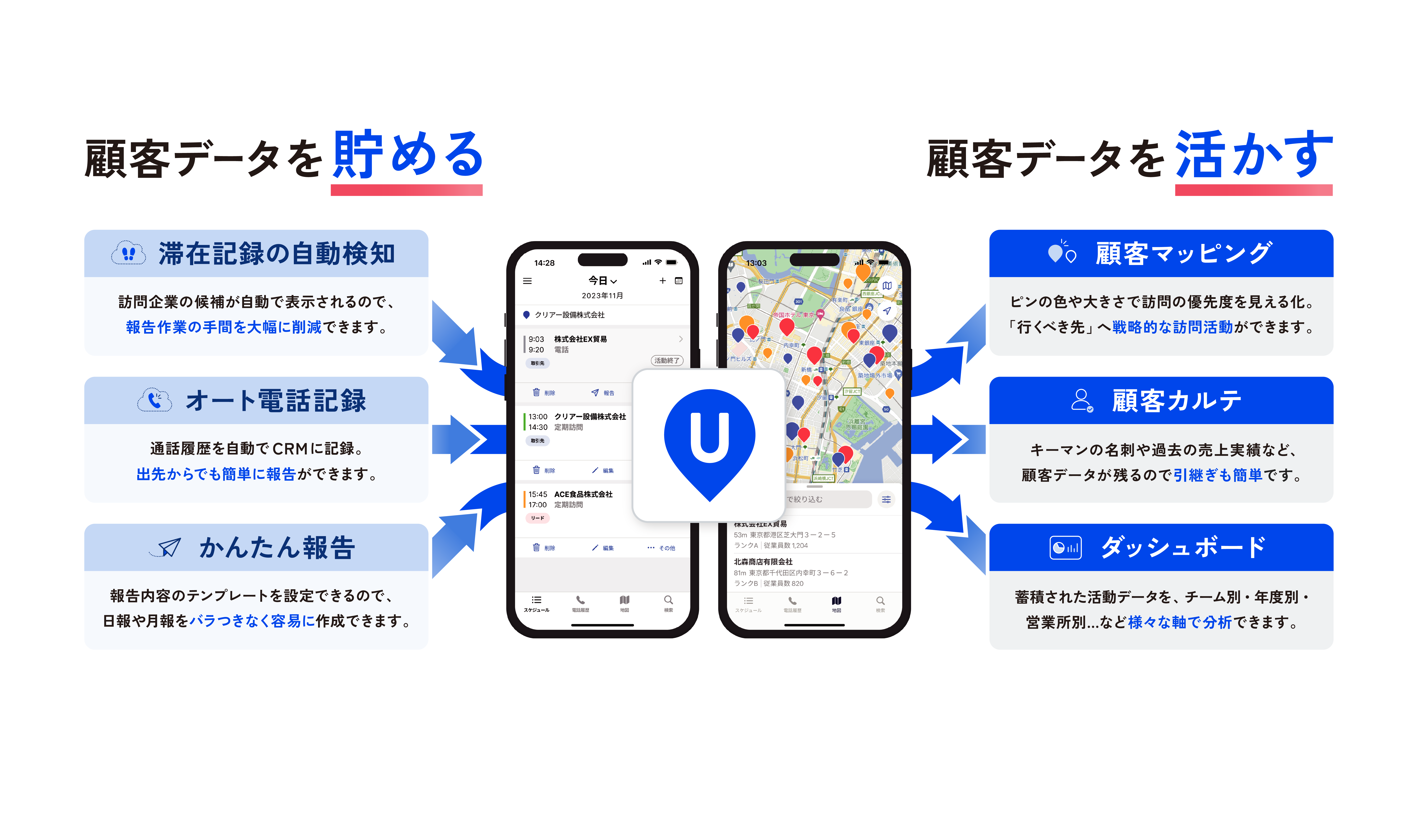
If you are looking for a mobile CRM with map functionality, we recommend UPWARD, which visualizes information stored in CRM on a map to realize efficient sales visits. For more detailed product information, please click here to download the brochure.

In an era of shortage of salespeople How should sales organizations respond?
PDF (18 pages)

Service Introduction Materials
More information about UPWARD.
Tips during the visit for successful door-to-door sales

Visit at the best time of day
When conducting door-to-door sales visits, be sure to visit at optimal times. If you visit during a customer's busy time, they may not listen to you or may reject your offer immediately. For example, it is best to avoid visiting at times that are inconvenient for the customer, such as between 12:00 and 13:00, which is the lunch hour, or after 17:00, which is close to the time the customer leaves work.
Don't oversell from the start.
If you oversell products at the first sales visit, you will put too much pressure on the customer, and you will not be able to get a contract, let alone make a second or subsequent appointment. In door-to-door sales, it is difficult to reach a contract after a single meeting. It is effective not to oversell from the beginning, but to communicate with the customer and gradually make proposals.
Conversation with questions
If the sales person talks one-sidedly, the customer will not only become bored, but also lose focus on the business discussion. A business meeting is a catch-all conversation. Do not forget to ask questions to the customer. By asking questions, you can improve the resolution of the issues and needs of the customer and the accuracy of your next and subsequent proposals.
Check the other party's response.
If you concentrate on what you say, you may not be able to check the other person's reaction and may continue to talk about things that do not interest you or that make the other person uncomfortable. When communicating, listen to the other person's facial expressions.
Speak calmly and slowly.
When you are in a river meeting with a client, try to speak calmly and slowly. If you speak too quickly, your impatience and nervousness will be conveyed to the other party, and the customer will feel uneasy and distrustful. Speaking calmly and slowly has various advantages, such as making it easier to understand what you are saying, making your words more persuasive, and reducing the number of mistakes because you are able to organize your speech in your mind. Daily practice is essential for speaking calmly and slowly. You should hone your skills through the aforementioned rope-playing and other activities.
Remember to smile
When you are concentrating on business negotiations, you may end up communicating with customers with a stiff or expressionless face, which makes the atmosphere of the meeting stiff. During business negotiations, look the other person in the eye and smile as you communicate. If you tend not to smile often, practice communicating with a smile by doing the aforementioned rope-play or by practicing raising the corners of your mouth while looking at yourself in the mirror and reading out a talk script at home.
Correct speech and demeanor
Pay attention to the way you speak, your posture, and your attitude when communicating with customers. A small quirk in your everyday speech or attitude may give a bad impression to the other party. If you are not confident in your speech and attitude, try to improve them by getting feedback on whether your use of honorifics and attitude toward customers are appropriate during the aforementioned rope-recreation session.
Check your budgetary sense
By understanding the customer's sense of budget, you will be able to make a proposal that is in line with the budget and determine the likelihood of closing the deal. When you have just started door-to-door sales, you may feel resistance to hearing about your sense of budget. However, be sure to ask the customer about his/her budget, thinking that it is for the purpose of making appropriate proposals to the customer. The best way to ask about budget is to ask straightforwardly, "What is your budget?" Rather than asking "What is your budget? It is easier to conduct an interview by indirectly asking, "What is your budget?
Understand who the payer (key person) is
BY UNDERSTANDING WHO THE KEY DECISION MAKERS ARE, YOU CAN APPROACH THEM DIRECTLY AND INCREASE THE CLOSING RATE. EVEN IF DISCUSSIONS PROCEED SMOOTHLY DURING BUSINESS NEGOTIATIONS, IF THE DECISION-MAKER WHO WILL ULTIMATELY MAKE THE DECISION TO INTRODUCE THE PRODUCT OR SERVICE DOES NOT SAY YES, THE CONTRACT WILL NOT BE SIGNED. ON YOUR NEXT VISIT, ASK THE CUSTOMER IF YOU CAN CONDUCT THE BUSINESS MEETING IN THE PRESENCE OF THE PERSON WHO WILL MAKE THE FINAL DECISION TO INTRODUCE THE PRODUCT OR SERVICE. IF IT IS DIFFICULT FOR THE PERSON IN CHARGE TO ATTEND THE MEETING, IT IS IMPORTANT TO DISTRIBUTE MATERIALS AND VERBALLY CONVEY THE APPEALING POINTS TO THE PERSON IN CHARGE SO THAT HE/SHE CAN EXPLAIN THE PRODUCT OR SERVICE TO THE SETTLOR.
Don't be afraid to say no.
In door-to-door sales, getting turned down is an everyday occurrence. Rather, the shortcut to success is to act on the assumption that you will be turned down. In door-to-door sales, it is not important to aim to close a deal in a single meeting. It is important to gain the trust of the customer over several meetings and to have the customer understand how your products and services can solve their problems.
Make an appointment for the next time
During the initial sales visit, it is more important to make an appointment for the next time than to close the deal for your company's service or product. However, if the customer does not feel that the product or service is valuable to him or her, he or she will not gracefully and willingly agree to the next appointment. In order to make the next appointment, it is desirable to understand the customer's issues and needs, and to be able to communicate the theme of the next visit and the benefits of making an appointment.
Post-visit tips for successful door-to-door sales

Send a thank you email
After the business meeting, be sure to send a thank-you e-mail early in the day. Sending a thank-you e-mail allows you to reflect on the business meeting and express your gratitude. Customers will feel that you are a sales representative who follows up well, and it will be easier to build a relationship of trust.
LOGTO CRM AND DAILY SALES REPORTS FOR CONTENT DURING BUSINESS MEETINGS.
Instead of keeping the content of conversations you have with customers to yourself, keep notes so that they can be used for the next business meeting. In addition, by reviewing your own sales activities, you can sort out what went well and what needs to be improved, which will also help you improve your sales skills. Related Articles>>Sales Personification Related article>>Causes of sales gerrymandering and 7 solutions
The characteristics of CRM and the differences between CRM and SFA, which are often confused with CRM, are summarized in detail in the following article. What is the difference between CRM and SFA? Explanation of which one to choose based on the differences in functions and roles.
Points to keep in mind when conducting door-to-door sales
Be aware of the frequency of door-to-door sales calls.
Multiple visits to a customer can help build trust. On the other hand, too frequent visits can be burdensome and alarming for the customer. Therefore, it is advisable to set an optimal frequency of visits through communication with customers. For example, if you feel that the customer's needs for your products and services are still low during communication, it may be a good idea to refrain from visiting the customer for a while.
Be on time for appointments
Being late for an appointment is absolutely unacceptable. Being late not only gives the other party a bad impression of you, but it also tarnishes the image of your company. On the other hand, arriving too early to a client can also be a nuisance. Therefore, it is advisable to arrive about five minutes early.
UPWARD" IS RECOMMENDED FOR MAXIMIZING THE RESULTS OF OUTSIDE AND DOOR-TO-DOOR SALES ACTIVITIES.
WE OFFER AND DEVELOP UPWARD, A SALES DIGITAL TRANSFORMATIONTOOL FOR OUTSIDE AND DOOR-TO-DOOR SALES.

BY UTILIZING "UPWARD," CUSTOMER DATA SUCH AS CUSTOMER PROFILE INFORMATION, BUSINESS MEETING HISTORY, AND ACTIVITY REPORTS CAN BE SEMI-AUTOMATICALLY STORED IN CRM WITH A SINGLE SMARTPHONE. WHEN THE PERSON IN CHARGE IN THE FIELD CREATES A DAILY SALES REPORT OR ACTIVITY REPORT, NOT ONLY IS THE REPORT FORMAT AUTOMATICALLY CREATED ON "UPWARD", BUT ALSO THE REPORT CAN BE EASILY CREATED IN HIS/HER SPARE TIME BY VOICE INPUT SUPPORT.
The data entered on a daily basis is visualized on a map, allowing users to intuitively know which customers to visit next. Anyone can make strategic visits to the places they really "need to go," not just the usual "easy-to-get-to" destinations. For more detailed information, please download the service document from the following URL. Click here to download the document
summary
In this issue, we have organized some tips for door-to-door sales. In order to increase the closing rate of door-to-door sales, it is important to establish continuous touch points with customers and gain their trust. We hope that you will make full use of the tips introduced in this article and apply them to your daily sales visits.
A full overview of the benefits and best practices of the introduction of the system
Download a free set of 3 documents