8 Sales Strategy Frameworks: How to Choose and Use Them Based on Your Objectives
"I tried doing a SWOT analysis, but in the end, I didn't know how to use it." I imagine there are quite a few managers who have had that experience.
If used incorrectly, a framework will remain nothing more than a desk-bound "task" and will not bring about any changes in on-site behavior.
In this article, we’ll explain eight frameworks you can use to develop sales strategies, along with how to choose the right one based on your objectives and stage, as well as practical tips for implementation.
Recommended Documents
SUCCESS STORIES OF COMPANIES THAT HAVE ACHIEVED RESULTS WITH UPWARD
As labor shortages become more severe, achieving maximum results with a small team requires moving away from a sales approach that relies solely on "instinct and experience."
The 2024 White Paper on Small Businesses also highlights examples of small businesses that have achieved success by clearly defining their target customers.
In addition, more than 40% of businesses cite “labor shortages” as a challenge in expanding their sales channels, underscoring the growing importance of developing strategies to achieve results with limited resources.
The greatest benefit of using a framework is that it structures what would otherwise be individual "instincts," thereby raising the overall quality of decision-making and action across the entire team. A framework provides a model that allows the entire organization to replicate the "mindset of top salespeople."
5 Common Mistakes When Using Frameworks
Frameworks aren’t a one-size-fits-all solution. If used incorrectly, you’ll end up spending a lot of time without making any real changes on the ground. Let’s start by looking at some common pitfalls.
Satisfied with the analysis but not taking action
Filling out the four quadrants of a SWOT analysis carefully in a conference room and ending the session satisfied that “we’ve got everything sorted”—this is the most common pitfall. Analysis is merely a means to an end; the real goal is to decide “what action to take.”
No matter how detailed the analysis, it will remain nothing more than a pipe dream unless it is translated into concrete strategic options or a list of actions.
Theoretical musings that ignore the realities on the ground
Plans that ignore on-the-ground constraints—such as the number of clients a sales manager can visit in a day, time lost to travel, and the skill levels of the staff—will go unused in the field, no matter how impressive the documentation may be.
The fundamental premise of using a framework is to design a "strategy that can be executed," rather than an "ideal strategy."
Turning KPIs into slogans
While policies such as “Let’s put the customer first” and “Let’s strive to be an organization that embraces challenges” are important, they do not constitute a strategy on their own. Unless specific targets—such as who will achieve what by when—are defined in numerical terms, these policies will amount to nothing more than slogans.
It is essential to have a process for translating the direction identified by the framework into KPIs.
PDCA cycle not designed after planning
It is not uncommon for companies to fail to schedule quarterly review meetings after drafting their strategic documents.
Even if it’s viewed during the first month, no one will open it after that—to prevent this from happening, it’s essential to design a monitoring system at the same time as you develop the plan.
Dependent on a single framework
The mindset that “as long as I do a 3C analysis, I’ll be fine” is dangerous. A single framework is, after all, merely a tool that provides a specific perspective; it cannot answer every question.
By combining multiple frameworks based on the objectives and phase, you can prevent gaps in your analysis and develop more accurate strategies.
For more details on how to develop and manage the implementation of an overall sales strategy, please refer to the following article.
With eight frameworks to choose from, many people probably wonder, "Which one should I start with?"
The key to choosing the right framework is simple: select one based on what you want to know or decide at that moment.
Please refer to the table below and select the option that best suits your current challenges and planning phase.
Objectives and Phases
Framework to use
I want to understand the external environment and the market
PEST Analysis, 3C Analysis
I want to identify our company's strengths and challenges
SWOT Analysis, Cross-SWOT Analysis
I want to decide who to sell to and what to sell
STP Analysis, 4P Analysis
We want to strengthen our sales and on-site processes
SPIN Selling, BANT, Lanchester Strategy
The basic approach to the order of use is: external environment → company → target audience → sales process.
By following this process—first understanding external changes, then reassessing your own company, deciding who to sell to, and finally designing how to proceed with sales negotiations—the outputs of each framework will naturally serve as inputs for the next step.
[8 Recommended Frameworks] How to Use Them and Practical Tips
PEST Analysis—A Broad View of Changes in the Overall Market
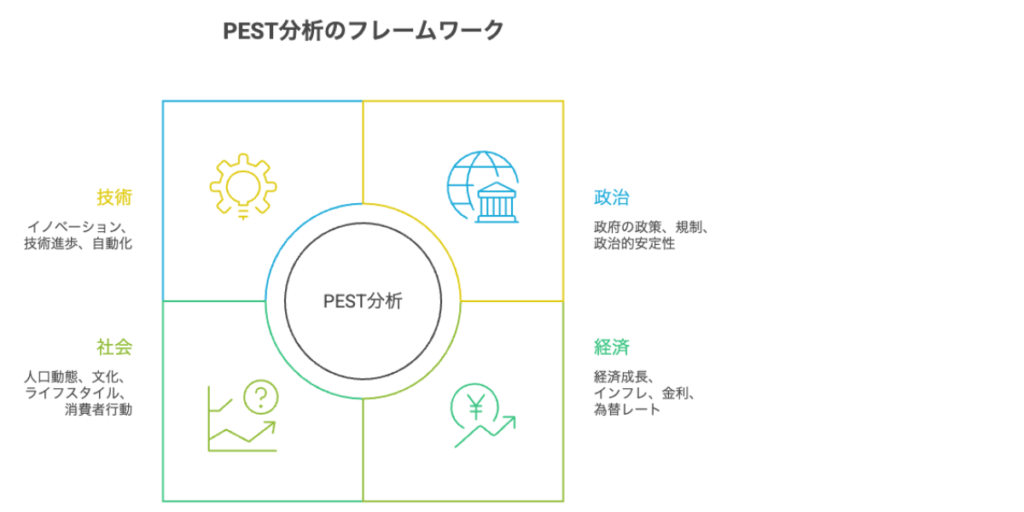
PEST analysis is a framework for organizing the macroenvironment based on four key factors: Politics, Economy, Society, and Technology.
It serves as a starting point for management and sales managers to establish a shared understanding of the factors that act as tailwinds and headwinds in the market.
A practical approach is to have sales managers conduct a "regular check-in" every quarter—lasting about 15 to 30 minutes—and report to senior management as needed.
For example, you can quickly detect signals that indicate changes in the underlying assumptions of your sales strategy, such as the emergence of new demand due to legislative changes or shifts in technical barriers to entry that make it difficult for competitors to enter the market.
3C Analysis—Organizing the Market, Competitors, and Company Triangle
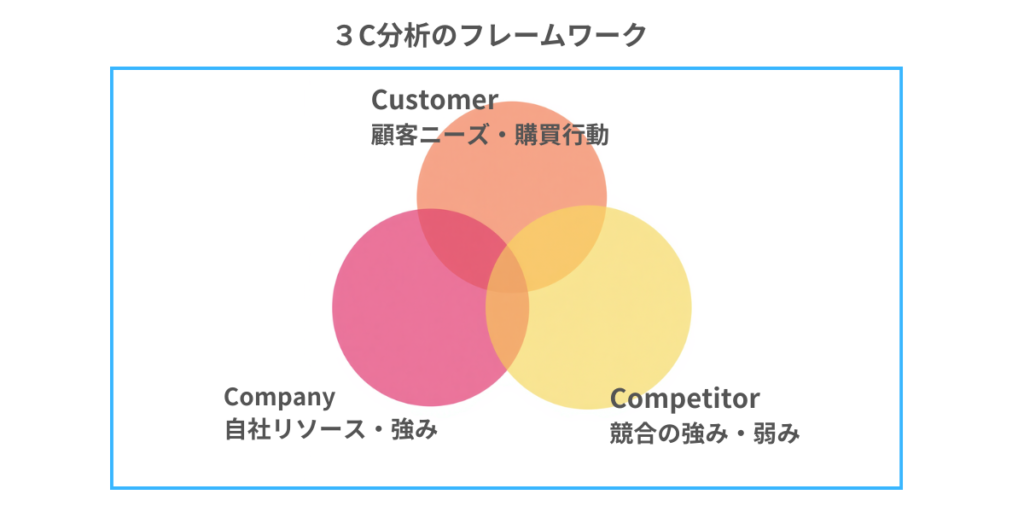
The 3C analysis is a framework that organizes three key elements—Customer (customer needs and purchasing behavior), Competitor (competitors’ strengths and weaknesses), and Company (the company’s resources and strengths)—to identify “areas where the company can succeed.”
The area where the three circles overlap represents "the area where customers have a need, competitors are failing to meet that need, and our company has a competitive advantage," and this becomes the focal point of our strategy.
SWOT Analysis + Cross-SWOT: Seizing Opportunities Through Strengths
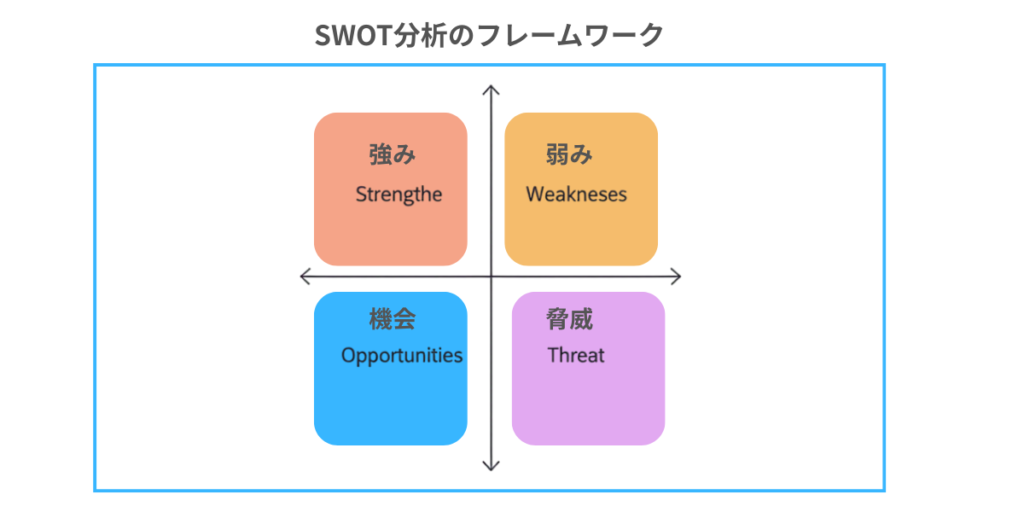
SWOT analysis is a framework that organizes the current situation into four quadrants: Strengths, Weaknesses, Opportunities, and Threats.
However, simply filling in the four quadrants would be a perfect example of the failure pattern described earlier: “being satisfied with the analysis and failing to take action.”
One approach you should always implement in conjunction with this is the Cross-SWOT Analysis. Only by translating the findings into the four strategies—SO (seizing opportunities through strengths), ST (mitigating threats through strengths), WO (overcoming weaknesses to pursue opportunities), and WT (minimizing weaknesses and threats)—can you identify the specific actions you need to take.
The key takeaway is to adopt the SO strategy identified through the Cross-SWOT analysis as the top priority in your sales strategy for the next quarter.
If you can make the process of "turning analysis into action" a standard practice within your organization, the effectiveness of using frameworks will increase significantly.
STP Analysis—Narrowing Down the Target Audience and Establishing a Position
STP analysis is a framework that proceeds through three steps: Segmentation (market segmentation) → Targeting (narrowing down priority customers) → Positioning (establishing the company’s market position).
Taking a field sales organization as an example, a particularly critical decision is to “stop trying to cover everything and instead identify priority customers.” In the context of field sales, the key lies in designing segments based on three criteria: region, industry, and company size.
For example, by narrowing your search to criteria such as "Greater Tokyo Area, Manufacturing Industry, 50–200 employees," you can significantly accelerate the optimization of your sales routes, the customization of your sales pitches, and the accumulation of successful closing patterns.
It is widely recognized in many workplaces that "targeting specific customers" leads to higher productivity and conversion rates than simply "selling to anyone."
4P Analysis—Designing Value Propositions from the "Seller's Perspective"
The 4P analysis is a framework used to assess the alignment of four key elements: Product (product or service), Price (price), Place (distribution channels), and Promotion (marketing and messaging).
After identifying the target audience through STP analysis, this is used during the stage of designing "what to communicate, at what price, where, and how" to that audience.
A key practical consideration is to ensure that these four elements are consistent with one another. For example, a typical mismatch occurs when a company offers high-quality, high-priced products (Product and Price) but focuses its promotional message (Promotion) on cost.
By designing the 4P framework based on the STP framework, we can create a consistent message that resonates with the target audience.
SPIN Sales—Structuring the Listening Process to Improve the Quality of Sales Meetings
SPIN selling is a sales technique that advances negotiations using a four-step questioning framework: Situation (assessing the current situation) → Problem (identifying the problem) → Implication (assessing the severity and impact of the problem) → Need-Payoff (confirming the value of the solution).
This is an advanced listening framework designed to elicit the process by which customers themselves recognize that "this is a problem that needs to be solved."
The key takeaway is to use this as a sales training tool to standardize and make the sales pitches of new and mid-level employees reproducible.
For example, a single question from the "Implication" category—such as "If this problem persists, how much revenue would you lose annually?"—can help the customer recognize the urgency of the situation and move the sales conversation forward.
By formalizing and sharing the practices that top salespeople engage in unconsciously, we can raise the overall quality of sales negotiations across the entire organization.
BANT—A Screening Framework for Determining Visit Priority
BANT is a framework used to prioritize potential customers based on four criteria: Budget (availability of a budget), Authority (decision-making authority), Needs (clarity of needs), and Timeframe (timing of implementation or purchase).
In field sales organizations in particular, using these criteria as a handover guideline from inside sales to field sales allows teams to objectively prioritize client visits rather than relying on intuition. Furthermore, even when field sales representatives schedule appointments directly, verifying BANT before the initial visit serves as a key criterion for determining visit priority.
Even if all four BANT criteria aren’t met, simply identifying which ones are still unconfirmed will clarify your next steps.
For example, if Budget and Needs have been confirmed but Authority is unclear, it becomes clear that the next step is to encourage the decision-maker to be present during the next visit.
It serves as a decision-making framework for focusing limited sales resources on customers with a high likelihood of closing a deal.
The Lanchester Strategy is a strategic framework based on a theory of competition that posits that "strong players" with a large market share engage in broad-scale, multi-front battles, while "weak players" with limited resources engage in localized, concentrated close-quarters combat.
For sales managers who feel they have little chance of winning in a head-to-head battle against major competitors, this provides a rationale for strategically "choosing where to fight."
This can serve as a strategic basis for field sales teams when narrowing down their focus to specific regions, industries, or customer segments. The key to implementation is to avoid expanding your assigned territory too broadly and to first design a plan aimed at achieving the No. 1 market share in a single region.
For example, by adopting a focused strategy—such as "increasing market share in specific industries within a single prefecture in the Kanto region"—you can build a strong foundation that is difficult for competitors to penetrate, as it allows you to deepen relationships with customers and improve the quality of your proposals through a better understanding of their specific needs.
How to Develop a Sales Strategy Using a Framework
Step 1 | Assess the External Environment (PEST and 3C)
The first step is to gain a clear understanding of the "external environment." Use PEST analysis to identify changes in the macroenvironment across the entire industry, and then use 3C analysis to clarify the relationships between the market, competitors, and your company based on those findings.
This order is important. The level of detail in your analysis will vary significantly depending on whether you first understand changes in the external environment before examining your own company, or whether you view the external environment from your company’s perspective.
For example, if you apply the 3C framework after identifying "the emergence of new markets due to deregulation" using PEST analysis, you can simultaneously assess competitive trends in those new markets and determine your company’s competitive advantage.
Step 2 | Assess Your Company's Current Situation and Strengths (SWOT and Cross-SWOT)
Using the results of the external environment analysis from Step 1 as input, we will conduct a SWOT analysis.
I would like to emphasize once again that you should not stop after simply filling in the four quadrants of the SWOT analysis. Be sure to proceed to the Cross-SWOT analysis and translate the results into the four strategies: SO, ST, WO, and WT.
The potential initiatives identified through the Cross SWOT analysis will serve as the basis for further development in subsequent steps.
Step 3 | Define Your Target Audience and Value Proposition (STP and the 4Ps)
This is the phase where we determine "who to reach, what to deliver, and how to deliver it."
We use STP analysis to identify our target customers and determine our company’s positioning, and then use the 4Ps analysis to align the four elements of value we offer to those customers.
In a field sales organization, it is particularly effective to design segments based on the axes of region, industry, and company size. Once you clarify “who to target” in this step, your visit planning, route design, and sales meeting preparation will all become much more focused.
Step 4 | Designing the Sales Process and Visit Prioritization (SPIN and BANT)
Once you’ve identified your target audience, you’ll move on to the execution phase, where you’ll plan who to visit first and how to approach them.
We use BANT to determine visit priority and prepare a structured interview process using SPIN questions for high-priority customers. This step marks the first point of contact in "translating strategy into on-the-ground action."
By incorporating Lanchester strategy principles to identify the specific areas and customer segments where we should focus our efforts, we can make the most efficient use of our limited sales resources.
Step 5: Set KPIs and establish a system for implementing the PDCA cycle
The final step in strategic planning is designing a post-implementation monitoring system.
We will establish KPIs tailored to each phase and its specific goals—such as the number of visits, the lead conversion rate, the order conversion rate, and area coverage—and establish weekly, monthly, and quarterly review cycles.
If KPIs are not established, there is a higher risk that the proposed strategy will not be implemented.
Monitoring design should be carried out in tandem with strategy development. Only when there is a system in place to track progress against established KPIs can the strategy formulated within the framework become a practical tool.
The Importance of Executing and Monitoring Strategies
Even the best framework is useless if it isn’t put into practice. In field sales organizations in particular, the key to managing execution lies in visualizing the extent to which planned strategies are reflected in the daily sales calls made by field representatives.
Even if you design an area-focused strategy (Lanchester) or a target-narrowing approach (STP/BANT), neither the evaluation of the strategy’s effectiveness nor the PDCA cycle will work unless you have a clear understanding of the actual locations visited, the frequency of visits, and the content of sales discussions.
Whether or not an environment exists that allows for "real-time" optimization of visit plans, area management, and log is a practical factor that determines the success or failure of strategy execution.
As a sales support tool designed specifically for field sales, UPWARD offers a single platform that enables customer data visualization via a map-based UI, optimizes visit planning, and automates log.
Creating an environment where you can immediately answer questions such as “How often are we visiting this customer?” and “Are we falling behind on follow-ups with customers we’ve prioritized using the BANT framework?” ensures that the strategies developed using the framework remain actionable.
It also integrates with CRM systems, allowing you to enhance the management of field sales activities while leveraging your existing customer data infrastructure. UPWARD is chosen as the foundation for ensuring that strategies developed within the framework are reliably executed in the field.
summary
In this article, we’ve explained eight frameworks you can use to develop sales strategies, along with how to choose the right one based on your objectives and stage, and a five-step planning process.
Finally, let’s summarize the key points.
Choose a framework based on your "goals and phase." You don’t need to use all eight; the priority is to select the one that best fits your current needs.
The root of failure lies in “being satisfied with analysis alone and failing to take action.” In particular, it is essential to conduct SWOT analysis—including cross-SWOT analysis—as a comprehensive process and translate the findings into concrete actions.
The order in which you use these steps is crucial. By proceeding in the following order—external environment (PEST, 3C) → internal analysis (SWOT, Cross-SWOT) → target design (STP, 4Ps) → sales process (SPIN, BANT)—each output serves as the input for the next step.
Lancaster Strategy is effective for organizations with limited resources that wish to focus on specific regions. Rather than competing against major rivals across a wide geographic area, it can be used as the basis for designing a strategy aimed at becoming the market leader in a specific region or industry.
Once a framework has been established, a comprehensive system for KPI design and monitoring is essential for effective implementation management. To ensure your strategy doesn’t get shelved, be sure to design a PDCA cycle at the same time you develop the framework.