

Erizen, a long-established kimono store, has nurtured relationships with customers that span generations using traditional and careful methods, and has continued to transmit the culture of "dressing in kimonos. The current situation is not less severe with the decrease in sales opportunities due to the outbreak of the new coronavirus, the shrinking size of the industry, the retirement of veteran salespeople with expertise, and the closure of the business of its creators. In such an environment, Mr. Kamei, a young leader and senior managing director who insists on "unique customer service" and "transmission of essential value," decided to introduce "Mobile CRM UPWARD" as a sales reform. In order to find out the reason why he chose to continue his contract with Corona Disaster even in the difficult situation, Mr. Kaneki, President and CEO of UPWARD, and Mr. Akira Kamei, Senior Managing Director of Erizen Corporation, discussed "Sales Reform of a Long-established Company Founded in Tensho 12, Tackling Adversity:" "The unique customer service and sales approach of a long-established company. We had the opportunity to have a dialogue with Akira Kamei, Senior Managing Director of Erizen Co. We will be posting two interviews on how UPWARD is going to realize the sales reform based on Erizen's beliefs, which will encourage all companies facing the waves of change of the times. Vol. 1→Vol. 1: Accumulation of corporate asset "customer information" will determine the future
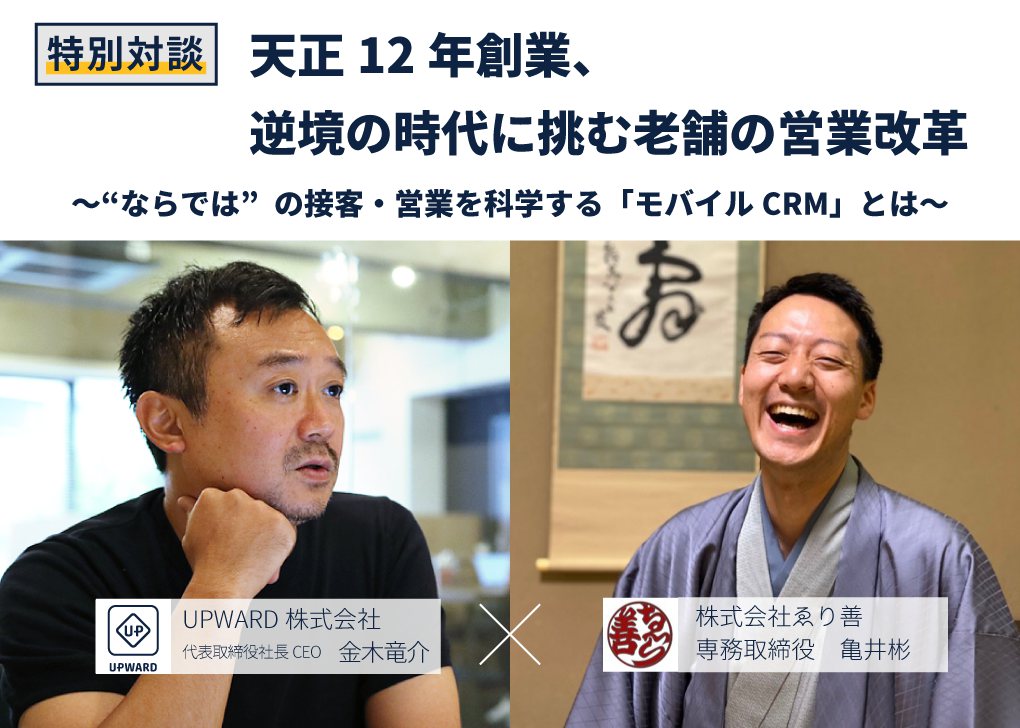
Sales Reforms at a Long-established Company Founded in 1923 that Took on the Challenges of Adversity - "Mobile CRM," the Science of "Unique" Customer Service and Sales - Vol. 2: Sales Reforms as a Tactic for Creating the Future
Recommended Documents
-

SUCCESS STORIES OF COMPANIES THAT HAVE ACHIEVED RESULTS WITH UPWARD
Click here to download the document
Pickup Articles


Table of Contents
COVID-19 BROUGHT ABOUT A CHANGE IN VALUES AND ESSENTIALIZATION OF SALES

Kaneki: I understand that there was an impact of the Corona Shock called COVID-19. What is the status of the business impact in your company and in the drapery industry?
Mr. Kamei: It is a big blow in terms of the impact of Corona. We have been hit harder than we could have imagined. This is a very difficult situation in terms of the business situation of the company, but if you look at the kimono industry as a whole, the situation is even more critical.
First of all, customers no longer have "opportunities to wear kimonos. There were no weddings, and tea ceremonies and events have been postponed or cancelled across the board, with no prospects for the fall season. The fact that there are no more occasions to wear kimonos is very damaging to the feelings of our customers.
Another issue that I am most concerned about is the closure of the artisan industry. This industry has been supported by skilled elderly craftsmen in their 70s and 80s, and many of them are now thinking of quitting their jobs. I am very concerned that the foundation of craftsmanship in this respect is crumbling.
Kaneki: Do you mean that this situation is spreading nationwide?
Mr. Kamei: Yes. It has been said for some time, but with the Corona disaster, the problem of artisan successors has become even more of an issue nationwide, as there is no one to carry on the work of the next generation.
Kaneki: Frankly speaking, is there a direct link between the industry becoming smaller and less demanding and the lack of a generational shift in craftsmen?
Mr. Kamei: It is a problem that is intertwined with many factors.
I think the reason why the younger generation does not continue to work in the industry is based on the fact that the kimono industry itself is becoming smaller and smaller.
As a retailer, I feel that we should continue to think about how we can help more people feel the appeal of kimono and contribute to making the industry as large as possible.
The value of a visit that cannot be compensated for by digital communication is in the shared experience.
Kaneki: Thank you very much.
Could you talk about the sales measures, efforts, changes in style, and challenges that your company is keeping in mind or continues to make in such an environment?
Mr. Kamei: I felt very strongly in the Corona disaster that the connection with customers is a major foundation for running a company. We often received phone calls from customers asking, "How is everyone doing?" We often received phone calls from customers saying, "How are you all doing? Since it is this time of year, it is not easy to meet with them, but I call each customer one by one to ask how they are doing and keep the connection with them so that they can be positive, even if the conversation is not kimono related.
In addition, not only the connection, but also the customer's heart will be enriched if they can feel the "beauty of harmony" through kimono, so we tell each and every one of them about recommended kimonos and new ways to enjoy kimonos. We have been making steady progress in this regard for the past two or three months.
Kaneki: I see. You also visited our customers, didn't you?
Mr. Kamei: Yes, we are happy to help as long as it does not inconvenience you. I believe that we were allowed to do so because of our small size and the deep connections and relationships that are unique to small and medium-sized companies.
Kaneki: There are still some things that cannot be conveyed or communicated over the phone.
Mr. Kamei: Yes, that's right. I think it is impossible to truly convey the appeal of an actual product unless you touch and feel it on your skin. I would like to stick to this aspect of the product until the very end.
Kaneki: When I heard your story, I thought that your company's sales style is to have customers experience your company.
Mr. Kamei: Yes, that's right. I think that in a sense, you may have taken the viewing of our products and services as a part of your experience.
Kaneki: If we think in terms of a business style in which customers experience the food, restaurants are also in the experience business.
The atmosphere when you enter the restaurant, the deliciousness of the food, the customer service that makes the space enjoyable... Delivery is the restaurant experience focused only on the food.
Depending on your sales style, I think one way to do this is to deliver part of the experience. In the case of your company, is the key value in the fact that people assist in the experience?
Mr. Kamei: I think that experience and people are very important.
We do not make one-size-fits-all proposals, but rather, we propose products based on the little insights we have gained through our past relationships.
For example, if someone says, "I would like to wear this in the fall," we can imagine and fantasize about what we might like to see, including the stories we have shared through our past relationships.
Kaneki: That's good. The word "imagination" is interesting. In English, it is creative work.
Mr. Kamei: Ah! Is that so?
Kaneki: Perhaps your company's style is to imagine and create together with your customers. That is, in a way, your culture.
Mr. Kamei: These are words I received after talking with a stylist overseas.
He told me that I should not think of myself asselling something, but rather as coordinating.
He told me thatlistening to what kind of occasions, in what kind of position, and with what kind of feelings, and then proposing coordination to match those occasions is considered extremely creative and highly valuable work worldwide. So, I was advised to be confident in my business.
Kaneki:It all comes back to the culture, the way of thinking, and the philosophy of "the half collar that conveys the Japanese sense of beauty to the present," as you explained at the beginning. That is the core.
Mr. Kamei: Yes. I believe so.
Why invest in customer information management now?

Kaneki: Even in a time when it was difficult to have a physical customer touchpoint, you were working hard to communicate with customers, establish contact, and provide them with experiences as much as possible.
However, sales growth was becoming difficult, and they introduced UPWARD to analyze and scientifically analyze this part of their business. However, the Corona vortex changed the situation drastically, and I think it was a business decision not to invest in a system at this time. In the midst of such a situation, we continued to contract with UPWARD.
I think we live in an era in which it is important to improve the resolution of the relationship with customers by converting qualitative information associated with salespeople into quantitative and stylized information as much as possible, as in the reform of contact points with customers and sales that you are taking the leadership in, as well as the " digital transformation" (Digital Transformation).
In this regard, could you tell us a little more about your thoughts on how you were able to continue the contract?
Mr. Kamei: Our company is now at a turning point. The members who have supported us since the establishment of the company after the war have reached the point of retirement, and I am about to look at the next 30 or 50 years of the store's future with my next colleagues.
In this context, I would like to pass on the know-how and ideas we have cultivated up to now as an important corporate resource.
However, I am afraid that these cannot be passed on verbally in a tangible form. We wanted to create a foundation that would allow us to properly pass on the knowledge to the next generation. That is the most important point.
We have avery long relationship with our customers. Once we have a customer, 20 years later, the kimono may be re-tailored for the customer's daughter and worn by her again.
With such a possibility, the store should keep the valuable information, and we believe that this will be a great source of information for the store in the future. First of all, we wanted to create a platform to accumulate this information.
Also, we have a very diverse clientele with a variety of know-how. What one person hears may be beneficial to other customers.
In that sense, it is sharing. The main reason for this decision to continue is that we want to be able to share the accumulated know-how and key events with everyone.


And that this should be done continuously. You believe that not stopping this even in the midst of the Corona Shock will lead to future reform of Erizen's customer contact points.
Mr. Kamei: Yes.
In particular, I believe that we will be receiving more and more various consultations from our customers.
There are very few stores that specialize in kimonos, and I think it will be difficult for them to survive unless they are able to respond to all kinds of requests. I think it will be difficult to survive without a store that can respond to all kinds of requests.
In that sense, I feel that we need to step up our game to accumulate information and create a foundation on which we can make proposals that will make our customers more satisfied.
Kaneki: I think that your company is very particular about the quality of the relationship with customers and the quality of contacts.
On the other hand, as technology continues to advance, there is a trend toward sales activities in which uniform information is provided to customers in a timely and broad manner and they react to the information. I believe that this is the future.
Even so, what is your reason and desire to continue to focus on high quality face-to-face customer touchpoint?
Mr. Kamei: "Broad and shallow" is one style, but our stance is based on "long and deep.
Some of our veteran sales staff tell us that they have been working with customers for more than 50 years, or five generations. Five generations, so we can say that we have had a very long relationship.
In this context, I believe that we cannot force a sense of "aesthetics" to be integrated into daily life. Without a presence that gently places kimonos in the timing and lifestyle of customers, I believe that kimonos will become more and more obsolete.
Rather than simply spreading the kimono to a large number of people, I believe that the most important role in preserving the culture is to be close to each and every customer and convey the charm of the kimono at the right time.
It is said that distribution will change in the future, and there is a trend for manufacturers to sell directly to customers. We believe that kimono requires more than just the purchase of a product; it requires service.
Wefeel that we should be able to help with this service, even though it is time-consuming and of course costly.

Kaneki: I think it is very important for retailers to play that role.
Mr. Kamei: There is no doubt that we are living in an era in which it is very difficult to find a balance between this role and profitability.
In this context, I would like to think about how we can make better use of the system and how we can use information in a meaningful way in the limited time we have.
Kaneki: I think the world will change a lot with this Corona as a catalyst.
Perhaps Corona was just one of the triggers, but I think people around the world are beginning to think about what true abundance is, in contrast to the way people are becoming more efficient with the growth of technology.
In this sense, Corona was a great opportunity, and I think that the reevaluation of essential ways of living and essential values has advanced at once in such a short period of time.
In this context, I think that your company's business is focused on essential values.
It may have been difficult in the past, but I frankly felt that your company's philosophy would be a good fit for the new reevaluation of intrinsic value that we are about to discover.
Mr. Kamei: I think it is both good and bad to say that things have remained unchanged from the past, but I think that extremely advanced technology and aesthetic sense are essential attractions that do not change greatly, even though times may change.
We are always thinking aboutwhat we can do to convey this appeal to our clients.
In addition, I feel that the joy of face-to-face meetings, or rather, the way we think about them, is changing at once in this sense.

Kaneki: Yes, that's right. The value of person-to-person meetings has certainly increased.
But it is also true that, in fact, for the part of the customer experience, the effective use of technology can increase the variation of the experience.
Mr. Kamei: Yes, I think that is definitely the case.
Kaneki: If the human encounter is the core of value creation, then the power of technology as a complementary approach to customers is significant.
Mr. Kamei: I wonder how we can make the best use of it.
If it isnecessary to use it to dress kimonos, I would like to work on it vigorously, even though I am mainly working offline.
Kaneki: We also meet many customers, and there are many companies that introduce IT and systemization without much hesitation and without any essential reason.
In this respect, when we talked with the executive director, we realized that he had continued to think about whatIT is essentially a tool to do. I think it is wonderful that you are able to simply think of IT as a tool to achieve this. I think it is wonderful.
Mr. Kamei: This is outrageous.
Kaneki: I wonder if the Corona Shock was an opportunity for your company to rethink the essential points of contact with customers.
In the midst of all this, you chose UPWARD, and as you lead Erizen to the next stage, what is your vision, like a cry from your soul, "This is what we are going to do! Could you tell us about your vision?

Mr. Kamei: No matter where you look in the world, you will not find such advanced dyeing and weaving techniques, so I believe that if we can preserve this technology and culture, it will attract attention. The trend of the times is not the age of mass production and mass consumption, but the age of so-called "sustainability.
The world is now paying more attention to sustainability, and the kimono is very well thought out. It is an item that is kind to the earth, and I would like to continue to convey its appeal.
Nevertheless, kimonos are becoming far removed from our daily lives. Especially in the case of purchases, the appeal and value of kimonos have been perceived as something that costs thousands of yen, and I would like to tell people that this is not true.
I strongly feel that wewant to be a store that can guarantee the value of kimono while maintaining contact with our customers and communicating that the real value of kimono lies in this.
Mr. Kamei: Our vision is that even if we are the last house...we want to convey the charm of kimono to Japan and to the world.
Kaneki: The strategy and tactic is to make good use of so-called cloud tools, for example, our appication UPWARD, to make it happen.
Mr. Kamei: You are right. Tools that are easy to use are constantly emerging, and we feel that we would like to realize how to make the best use of them by selecting them as soon as possible.
Kaneki: Thank you very much. We, too, believe that it is important for us as a service supplier in the future to take an approach not only to provide appapplications, but also to have our customers use and grow with us.
The idea is that in the end, the growth of our customers leads to the growth of us. We would like to contribute to your business, even if only in a small way, through the reform of customer contact points. Thank you for your continued support.
Mr. Kamei: Thank you very much. I would very much appreciate your wisdom.
Kaneki: I think this interview is really encouraging for those who are doing business with Japanese traditions. Thank you very much, Executive Director Kamei.
Profile of interlocutor

Akira Kamei, Executive Director of Erizen Corporation
Born in Kyoto in 1987. 33 years old. Graduated from the Department of Commerce, Faculty of Commerce, Doshisha University. In his seminar, he researched business succession of family businesses in Kyoto, which have been in business for over 100 years, mainly through fieldwork. After graduating from university, worked for an IT company in Tokyo. Engaged in development and system proposal of industry-specific packaged systems. As she became deeply acquainted with her family roots upon marriage, she decided to change her career, hoping to do something about the current critical situation of the kimono industry. Currently, he spends his days repeatedly discussing kimono with customers and rediscovering the profound charm of Japanese culture. His hobby is to travel around Japan and experience the local climate and traditional goods.

Ryusuke Kaneki, President and CEO of UPWARD Corporation
Born in Tokyo in 1973, Ryusuke Kaneki is well versed in LBS (location-based service) and GIS (Geographic Information System) and has built more than 200 He has built more than 200 systems related to LBS (Location Based Service) and GIS (Geographic Information System). He founded "UPWARD," Japan's first next-generation sales support SaaS that highly integrates Salesforce with maps and location information. Currently, UPWARD is used by more than 300 companies, mainly major corporations, and boasts the top market share in Japan as a cloud service for field sales.


A full overview of the benefits and best practices of the introduction of the system
Download a free set of 3 documents