Sales at home appliance manufacturers have a unique focus on "who to sell to"
A key characteristic of sales at home appliance manufacturers is that their customer base differs from that of typical B2B sales.
Understanding this structure is the key to achieving better results in sales and management.
We don’t sell directly to the client—the structure of a multi-tiered distribution channel
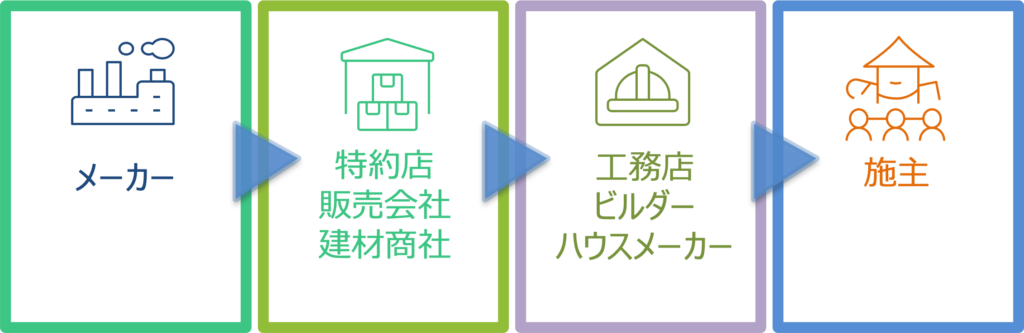
The sales representatives at home equipment manufacturers deal primarily not with end-users—the homeowners—but with authorized dealers and construction companies. The distribution channel has a multi-tiered structure as follows:
Manufacturer → Authorized dealers, distributors, and building materials wholesalers → Contractors, builders, and home builders → Homeowners
Manufacturers first supply their products to authorized dealers and building materials distributors. Authorized dealers then sell these products to general contractors, builders, and home builders, and ultimately, general contractors install the fixtures in the homeowner’s residence.
It is the construction company that deals directly with the homeowner; it is rare for a manufacturer’s sales representative to negotiate with the homeowner. For this reason, sales representatives at home equipment manufacturers need to understand who holds decision-making authority at each level of the hierarchy.
The Goal of "Spec-In"—A System That Leads to Repeat Orders
One of the key concepts in sales at home equipment manufacturers is "spec-in."
"Spec inclusion" refers to the process of having a company’s product model numbers listed in the standard specifications of a general contractor or homebuilder. Once a company’s products are listed in these standard specifications, it becomes easier to secure ongoing orders for projects handled by that contractor.
Since clients tend to select fixtures and fittings from the standard plans provided by contractors, inclusion in the specifications directly affects the likelihood of a product being selected. Conversely, if a competitor’s product is included in the specifications, the chances of our own product being chosen tend to decrease.
Spec-in is a sales activity aimed not at securing one-off orders, but at establishing a steady stream of repeat business.
There are three types of customers—what you say to each one differs
The customers that sales representatives at home appliance manufacturers deal with can be broadly categorized into three types. Since each group has different concerns, a one-size-fits-all approach will not work.
The primary objective for sales representatives at authorized dealers is to provide information and maintain relationships in order to increase the priority given to our products.
We need to encourage sales representatives at authorized dealers that carry products from multiple manufacturers to actively propose our products to construction companies.
A construction company owner explains how using the company’s own equipment benefits the business.
It is effective to clearly demonstrate the specific business benefits, such as eligibility for government grants and the ability to make stronger proposals to clients.
Design Engineers: Their primary role is to provide installation manuals, dimensional drawings, BIM data, and CAD data—all of which serve as key decision-making tools for adopting our products. Since design engineers are responsible for drafting specifications, they are the key point of contact for incorporating our products into project specifications.
Route sales is our standard approach
In particular, sales at mid-sized housing equipment manufacturers focus primarily on route sales—regularly visiting existing authorized dealers and construction companies—rather than developing new business. This approach presents unique challenges.
Make regular visits to authorized dealers and contractors in my assigned area
In route sales, representatives often handle dozens to hundreds of authorized dealers and contractors, and visiting each of them on a regular basis makes up the bulk of their work.
The purpose of the visit is not limited to simply "product proposals."
This includes exchanging information to maintain relationships, gathering information to stay abreast of trends among contractors and in the market, and handling complaints and construction-related issues.
The frequency of visits varies depending on the importance and nature of the customer relationship; it is common practice to adjust the schedule accordingly—for example, visiting key clients once a week and general customers about once a month.
I’m often out and about, so administrative tasks tend to get put off
One structural challenge of field sales is that, since the daytime is filled with visits and meetings, tasks such as entering daily reports, preparing quotes, and submitting internal reports tend to pile up after returning to the office.
The more client visits we have in a day, the more administrative work tends to pile up when we return to the office.
If data entry tasks remain unfinished after returning to the office, it often leads to a cycle where preparations for the next day’s visits fall behind schedule. Establishing a system that reduces the data entry workload while out in the field is the starting point for improving operations.
4 Tips for Sales in the Home Appliance Industry
Taking into account the structure of the supply chain and the nature of route sales, here are four practical tips that are easy to implement in the field.
All of the content is designed with a focus on specifying "who to communicate with, what to communicate, and how to communicate it."
When speaking with construction company owners, focus on the business context rather than product specifications
Construction company owners tend to focus their attention on day-to-day operations—securing contracts, managing costs, and coordinating workers. Rather than emphasizing product specifications or technical advantages, it’s often more effective to frame the discussion around the question, “How will adopting this equipment benefit your business?”
Please compare the following examples of what not to do with the examples of what to do.
Example to avoid: "Our water heaters exceed industry standards for energy efficiency."
OK Example: "This equipment is eligible for the XX subsidy. Since it can be used in proposals to clients, including it in the standard specifications will make it easier to use during sales negotiations."
The example above simply describes the product’s features, leaving the construction company owner to figure out for themselves what benefits they stand to gain from it.
On the other hand, the "OK" examples are directly linked to the business context of construction companies, such as grant applications and the ability to make proposals to clients.
Designing conversations with the intention of making the owner of a construction company feel that the information is relevant to their own work tends to make it easier to present proposals.
Provide construction procedures and data to the design team
The people who actually determine the specifications are the "specification writers," that is, the design and cost estimation staff.
Whether a design engineer includes a company’s product in the specifications depends on whether they consider it easy to adopt. To facilitate the inclusion of your product in the specifications, a practical step is to provide information in advance so that your product is considered a candidate when the design engineer is drafting the specifications.
Specifically, it is important to ensure that all necessary data—such as construction manuals, CAD data, BIM data, and dimension drawings—is readily available for immediate use on the design and construction site.
If you don’t have this data yet, start by converting the construction manuals into PDFs and posting them online.
In addition to reaching out to construction company owners, it is effective to position yourself as someone who can quickly provide designers with user-friendly data.
Make it a habit to provide written materials and digital files that can be easily referenced later, rather than just explaining things verbally during your visit.
Visit the construction company with the dealer representative
In multi-tiered distribution channels, it is common for authorized dealer representatives to handle product proposals to contractors.
However, since authorized dealers handle products from multiple manufacturers, their own products are not always given top priority.
To address this situation, effective strategies include “joint sales visits,” in which manufacturer representatives and authorized dealer representatives visit construction companies together, as well as holding product training sessions for authorized dealers.
Joint sales visits and training sessions provide opportunities for authorized dealer representatives to more easily propose their company’s products to construction companies.
However, it is important to design these activities not with the aim of “pushing our products on authorized dealer representatives,” but rather as opportunities to “support authorized dealer representatives in strengthening their relationships with construction companies.”
For dealership representatives, increased interaction with contractors also serves as the foundation for an ongoing cooperative relationship.
Visiting Authorized Dealers and Retailers Efficiently
In route sales, there is a tendency to visit "easy-to-reach customers" or "easy-to-sell-to customers" rather than focusing on sales volume. While maintaining customer relationships is an important part of the sales role, strategically visiting customers with high sales potential—and those to whom high-value-added products can be proposed—is crucial for achieving KPIs.
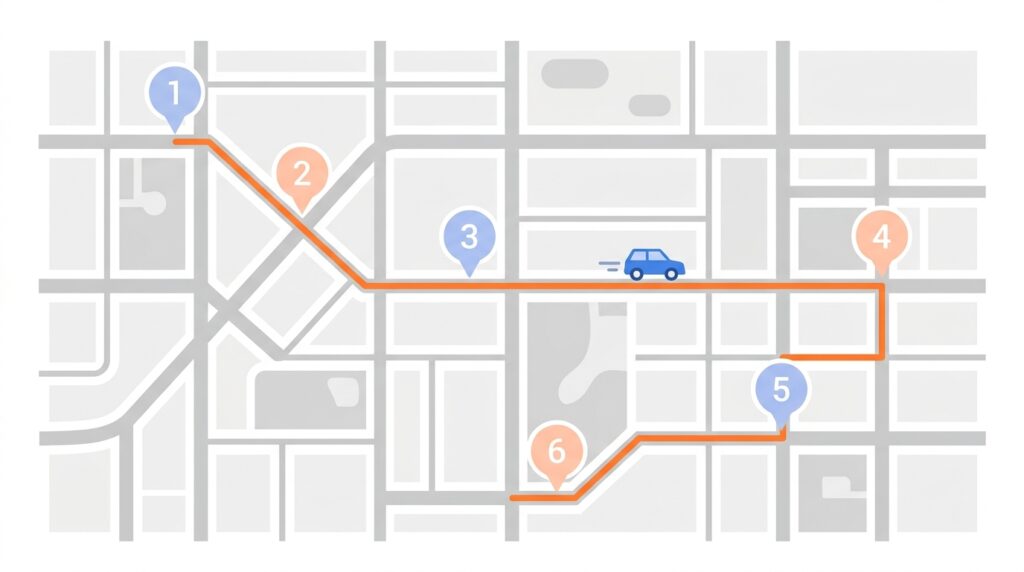
By utilizing tools like UPWARD that visualize map data, sales figures, and the time since the last visit, sales representatives can intuitively identify which customers to visit and which ones require regular follow-ups.
A full overview of the benefits and best practices of the introduction of the system
Download a free set of 3 documents
Four Common Pitfalls and How to Address Them
Even if you try to put these tips into practice, there are obstacles you’ll encounter on a daily basis in the field of route sales. Here are some common scenarios and possible ways to handle them.
It's hard to get in touch with the contractor's representative
Construction company representatives are often unable to answer the phone while working on-site, and it is not uncommon for them to be absent even when you visit. Here are some strategies for dealing with contacts who are difficult to reach:
By keeping your visits on the same days and at the same times, and becoming a familiar face, the staff will find it easier to recognize who is coming.
It is also helpful to have a general understanding of the contractor’s schedule—such as periods when construction starts are concentrated or the end of the fiscal year—and to adjust the timing of your visits accordingly. Another option is to create opportunities for interaction beyond visits by inviting them to showroom events or product seminars.
Authorized dealers don't give priority to our products
Authorized dealers handle products from multiple manufacturers, so there is no guarantee that their own products will always be given priority.
The following are possible ways to address this situation.
The key is to regularly provide product information and promotional materials to ensure that authorized dealer representatives can easily make proposals to contractors.
By increasing opportunities to accompany construction companies on site visits, you can support the activities of authorized dealer representatives while also increasing exposure for your own products.
Holding training sessions for authorized dealers to share product knowledge also helps create an environment where sales representatives can make recommendations with confidence.
The team's activities are not visible, and managers cannot track their progress
In the route sales team, because each representative is assigned to different clients, it is difficult for managers to keep track of the team’s overall activities. In particular, information on specification inclusion tends to remain in the representatives’ heads, making it hard to see in real time which construction companies have included our products in their specifications and where we are losing ground to competitors.
By linking and managing records of visits to authorized dealers and construction companies, managers can more easily determine which clients to prioritize and provide specific instructions to staff.
I’ve fallen behind on administrative work while out and about, so I don’t have time to prepare for my visits
In route sales, daily reports, quotes, and other documents tend to pile up while you’re out on the road, making it easy to fall behind on preparations for the next day’s visits. To address this, you can use smartphone apps to develop the habit of completing these entries immediately after each visit, thereby reducing the workload once you return to the office.
Making use of your travel time to review the next day’s visit locations and materials is also an effective way to improve the quality of your visits.
Reducing the burden of data entry while on the go by using tools
In some cases, utilizing tools specifically designed for field sales can help address administrative challenges faced by route sales teams. Here is a case study of a manufacturer in the home equipment industry that has implemented such a solution.
Case Study: Activity entries increased by approximately 60%, while daily report entries after 5:00 PM decreased by approximately 50% (Toso Corporation)
Toso Co., Ltd. (a manufacturer and seller of curtain rods and blinds, with 301 to 1,000 employees) conducts route sales targeting construction companies and interior design retailers.
Before implementing UPWARD, the company used a different tool to record its activities. Since it was difficult to enter data on the spot and they had to do so on a PC after returning to the office, the data entry process was a source of stress.
Since implementing UPWARD, the number of activity entries has increased by approximately 60%, while the number of daily reports submitted after 5:00 PM has decreased by about 50%. In addition, by utilizing the map-based UI, we have been able to make "drop-in visits" to customers located near our current location.
Case Study >> Toso Corporation: UPWARD Implementation Case Study
summary
Sales representatives at home appliance manufacturers must adopt different approaches for authorized dealers, contractors, and designers within a multi-tiered distribution network.
Let’s review the four tips we’ve covered today.
- When speaking with construction company owners, focus on the business context (such as subsidies and the ability to propose ideas to clients) rather than product specifications.
- We provide design engineers with construction manuals, CAD data, and BIM data to create an environment that facilitates their adoption.
- Conduct joint sales visits and training sessions with authorized dealer representatives to increase opportunities to propose our products
- Visiting Authorized Dealers and Retailers Efficiently
Start by reviewing your client list and determining who should receive what information. Providing the right information to each level of the supply chain lays the foundation for securing product specifications and securing repeat orders.
UPWARD has a proven track record of use within the field sales organizations of manufacturers of residential equipment and building materials.
If you are interested in streamlining log, please feel free to request our materials.
Frequently Asked Questions (FAQ)
We’ve compiled a list of frequently asked questions about sales at home appliance manufacturers.
Q1. What is "Spec-in"?
This involves having our product model numbers listed in the standard specifications of construction companies and home builders.
Once a product is included in the specifications, it becomes more likely to be reordered.
Q2. What should I do if I can’t get in touch with the representative from the construction company?
It is effective to establish a regular schedule for visits to build familiarity, use data to make tailored recommendations and gain trust, and create opportunities for interaction beyond visits, such as through study sessions.
Q3. Are there any effective ways to strengthen relationships with authorized dealers?
Regularly providing product information, conducting joint sales visits with contractors, and hosting training sessions for authorized dealers will help maintain and expand opportunities to make proposals.
Q4. Can sales representatives effectively use SFA and CRM systems?
UPWARD is designed with smartphone input in mind, making it easy to use even for sales representatives on the go.