Structural Challenges Hindering Regional Banks' digital transformation and Approaches to Resolve Them
Recommended Documents
-
SUCCESS STORIES OF COMPANIES THAT HAVE ACHIEVED RESULTS WITH UPWARD
Click here to download the document
Pickup Articles
Table of Contents
Why Does digital transformation at Regional Banks Stall at the "Front Lines"?
The financial industry, particularly regional banks, is currently facing a major turning point. Beyond external changes like declining birthrates, aging populations, and prolonged low interest rates, there is a growing shortage and aging of frontline sales staff (customer relationship managers). The traditional "legwork-based" sales approach has fostered a reliance on individual intuition and experience, creating a "person-dependent" model that threatens the organization's sustainability.
Amidst this, many financial institutions have begun promoting digital transformation and implementing CRM systems like Salesforce. However, numerous voices express concerns such as "it's not taking root," "it only increases the input burden on the front lines without showing results," and cases where digital transformation becomes merely a formality are not uncommon. What hinders digital transformation is not merely a lack of technical capability, but the industry's unique "structure" built up over many years.
① Persistence of Analog Sales Methods
In many regional banks' sales operations, vast amounts of paper documents and maps remain indispensable tools. One estimate suggests that processing financial statements alone consumes 21 million sheets of paper annually. This culture of analog procedures is one factor hindering digital transformation.
② Personalization of Data and the "Black Box"
Customer information often resides solely on the personal computers, notebooks, or in the memory of individual staff members. This frequently leads to situations where customer relationships are reset with every personnel change. Because customer information depends on the memory and subjective judgment of the individual in charge, inconsistencies arise in the comprehensiveness and objectivity of the data. This also makes it difficult for senior management to provide accurate oversight.
③ Administrative Burden from Regulatory Compliance
Financial institutions are obligated under the Financial Instruments and Exchange Act to "create and retain records." log with customers to ensure compliance. However, in many operations, it has become routine for staff to "spend the day on field visits and then input data into the CRM system in the evening based on memory."
④ "Information Silos" and Remote Access Restrictions
Due to the high security requirements in this industry, strict internet access restrictions and limitations on remote environments pose significant barriers. Inefficient operations occur, such as being unable to check the latest customer information while away from the office and having to return to the store just to find out "who visited and when."
Solution Approach: AI and Maps Paving the Way for "Sales Where People Thrive"
Visualizing Business Operations Using Digital Maps (Case Study: Ryukyu Bank)
At Ryukyu Bank, initially, each relationship manager managed customer information individually in Excel, and there was no sharing of this data. This led to various challenges in sales activities, such as different managers accidentally targeting the same customer twice or handoffs not going smoothly.
That's when we set our sights on UPWARD's map feature. By plotting customer information on the map, we're starting to see effects like the following:
・Visualization of Sales Activities
For our payment service sales, key accounts and activity progress became immediately visible, enabling efficient field visits.
・Shift in Field Mindset
Usage evolved from maps for location searches to maps for "developing sales strategies." Field staff began proactively suggesting, "We want to visualize this kind of information," leading to self-driven efforts to devise efficient sales approaches.
The Ryukyu Bank "UPWARD" case study article is here.
https://upward.jp/case/ryugin/
You can also watch the Ryukyu Bank digital transformation story in video format.
AI-powered automation of activity input and companion-style support that guides your next move
AI has become indispensable in sales operations due to its rapid evolution in recent years.
UPWARD is an AI agent specialized for field workers, including outside sales representatives. In the field, customer touchpoint arise daily through face-to-face meetings and phone calls. While these interactions contain many genuine customer insights and challenges that influence sales outcomes, examples where this reality is shared and digitized within the organization, and fully leveraged for management decisions and oversight, are not common.
To address these challenges, UPWARD is building a foundation that automatically digitizes the "raw communication" only obtainable in the field during outside sales, using this as a starting point to enhance decision-making accuracy and boost sales.
AI Meeting Notes: Automatically detects arrival at the visit location and begins log face-to-face meeting log. Conversation details are summarized by AI, transforming unstructured information generated on-site into actionable data for strategic decision-making.
AI Scan: Instantly digitizes textual information encountered on-site, such as business cards, product labels, and signage. Accumulates information as organizational assets without relying on sales reps' memory or manual input.
AI Scheduler: Based on visit frequency, transaction status, and past activity history, AI suggests the next action to take. It supports sales representatives and managers in their decisions, optimizing sales activities.
AI Call Analysis (Rolling out starting first half of 2026): Supports both outgoing and incoming calls, recording and summarizing call content for registration in CRM.
We've summarized the overview of "UPWARD" in a one-and-a-half-minute video.
Utilization of a cloud infrastructure with enhanced security features
Financial institutions require strict information management. However, by adopting a platform like Salesforce—which has extensive implementation experience in the financial industry and meets stringent security standards—they can potentially take a step digital transformation.
Furthermore, technologies that securely connect core systems with external devices are continuously emerging. Financial institutions are steadily increasing their adoption digital transformation to achieve both robust security and convenience, thereby maximizing business results.
Summary: The goal digital transformation is not efficiency, but "maximizing results."
digital transformation may initially appear as an effort to reduce the burden on the front lines. Automating log, visualizing customer information, and reducing data entry tasks—all are measures to improve immediate operational efficiency.
However, its essence is not merely about efficiency.
Accurate sales activity data is accumulated, and based on this, AI will indicate the next steps. This will transform sales activities from being dependent on "experience and intuition" to becoming "data-driven and reproducible."
Eliminating dependency on specific individuals will streamline handoffs, enhance management precision, and enable strategic approaches to key customers.
Initiatives started to reduce input burdens ultimately lead to maximizing sales results—that is digital transformation.
Amid declining birthrates, an aging population, and growing labor shortages, building systems that consistently deliver results with limited resources is unavoidable. For the financial industry entering a period of transformation, digital transformation is no longer something to pursue only if there's spare capacity—it is becoming an essential requirement for establishing sustainable sales operations.
Why not start with what you can do?
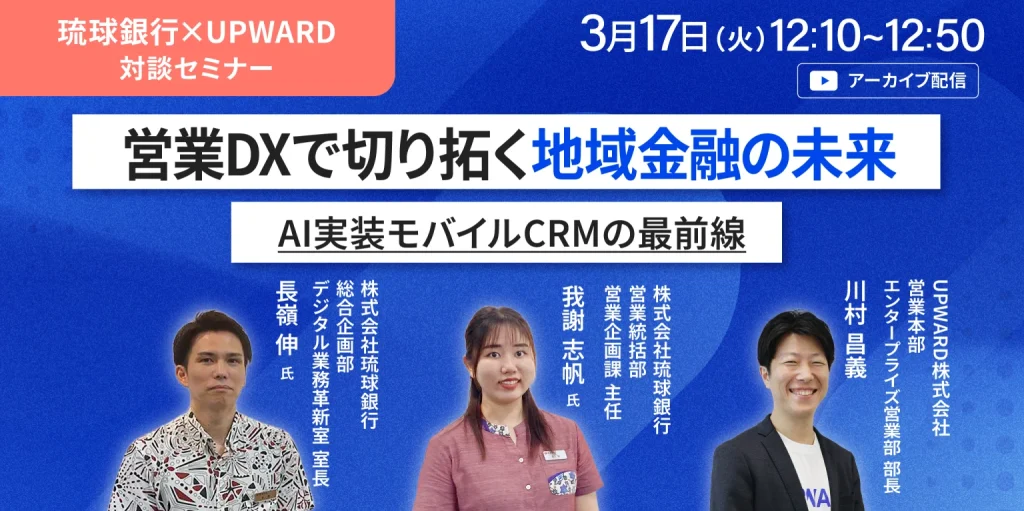
【Fully digital transformation Re-Broadcast!
Ryukyu Bank Presentation: " digital transformation the Future of Regional Finance digital transformation: The Cutting Edge of AI-Implemented Mobile CRM"
Re-broadcast Date and Time: Tuesday, March 17, 2026, 12:10 PM - 12:50 PM

A full overview of the benefits and best practices of the introduction of the system
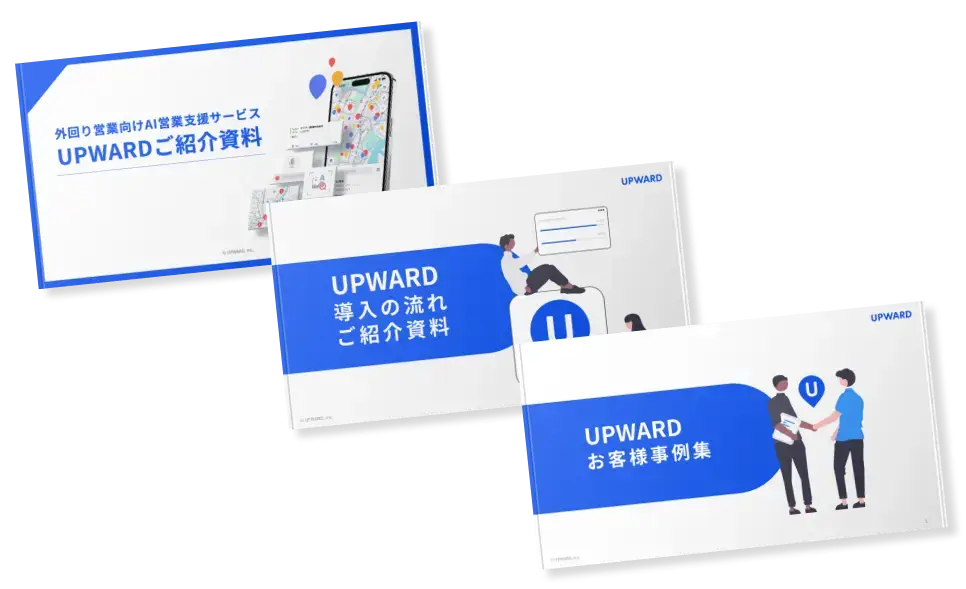
Download a free set of 3 documents