

Two years have passed since the emergence of the new coronavirus, and the conventional worldview of "coming to the office every day to work" has begun to change dramatically. What trends are emerging in this period of work-style change, and how should we maximize the productivity of our sales organizations and unleash the creativity that only people can bring to the table? How should we work to increase the rate of innovation while leveraging the "people-oriented" technologies provided by Microsoft Japan and UPWARD? The key to achieving this is how to utilize the data obtained from actual customer touchpoint as an important corporate asset. Mr. Kaneki, President and CEO of UPWARD K.K., which has supported numerous sales digital transformation centered on enterprise companies through its sales engagement services, and Microsoft Japan, which has realized and led hybrid work for many companies, will discuss how to make the data obtained from actual customer touchpoints an important corporate asset. who has realized and led hybrid work for many companies, together with Mr. Chikara Tejima, Executive Vice President, General Manager of Cloud & Solution Business Division and Officer in charge of Work Style Transformation, Microsoft Japan Co. We will share with you the best sales organization for the future. Chikara Tejima (Executive Officer, Executive Vice President, General Manager of Cloud & Solution Business Division and Director of Work Style Transformation, Microsoft Japan K.K.) Joined Microsoft Japan K.K. in December 2017. He is responsible for the current organization that supports the promotion of "Digital Transformation," the business transformation of an organization by leveraging the latest technologies, including AI and IoT, with a focus on cloud computing. He is also leading the company-wide "Work Style Innovation" project, which is positioned as the core of the management strategy, and is working on in-house implementation of in-house digital transformation through creativity and collaboration centered on employee growth. Ryusuke Kaneki (President and CEO, UPWARD Co., Ltd.) Born in Tokyo in 1973, Ryusuke Kaneki is well versed in location-based services (LBS) and geographic information systems (GIS). GIS (Geographic Information System), and has built more than 200 GIS-related systems. He founded "UPWARD," Japan's first next-generation sales support SaaS that highly integrates maps and location information with Salesforce. UPWARD is currently used by more than 300 companies, mainly major corporations, and boasts the top market share in Japan as a cloud service for field sales.
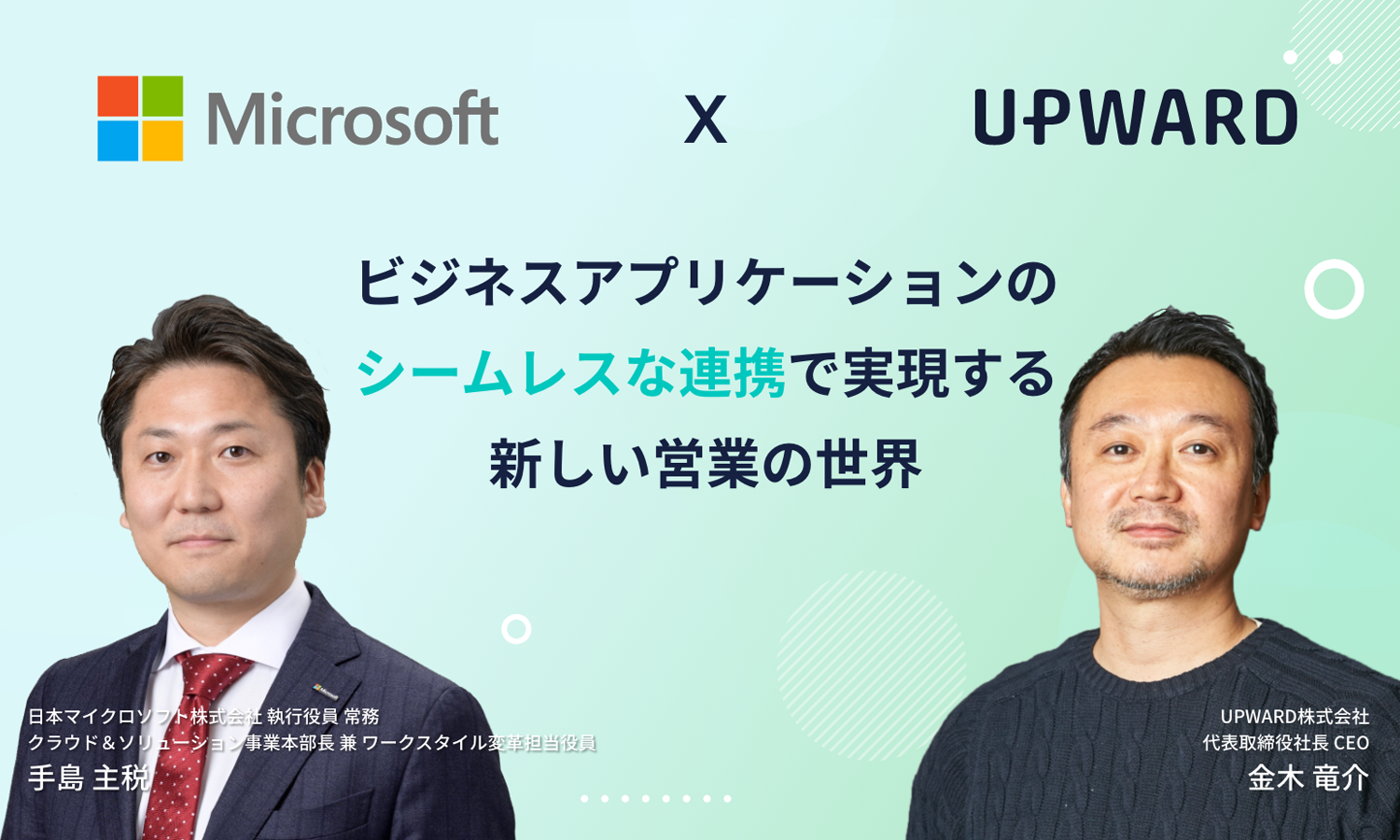
[Microsoft x UPWARD Part 2] Business appA new world of sales enabled by seamless collaboration between
Recommended Documents
-

SUCCESS STORIES OF COMPANIES THAT HAVE ACHIEVED RESULTS WITH UPWARD
Click here to download the document
Pickup Articles

Table of Contents
Business appA new world of sales enabled by seamless collaboration between

Kaneki: Mr. Teshima, thank you for discussing the state of innovation in the changing demand andwork styletransformation at Corona Disaster in the first part of your presentation.
How do you think business appcommunications will change in response to these changes in the future?

Teshima: I believe that our very major mission is how to seamlessly connect thefragmented world and how to trigger innovation in it. How do we create algorithms from a technological perspective that allow the data in each system to move back and forth between each other and derive new insights?

Teshima: We have a " building block " concept. We have Microsoft 365 in our solution, we have Teams. For developers, we have Github commitments, and we have Azure DevOps. From these various perspectives, can we create a system that allows customers to tailor-make what they think they need by combining various parts, like Lego blocks, and adapt it to their business? I think this is a great challenge.
Of course, we are not only focusing on Microsoft solutions, but we are also focusing on openness, including collaboration with technologies that are already in use by people in various industries.

Kaneki: Thank you very much. In relation to what you just said, I would like to talk again about why UPWARDmoved part of its development platform to Azure.
First of all, since many of our enterprise customers are using appapplications, we focused on the need foravailability,scalability, and a secure environment. We do not yet have the know-how to build such an environment on our own. We wanted to start with Azure. Also, since the appapplication is connected as an interface, we can provide UPWARD's insights through various channels.

Kaneki: By the way, what trends are you seeing in the ISV appapplications* being developed on Azure, especially in Japan?
(*) ISV...Abbreviation for Independent Software Vendor. A classification of software development and sales companies, i.e. independent companies that are not part of or affiliated with platform operators such as computer manufacturers.
Teshima: Well...there are many different world views, but I feel that the activation of business appapplications for collaboration purposes is becoming very important. In fact, there are a number of appications being developed in other countries, especially those that can work with Teams.
In addition, the number of collaborationappapplications is currently increasing, as there is a need to innovate as a single business appapplication, without separating CRM andERP. We would like to increase the number of such applications in Japan, and since UPWARD is also making efforts, we would like to ask you to share new insights from your perspective on development and to lend us your help as well. We would also like to contribute more actively to other ISVs.

Kaneki: We would like to enhance UX/UI throughcollaborationfrom the customer's perspective, so this is a partnership or collaboration based on that premise.
We are very particular about UX/UI at app, and we have a "UX Values" that are very important to us. 6 UX Values We have defined the experience values we want to provide to users through our service, "6 UX Values," and have a product vision to "realize this kind of UX.
Our technologies include location information, MAP, and CRM integration, but the banner for innovation and improvement is UX, and we share the concept of technology for this purpose within the company. We want to make it seamless, easy-to-use, and light appcommunication. For example, I would like to solve issues unique to the field, such as making appcation that can be handled offline.
There is the " metaverse " world that your company has on its roadmap, and I think it is about to arrive in the world of business appapplications as well. Our position is mainly location information and visualization on maps, so it is truly a two-dimensional metaverse.

Kaneki: If we can create a world where we can become a metaverse in the 3D world, where a business community is created there, where customers and vendors enter the community, and where business transactions are initiated in the virtual space, I would like to be the gateway for people to go back and forth between the real and virtual space.
With our interface, since it uses location information, I think it will be possible to use AR as a business appapplication without the need for so-called VR goggles.

Kaneki: Like location information, I feel it is important to access informationintuitively and operate intuitively. I think it is still a bit "rigid" to put in data, look at data, and give suggestions based on that data.
Ultimately, I think this is the world that your company is aiming for, but I would like to make business appcommunications like a game. This way, even those who are not highly literate will get pleasure from using it, and it will become natural. I think the quality of the business transactions will be much higher because there will be more business transactions and less waste and less load.
Teshima: There is what is called mixed reality or MR, the so-called Star Wars world... I also feel that we still need to utilize digital in the real world.
In the world of games, we are confined to a virtual space, but business is real, so we want to turn risk into value. Or, a worldview in which technology can support the switch that makes it worthwhile for people to do things in the real world. Without such things, people will stop using digital technology.
Kaneki: Really, depending on the age of the product, it could be that it is no longer used at all.
Teshima: Once again, UX/UI is important, as you said, Mr. Kaneki. If we are not satisfied with the UX/UI, we will not use the product.
In my dealings with UPWARD, what amazes me is theirsense of aesthetics. It is said that the digital world of the future will be more and more like the world of artists, where " how to give form to the human sense of beauty " will be the key. How can we embody the creativity that people possess?
How do we reproduce in the world of appcommunication what makes us "happy" and "joyful" in a deeper way? In this respect, I feel that UPWARD has a wonderful aesthetic sense.
Kaneki: Thank you very much. Maps arevisual to begin with, and the design is very logically organized as a prerequisite, so one of the most important factors is the use of the functionality of the map.
Teshima: It is said that in the world of the future, every part of the world will become more diversified.
The world will surely transcend the barriers of distance and culturefrom the perspective of technology, so the challenge for the future is how we, as Japanese, can contribute to the world as much as possible, not to mention the last mile. I think this is our common philosophy.
Kaneki: We would like to continue to provide solutions to our customers through collaboration. I would also like to continue to pursue what the real digital transformationis.
Thank you very much for your time today!

Click here to read the first part of the dialogue article.
A full overview of the benefits and best practices of the introduction of the system
Download a free set of 3 documents