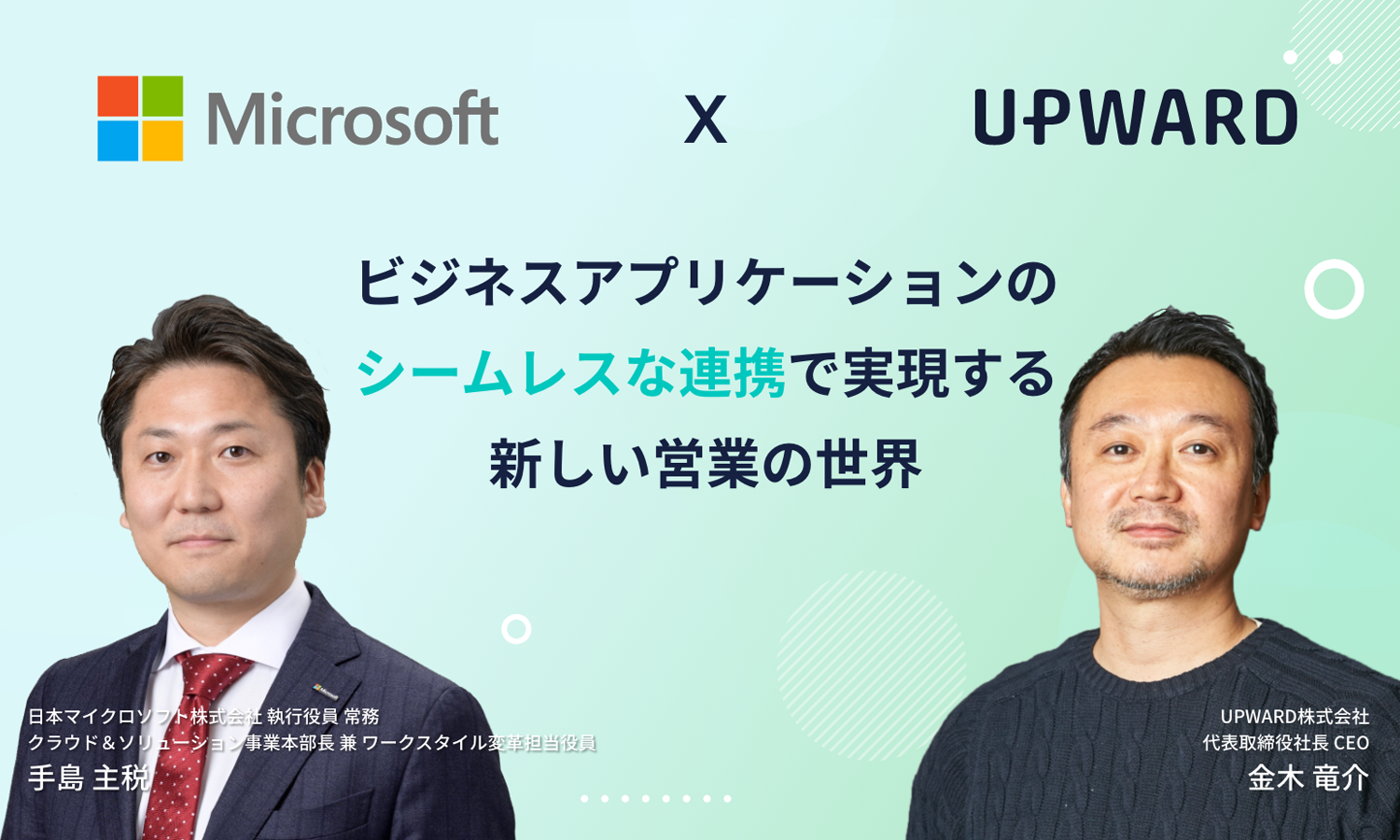
Two years have passed since the emergence of the new coronavirus, and the conventional worldview of "coming to the office every day to work" has begun to change dramatically. What trends are emerging in this period of work-style change, and how should we maximize the productivity of our sales organizations and unleash the creativity that only people can bring to the table? How should we work to increase the rate of innovation while leveraging the "people-oriented" technologies provided by Microsoft Japan and UPWARD? The key to achieving this is how to utilize the data obtained from actual customer touchpoint as an important corporate asset. Mr. Kaneki, President and CEO of UPWARD K.K., which has supported numerous sales digital transformation centered on the enterprise through its sales engagement services, will be joined by Microsoft Japan, which has realized and led hybrid work for many companies. who has realized and led many companies' hybrid work styles, held a special discussion with Mr. Chikara Tejima, Executive Vice President, General Manager of Cloud & Solution Business Division and Officer in charge of Work Style Transformation, Microsoft Japan Co. We will share with you the best sales organization for the future. Chikara Tejima (Executive Officer, Executive Vice President, General Manager of Cloud & Solution Business Division and Director of Work Style Transformation, Microsoft Japan K.K.) Joined Microsoft Japan K.K. in December 2017. He is responsible for the current organization that supports the promotion of "Digital Transformation," the business transformation of an organization by leveraging the latest technologies, including AI and IoT, with a focus on cloud computing. He is also leading the company-wide "Work Style Innovation" project, which is positioned as the core of the management strategy, and is working on in-house implementation of in-house digital transformation through creativity and collaboration centered on employee growth. Ryusuke Kaneki (President and CEO, UPWARD Co., Ltd.) Born in Tokyo in 1973, Ryusuke Kaneki is well versed in location-based services (LBS) and geographic information systems (GIS). GIS (Geographic Information System), and has built more than 200 GIS-related systems. He founded "UPWARD," Japan's first next-generation sales support SaaS that highly integrates maps and location information with Salesforce. UPWARD is currently used by more than 300 companies, mainly major corporations, and boasts the top market share in Japan as a cloud service for field sales.
[Microsoft x UPWARD Part 1] Business appA new world of sales enabled by seamless collaboration between
Recommended Documents
-
SUCCESS STORIES OF COMPANIES THAT HAVE ACHIEVED RESULTS WITH UPWARD
Click here to download the document
Pickup Articles
Table of Contents
Business appA new world of sales enabled by seamless collaboration between

Kaneki: Mr. Teshima, thank you for coming to our office. As we deepen our collaboration in the future, I hope we can talk again about our mutual visions through this dialogue.

Teshima: Thank you for inviting me. Once again, my name is Teshima from Microsoft. I am in charge of the Cloud Solutions business and the company-wide lead for employee work style innovation.
I would like to listen to Mr. Kaneki, who has newly migrated part of his development platform to Microsoft Azure this year, and together we will steer the ship by considering how we can more powerfully support our customers' business together based on Microsoft's overall portfolio. Thank you very much for your cooperation.

Kaneki: First, let me briefly introduce our service. UPWARD" is a cloud service for field sales and has been introduced by more than 300 companies, mainly major corporations. It boasts a high contract retention rate of approximately 98% on a monthly basis, and is characterized by its intuitive and easy-to-use interface, which makes it effective and easy to establish.


Kaneki: In Japan, field sales and managers are facing many problems such as " information from CRM and ERP cannot be used well in field sales activities " and " visualization of the sales field cannot be done in real time. We are solving such problems by providing customer touchpointa function toeasily auto-populate information and return insights to the field.
Sales Engagement " is a word that simply describes the areas we deal with.


Kaneki: One layer above the CRM database is this sales engagement, and above that is the layer of sales activities that establish contact with customers through salespeople. How can we automatically and in an optimized way put customer touchpointdata from sales activities such as visits, phone calls, e-mails, and online meetings into the CRM? How can this data be combined with CRM information to provide insight to the sales force in the field?
customer touchpointThe CRM has a wide variety of channels, such as Outlook e-mail and Teams online meetings, but I would like to take on the challenge of converting these channels to log, including transactions. We look forward to working with your company more and more on these and other initiatives.


Teshima : There will continue to be much demand for strengthening field sales based on CRM, and I feel that there is a particularly high need for this kind of challenge, as Japan has productivity issues even among global markets.
On the other hand, however, there has been a pandemic of a new type of coronavirus since 2020, hasn't there? Has there been a change in demand in the field sales area?


Kaneki: As Teshima-san said, the business itself experienced a temporary drop in sales, and many of our stakeholders asked us if this solution was safe. However, as a result, we are still growing.
The " last mile" by field salespeople is still very important, and the final communication with the customer is what differentiates a company and leads to customer satisfaction. We are seeing an increase in the number of inquiries as a shift is taking place to create a winning sales organization that utilizes data, with the aim of making this a science and moving away from the haphazard sales approach that was once used. We believe that sales digital transformation continues to be in demand regardless of Corona and that we can help.


Teshima: Yes, that's right. In the end, a simple way to describe digital transformationis " how to increase the batting average of human innovation. Even if the skeletal DNA of sales is the mold, the way it is done and the way it customer touchpointis done is evolving every day. I wonder how technology can provide new insights and draw out people's potential.
At Microsoft, we are also working on designing the future ofwork styles that will be possible in the future, and what kind of job types will have the opportunity to innovate.
We are also designing Teams, Azure, Dynamics, Power Apps, and other products based on the index of " people-centered innovation," so we share a lot of the same ideas as Kaneki-san. I share many of Mr. Kaneki's ideas.

Kaneki: I think there are a lot of similarities in the emphasis you place on the potential of people, creativity andinnovationgenerated by people.
Now that you have touched on this point a little, please tell us more about the worldview that Microsoft conveys to its customers.

Teshima: To give you an idea of our own situation, of our 180,000 employees globally, 160,000, excluding those working in data centers, are now working from home. While we have learned a great deal from this change, we have also seen challenges in terms of human relations,communication, and employee collaboration.

Remote work has become the norm, with only 2% of employees wanting to come to work every day as in the past. The concept of hybrid work, where people have a choice ofwhere to work and focus on how they want to work and what they want to do, is spreading.
Does the demand from field salespeople that Mr. Kaneki mentioned earlier also come from this type of work style?

Kaneki: In the past, field salespeople had to go to theoffice first, meet the customer, and come back, but I feel that this change has highlighted how inefficient that was,customer touchpoint With UPWARD, daily reports and other document work can be done with a single mobile device.log I think the demand for UPWARD is growing in this respect.
And all non-work time goes to private time. Once the mission that needs to be done is accomplished, the rest of the time can be spent running errands or going back into your own life. I feel that I am helping to bring us a little closer to that kind of world.

Teshima: We are also discussing this point globally, and I think we have come up with three major pillars.


Teshima: First of all, distance should be converted into value. As Mr. Kaneki mentioned earlier, there are many areas where we can improve the way we contact and collaborate with our customers, whether it is thelast mile or the internal sales stage. We are currently exploring where we can find innovation for this purpose.
The other is to move toward a world where automation is a prerequisite. He said, "Let's thoroughly automate the areas that can be automated, and create time that can be used to utilize human creativity in order to increase the batting average of the original innovation. In order to do this, we should have a sense of security and leave to technology what can be left to technology. We need to strike a balance between areas that should be automated and areas that should be done by people.
We will continue to explore how to achieve automation so that people, things, and everything else do not become impediments to each other.


Teshima: The last one is to make data a corporate strength. Recently, we have seen an overwhelming increase in the scale ofcustomers utilizing data. We have been supporting a great number of customers through Azure Synapse and Analytics, but even if we just say " data," there are many different types of data, some of which are suitable for CRM and others for ERP. Analyzing data within a single CRM inevitably leads to a maturation ofinsights.
As a more advanced customer data platform, we want to perform highly accurate data analysis behind the CRM. We want new insights that are commonly generated from data in different systems. These needs are increasing greatly among various industries, especially consumer products and retail customers, due to the Corona disaster.

Kaneki: Thank you, Mr. Teshima. We have seen firsthand the needs of enterprise customers in particular.
In the second part, please join us in digging deeper into the future of business appcommunications required in these changes.
Click here for the second part of the dialogue article.
A full overview of the benefits and best practices of the introduction of the system
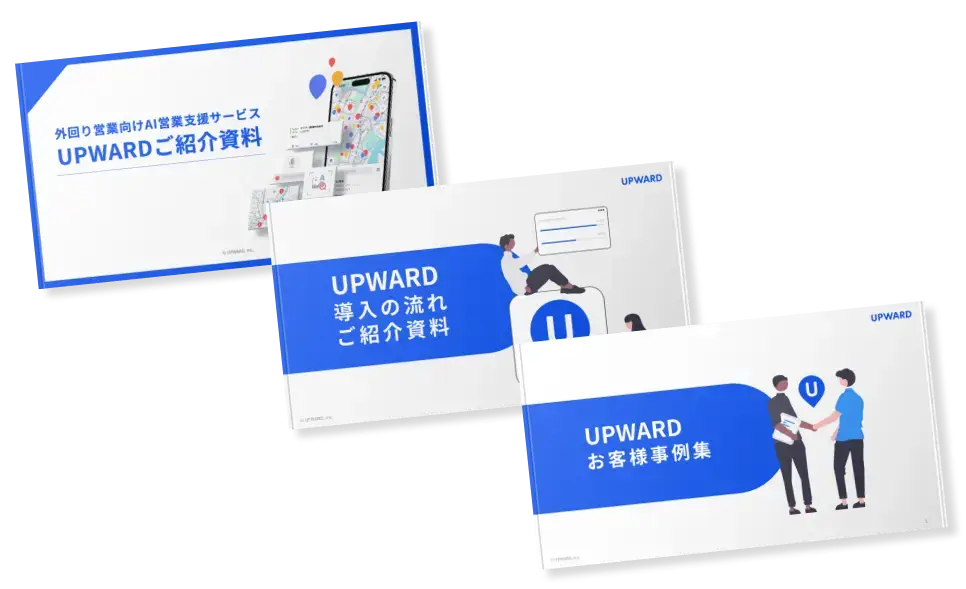
Download a free set of 3 documents