digital transformation | Explaining Challenges and Success Stories digital transformation | Featured Image
26
.
05
.
29

[2026] digital transformation in the digital transformation: An Overview of Challenges and Success Stories digital transformation

While digital transformation has traditionally been discussed in relation to the "2025 Cliff," the focus of the debate shifted significantly following the release of the Plan to Strengthen Regional Financial Capabilities by the Financial Services Agency in December 2025.

In this article, we provide a comprehensive overview of the context surrounding this policy shift, the structural challenges unfolding simultaneously across two key dimensions—internal organizational structures and the external environment—primarily within the financial industry’s sales operations; customer touchpoint key areas of focus, customer touchpoint; case studies from three companies—a regional bank, a credit guarantee provider, and an insurance company; and the evolution toward AI Transformation (AX), which will shape the next decade.

Table of Contents

What Is digital transformation?

digital transformation refers to efforts to redesign financial institutions’ operations and customer touchpoint using digital technology. It is a broad concept that goes beyond the mere implementation of systems to encompass the transformation of business processes and revenue structures.

Definition digital transformation

digital transformation defines digital transformation as “the transformation of products, services, and business models through the use of data and digital technologies.”

This is a broad concept that encompasses not only infrastructure upgrades such as core system modernization and going paperless, but also customer touchpoint and optimizing external relations activities.
Source: Ministry of Economy, Trade and Industry (METI) digital transformation

Policy Changes Surrounding digital transformation in the Financial Industry

digital transformation in digital transformation has centered on the "2025 Cliff"—the prediction that economic losses of up to 12 trillion yen will occur after 2025 if legacy systems are left unaddressed.

Now that we have moved past 2025, the focus of the discussion has shifted to the Plan to Strengthen Regional Financial Capabilities proposed by the Financial Services Agency. In other words, the emphasis of policy has shifted from defensive IT modernization to proactive efforts to enhance profitability and contribute to the local community.

The Shift from digital transformation to AX

Beyond digital transformation lies the phase of AI Transformation (AX), in which AI agents autonomously perform business operations. We are entering a stage where AI is taking over not only the digitization of CRM systems and daily reports, but also the optimization of client engagement activities, schedule planning, and daily reporting.

The Background of digital transformation in the digital transformation | Latest Trends for 2026

digital transformation entered a new phase with the "Plan to Strengthen Regional Financial Capabilities" announced by the Financial Services Agency in December digital transformation 2025. Another contributing factor is that regional banks’ core operating profits have begun to recover, creating an environment where they can now make proactive investments.

The Financial Services Agency's Vision for digital transformation in the Financial Industry

On December 19, 2025, the Financial Services Agency released its Plan to Strengthen Regional Financial Capabilities. Aimed at strengthening financial functions to support the sustainable growth of regional economies, the plan calls on regional financial institutions to restructure their business models and secure and develop talent.

The Financial Administration Policy for Fiscal Year 2025 also identifies strengthening the management foundations of regional financial institutions and customer-centric business operations as key priorities. There has been a clear shift in policy focus digital transformationdigital transformation that envisions co-creation with the regional economy.

Source>> Financial Services Agency, Plan to Strengthen Regional Financial Capabilities
Source>> Financial Services Agency, Financial Administration Policy for Fiscal Year 2025

The 21.7% increase in core operating profit at regional banks signals a shift in the earnings landscape

According to the National Association of Regional Banks’ fiscal 2024 financial results, core operating profit for its 62 member banks improved significantly, rising 21.7% year-on-year. This improvement was driven by a shift away from the prolonged low-interest-rate environment and an increase in the yield on loan portfolios.

Now that revenue has recovered, this is the perfect opportunity to ramp up digital transformation. The time has come to shift the focus of our investments from defensive cost-cutting to proactive revenue generation.

Source: National Association of Regional Banks, FY2024 Financial Results

Efforts to improve the quality of field sales activities are gaining momentum

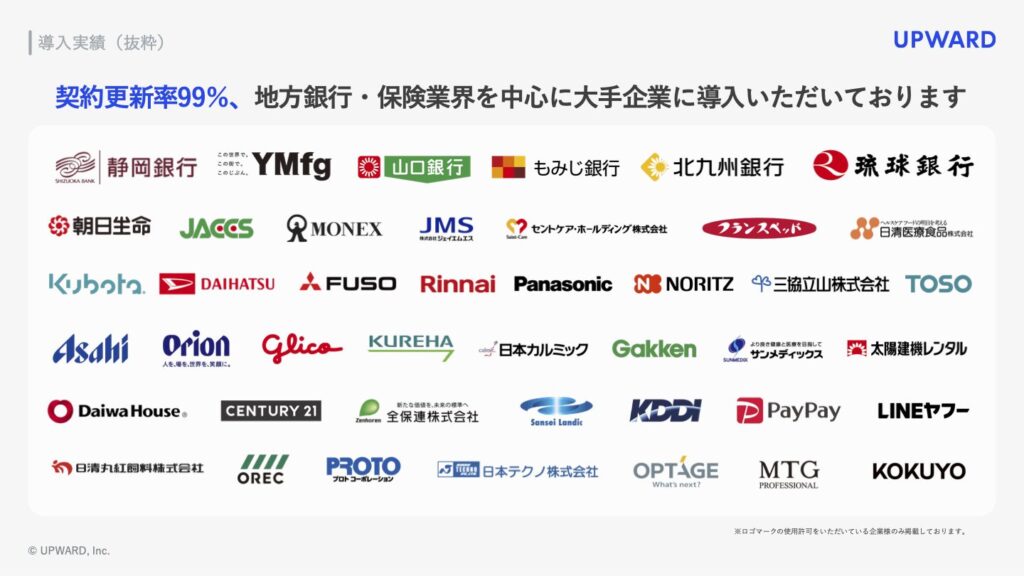
UPWARD, the provider of "UPWARD"—a sales support tool specialized for field sales—has announced that the tool is being adopted by a growing number of financial institutions, including regional banks, credit unions, insurance companies, and guarantee corporations.

Case Study Logos

It has been implemented primarily to improve customer touchpoint and has achieved significant results.

Related News>> Yamaguchi Financial Group Introduces "UPWARD," a Field Sales Support Service, to digital transformation in Sales

Three Structural Challenges Facing the Financial Industry

Challenges digital transformation in the financial industry’s digital transformation can be divided into two categories: the external environment (markets and customers) and internal structures (organization and systems). These challenges cannot be resolved through isolated, piecemeal solutions; rather, they require a structural approach that involves redesigning CRM systems and frontline operations.

[External Environment] Polarization of Regional Financial Institutions and Market Contraction

The gap in financial strength among regional financial institutions is widening rapidly. A clear disparity is emerging in their digital transformation between banks that are taking a proactive approach to investment and those that are adopting a defensive stance by downsizing their branches and staff.

Given the inevitable market contraction resulting from the declining population, we need to shift our operations to make the most of our limited customer touchpoints.

[Internal Structure] Legacy Systems and Data Dependent on Specific Individuals

It is not uncommon for core systems to have been in operation for decades, while customer information and activity data at the front lines remain reliant on paper, Excel spreadsheets, or individual management. Because data is not shared across the organization, headquarters and the front lines continue to lack a shared view of the customer.
As the “2025 Cliff” illustrates, digital transformation legacy systems is the greatest obstacle digital transformation. Centralizing the data infrastructure and establishing a system that frontline staff can use as a matter of course is the first hurdle digital transformation.

[Internal Structure] Increased Burden of External Relations Activities and Organizational Silos

Field representatives at regional financial institutions are often burdened with tasks ranging from selecting clients to visit, traveling to those locations, conducting meetings, and entering data upon returning to the office, leaving them with little time for their core business of developing proposals. At some credit unions, field representatives account for as much as 25% of the workforce, meaning their productivity has a direct impact on the institution’s bottom line.

Furthermore, the siloed structure separating sales, agencies, products, and administration hinders efforts to transform insights from the front lines into organizational knowledge. Driving improvements through a dual-pronged approach—combining digital infrastructure with on-the-ground operations—will benefit both the front lines and management.

As these challenges related to the external environment and internal systems occur simultaneously, we end up in a situation where digital transformation are increasingly lost. We need to reevaluate both our competitive strategy and our work practices.

Click here to view case studies and performance data on how UPWARD is used specifically in the insurance industry. We’ve also compiled before-and-after comparisons of the changes brought about digital transformation across the field, headquarters/management, and compliance departments.
Related Materials >> [With Case Studies] Download Case Studies on UPWARD in the Insurance Industry

Five Key Areas of digital transformation in the Financial Industry

digital transformation is advancing customer touchpoint key operational areas: digital transformation, customer touchpoint relationship management, daily reports, customer touchpoint. These are not standalone initiatives but rather work in tandem as part of a comprehensive roadmap to redesign the revenue structure of regional financial institutions.

Areas of FocusDepartment in ChargeExpected effects 
1. Centralization of customer data using CRMCorporate Planning DivisionImproving customer touchpoint on customer touchpoint touchpoints
2. Streamlining External Relations ActivitiesIT and Sales DivisionStreamlining Visits and Preventing Lost Opportunities
3. Automating Activity Reports and Daily ReportsBranch and Field ManagementReduced data entry time and faster decision-making
4. A qualitative transformation customer touchpointRetail and Insurance PlanningImproving LTV + Regulatory Compliance
5. Analysis and Utilization of Sales DataSales Planning and digital transformation InitiativesA Bridge to Data-Driven Management and Digital Transformation

Centralization of Customer Data via CRM

CRM is entering a phase where it is being redefined from a mere repository of customer information into a tool for generating revenue. By ensuring that all accumulated transaction histories, interaction records, and attribute data are entered completely and accurately, and by visualizing this data, we can align corporate policies with on-site decision-making on a single screen.

Streamlining external relations activities (selection of client visits and route optimization)

In many cases, companies track only the number of visits made by their staff, without being able to determine whether their outreach efforts are aligned with the size of their customer base or their customers’ expectations.

By systematizing the process of clearly categorizing customers, prioritizing visits to key accounts, and creating a plan to visit nearby prospects during downtime, you can significantly improve the efficiency of your sales activities.

By applying mathematical optimization to the selection of client sites and route planning, we can increase the number of productive meetings with the same staff.

For more details on how to streamline your sales visits, check out the article below.
Related Article >> Field Sales Visit Planning Guide: 5 Steps You Can Start Using Today

Automation of Activity Reports and Daily Reports

A persistent burden for branch staff is entering daily reports after returning to the office. Not only can this be done via smartphone, but by minimizing the workload involved, we can collect truly useful data.

For example, with UPWARD, the AI meeting note feature on your smartphone launches automatically when you arrive at a client’s location and closes automatically when you leave. The details of the meeting are then summarized according to your company’s templates and automatically synced to your CRM system, linked to the client’s location data. This is expected to reduce data entry time and speed up decision-making in the field.

Qualitative Transformation customer touchpoint (Improving LTV and Regulatory Compliance)

There is a growing need to shift from the traditional one-off sales model to a consultative sales approach focused on maximizing customer lifetime value (LTV). In corporate banking, evaluating business viability and supporting core business operations leads to success, while in retail banking, providing medium- to long-term proposals aligned with customers’ life plans yields results.

In the insurance industry in particular, it is crucial to establish mechanisms that balance maximizing customer lifetime value (LTV) with compliance with regulatory guidelines. AI integrated into the system suggests optimal timing for customer engagement, while the automation log supports the control log. Strengthening compliance to enable customer-centric sales is also an essential aspect digital transformation.

Analysis and Utilization of Sales Data (Bridging the Gap to AX)

This stage involves leveraging the data accumulated log for analysis, forecasting, and actionable insights. By using AI to automatically score priority customers and suggest next steps, we are moving away from a reliance on individual expertise.

The accumulation of data-driven decisions will serve as a bridge to the next phase of AI Transformation (AX). The quality and quantity of the data accumulated will become the foundational assets that determine competitiveness in the AX era.

Case Studies digital transformation in the digital transformation Industry | Three Companies: Regional Banks, Credit Guarantee Institutions, and Insurance Companies

digital transformation within the financial industry is yielding results regardless of business type or size. We will present concrete examples from three companies: Ryukyu Bank as a case digital transformation, Zenhoren digital transformation, and Premier as an example of initiatives by insurance agencies. In all three cases, reforms driven by frontline staff have led to positive results.

CompanyBusiness Type and SizeKey ChallengesKey Achievements 
Ryukyu BankRegional bank (1,001–5,000 employees)Reliance on individual sales representatives in field salesSales Visibility and Self-Driven Efficiency
All Japan Federation of Health Insurance SocietiesGuarantee Company · 301–1,000 employeesDelay in New Employee Onboarding · FISC ComplianceDouble-digit sales growth and new graduates ready to contribute immediately
PremiumInsurance · Up to 300 peopleCustomer Management and Route PlanningMore than 130% compared to last year (including effects other than UPWARD)

Ryukyu Bank | Visualizing CRM on Maps to Drive Organic Efficiency

This is the case of Ryukyu Bank, known as digital transformation. In their sales efforts targeting credit card merchants, the bank managed client and project information using Excel, which meant that staff had to return to the branch to check the data in order to understand the current status.

After implementing UPWARD, we visualized CRM data on maps, which led to greater efficiency in field sales. By making key customers and sales activities visible, field staff began to proactively suggest improvements, resulting in a significant change in the quality of their work.

Related Case Studies >> [UPWARD Case Study] | The Ryukyu Bank, Ltd. ★ Includes video interview

Zenhoren | Double-digit revenue growth and new graduates ready to contribute immediately thanks to the ability to focus on core business operations

For a long time, Zenhoren relied on paper maps and notebooks for manual record-keeping, which made the handover process difficult. The implementation of Salesforce enabled centralized information management. However, in response to requests from the field to continue viewing customer information on maps, the company adopted UPWARD. Since the system complies with FISC standards, the implementation was smooth and worry-free.

Revenue has continued to grow at a double-digit rate year after year, and new graduates in the recruitment department are quickly becoming productive members of the team. This is an example of how the implementation of a new system helped the company move away from a reliance on individual expertise, thereby becoming a driving force for organizational growth.

Related Case Studies >> [UPWARD Case Studies] | Zenhoren Co., Ltd.

Premium | 130% year-over-year growth; on-site reforms through paperless initiatives

Premier, a leader in the auto loan industry, manages 14,000 client companies across 14 locations with a staff of 60, resulting in each sales representative handling approximately 250 companies. Facing challenges with customer management, the company implemented Salesforce. Additionally, they faced the challenge of “trying to map routes by pinning a map to the wall, but struggling to create optimal routes.”

With the implementation of UPWARD, we are now able to efficiently manage activities such as "new business development," "account reactivation," and "contract collection." Administrators can also provide appropriate follow-up by gaining a comprehensive overview of the status of proposals to clients.

By eliminating waste and inconsistencies in route planning, visits, and travel, we’ve also improved the quality of our sales efforts. We now have more time to spend with customers, allowing us to focus on building trusting relationships with each and every one of them.

Related Case Studies >> [UPWARD Case Studies] | Premier Co., Ltd.

If you’d like to learn about use cases that can’t be shared online or how to apply our solutions to your company’s specific challenges, please feel free to contact us.
[A representative will contact you shortly] UPWARD Inquiry Form (Takes 1 minute to complete)

Click here to view case studies and performance data on how UPWARD is used specifically in the insurance industry. We’ve also compiled before-and-after comparisons of the changes brought about digital transformation across the field, headquarters/management, and compliance departments.
Related Materials >> [With Case Studies] Download Case Studies on UPWARD in the Insurance Industry

digital transformation to AX in the Financial Industry

The next phase digital transformation can be described as AX (AI Transformation), in which AI agents autonomously perform business operations. Here, we will outline digital transformation, as well as how they might be implemented in the financial industry.

What is AX (AI Transformation)?

AX (AI Transformation) refers to the phase in which AI agents autonomously execute and improve business processes. Gartner defines AI agents by three characteristics—learning, adaptation, and autonomy—and this is where they clearly differ from traditional automation.

Source>> Gartner | What Is an AI Agent?

Perspectivedigital transformationAX (AI Transformation) 
The main characterPeople + SystemsAI Agents + Humans
Objective.Digitization and Streamlining of Existing OperationsAutonomous Execution and Redesign of Business Processes
Examples from the Financial IndustryPaperless Application Forms and CRM ImplementationAutomated Optimization of External Relations Activities and Automated Activity Reporting
Performance indicatorsReduction in man-hours and costsRevenue Generation, LTV Improvement, and Self-Driven Improvement

An Overview of AX Implementation in the Financial Industry

In the financial industry, AX is implemented so that AI learns from the behavioral data of account managers and suggests the next client to visit, the content of the proposal, and the optimal timing. Combined with automated activity reporting, data is accumulated with zero input effort, and the AI agent drives a continuous improvement cycle.

For a comprehensive overview of sales AI agents, please see the following article:
Related Article >> What Are Sales AI Agents? | How to Choose Them and Use Cases by Type (2026 Edition)

Three Key Points for Advancing digital transformation in the Financial Industry

The three keys to successful digital transformation are a field-first approach, phased implementation, and a focus on AX.

First, start with the systems that field-level customer relations staff use on a daily basis; second, implement the CRM overhaul in phases rather than all at once; and third, make investment decisions with AX as the ultimate goal.

Given these three points, it is possible to develop a realistic plan that achieves both the enhanced profitability and effective utilization of human resources called for by the Regional Financial Strengthening Plan.

It is also important to establish relationships with vendors who meet the security requirements essential to the financial industry. We recommend starting by consulting with vendors who have a proven track record.

summary

digital transformationdigital transformation is evolving digital transformationdigital transformation to digital transformation centered on the Regional Financial Strength Enhancement Plan, and is now entering a phase of transition toward AX. Based on the five key areas of focus and case studies from three companies, identify your company’s priorities and proceed with investment decisions.

Furthermore, retaining talent and ensuring that young employees can contribute immediately are essential factors for the financial industry’s sustainable growth. By integrating log into the infrastructure for new employee training, we can transform the tacit knowledge of experienced staff into explicit knowledge. The fact that an industry or organization has advanced digital transformation is, in itself, a major draw for new graduates and job seekers.

At UPWARD, our specialists in the financial industry offer demonstrations and provide tailored proposals. If you’d like to have a quick conversation or simply hear more about what we offer, please feel free to contact us.

Frequently Asked Questions

Q: digital transformation of digital transformation regional banks digital transformation?

This approach is particularly effective for improving productivity in CRM and client relations. We recommend starting with a phased rollout of systems that frontline client relations staff use on a daily basis.

Q: What changes will the Financial Services Agency’s “Plan to Strengthen Regional Financial Capabilities” bring about?

The policy calls on regional financial institutions to restructure their business models with a view to co-creation with the local economy, as well as to secure and develop talent. The policy focus has shifted from defensive IT upgrades to proactive efforts to strengthen profitability and implement customer-centric business operations.

Q: What is the difference digital transformation and the "2025 Cliff"?

The "2025 Cliff" is a concept that highlights the risk of economic losses resulting from the neglect of legacy systems, and it served as an early driving force digital transformation. Currently, the focus of the discussion has shifted digital transformation centered on the Regional Financial Strengthening Plan.

Q: What is the difference between digital transformation AI transformation ( digital transformation ) in the digital transformation?

digital transformation refers to the digitization of existing operations and improvements in efficiency, while AX refers to the autonomous execution and redesign of operations using AI agents. In the financial industry, typical examples of AX implementations include the automated optimization of client engagement activities and the automation of activity reports.

Download a free set of 3 documents

A full overview of the benefits and best practices of the introduction of the system

Download a free set of 3 documents

If you have any questions, please feel free to contact us.

TEL: 03-6897-3683
*Open hours: 10:00-17:00 (except Saturdays, Sundays, national holidays, and year-end and New Year holidays)