IMPROVING CUSTOMER SATISFACTION IS ESSENTIAL FOR A COMPANY TO ACHIEVE SUSTAINABLE GROWTH. SO, WHAT KIND OF INITIATIVES SHOULD A COMPANY TAKE TO IMPROVE CUSTOMER SATISFACTION? THIS ARTICLE PROVIDES A WIDE RANGE OF EXPLANATIONS, FROM AN OVERVIEW OF CUSTOMER SATISFACTION (CS) TO SURVEY METHODS, MEASUREMENT INDICATORS, AND SPECIFIC EXAMPLES OF INITIATIVES TO INCREASE CUSTOMER SATISFACTION. WE HOPE YOU WILL FIND IT USEFUL.
What is Customer Satisfaction (CS)? Reasons why it should be improved and 6 concrete examples
Recommended Documents
-
SUCCESS STORIES OF COMPANIES THAT HAVE ACHIEVED RESULTS WITH UPWARD
Click here to download the document
Pickup Articles
Table of Contents
What is Customer Satisfaction (CS)?

Customer satisfaction is an abbreviation for Customer Satisfaction, also known as CS. Customer satisfaction is quantified by conducting surveys and interviews with existing customers to determine their level of satisfaction with the company's products and services.
Customer satisfaction survey figures are said to indicate the gap between the expectations people have before purchasing a product or service and the value it provides after purchase. Expectations of a product or service can vary from satisfaction with the product itself to the level of attentive support provided by customer support after the service, depending on the product or service. Customer satisfaction is an indicator that companies should track on a daily basis in order to achieve sustainable growth.
DIFFERENCE BETWEEN CS AND ES
Similar to CS is the term ES, which stands for Employee Satisfaction. Although they have different meanings, ES (Employee Satisfaction) must be improved in order to enhance CS (Customer Satisfaction). ES can be improved by creating an environment where employees feel comfortable and rewarded. In a good work environment, the quality of output is likely to improve, which in turn improves the quality of the company's products and services, creating a virtuous cycle of increased CS satisfaction.
FOUR REASONS TO IMPROVE CUSTOMER SATISFACTION (CS)
To increase repeat business
PRODUCTS AND SERVICES WITH HIGH CUSTOMER SATISFACTION WILL HAVE A HIGH REPEAT RATE. A HIGH RATE OF REPEAT BUSINESS INCREASES THE CUSTOMER'S LTV (CUSTOMER LIFETIME VALUE), WHICH IS A MAJOR BENEFIT FOR CORPORATE MANAGEMENT.
To increase customer loyalty
Customer loyalty refers to loyalty or attachment to a product or service. It is also an indicator of a longer-term perspective, even more so than customer satisfaction. When customer satisfaction is high, customer loyalty also tends to increase. Not only does higher customer loyalty lead to higher repeat business for the company's products and services, but customers themselves spread good word of mouth and reputation of the products and services, helping the company to acquire new customers.
To differentiate ourselves from our competitors
Increasing customer satisfaction differentiates your company from your competitors. If customer satisfaction with your products and services is higher than that of your competitors, they will continue to choose your products even when similar new products are introduced, and they will return to your products even if they once used other companies' products.
To acquire new customers & reduce costs
As mentioned above, when high customer satisfaction spreads as word of mouth and reputation on the Internet, customers who see that word of mouth and reputation are more likely to become new customers. This leads to a reduction in advertising costs previously required to acquire new customers. When advertising costs can be reduced, budget can be allocated to improving the added value of existing products and services and to research and development of new products and services, creating a positive cycle of business growth.
INDICATORS FOR MEASURING CUSTOMER SATISFACTION (CS)

C-SAT
A commonly used indicator in customer satisfaction surveys is the C-SAT (Customer Satisfaction / Customer Satisfaction). In Japanese, it is also called "customer satisfaction score. The measurement method is a visual survey using star ratings and point ratings for "satisfied," "normal," "unsatisfied," etc. The calculation method is based on the total number of responses to the survey. The calculation method is based on the number of "satisfied" responses divided by the total number of survey responses.
C-SAT(%)=TOTAL NUMBER OF QUESTIONNAIRES / NUMBER OF "SATISFIED" RESPONSES X 100
C-SAT IS THE EASIEST INDICATOR TO MEASURE FOR CUSTOMER SATISFACTION. HOWEVER, IT IS ALSO DIFFICULT TO CONDUCT OBJECTIVE CUSTOMER SATISFACTION SURVEYS BECAUSE USERS WHO ARE COOPERATIVE IN THEIR EVALUATIONS ARE ALREADY HIGHLY LOYAL TO PRODUCTS AND SERVICES.
LTV
LTV is an abbreviation for "Life Time Value," a marketing term that is translated in Japanese as "customer lifetime value. It refers to the total amount of money that one customer (one company) spends on the company's products or services throughout his or her lifetime, from the time he or she begins doing business with the company until the end of his or her business relationship with the company.
BY UNDERSTANDING LTV, IT BECOMES CLEAR HOW MUCH EACH CUSTOMER (EACH COMPANY) CONTRIBUTES TO THE COMPANY'S PROFITS. IT IS ALSO AN INDICATOR THAT INFLUENCES MARKETING STRATEGIES FROM A LONG-TERM PERSPECTIVE, SUCH AS IMPROVING CUSTOMER SATISFACTION AND STRENGTHENING LOYALTY.
The basic method of calculating LTV is to multiply the "average purchase price," "frequency of purchase," and "duration of continuous purchase" and subtract the cost.
The general LTV calculation method is as follows

LTV = (average purchase price x purchase frequency x duration of continuous purchase) - (new acquisition cost + purchase retention cost)
Related Articles>> 5 effective sales strategies, benefits and calculation methods to improve LTV
JSCI
JCSI stands for Japanese Customer Satisfaction Index. The JCSI indexes the degree to which customers are satisfied with the services of a company or brand over a certain period of time and a certain number of purchase experiences, and the causes and results of customer satisfaction using six indices. This enables multifaceted comparison and analysis of the reasons for satisfaction or dissatisfaction with the company's products and services, as well as subsequent behavior.
The six indicators are as follows.
-Customer Expectations
- Perceived Quality
- Perceived Value
- Customer Satisfaction
- Recommendation Intentions
- Loyalty
NPS®
NPS® stands for Net Promoter Score Net Promoter Score and is a measure of customer loyalty (trust and attachment to a product or service), NPS® asks customers who have purchased the company's product or service the question, "To what extent would you recommend this product (service) to your close friends? The 11 levels are categorized as "recommenders (9-10 points)," "neutrals (7-8 points)," and "critics (0-6 points).
The NPS® value is the result of subtracting the percentage of critics from the percentage of recommendations among all respondents.
The NPS is calculated as follows
Percentage of recommenders (%) - Percentage of critics (%)
FOR EXAMPLE, IF, OUT OF 10 RESPONDENTS, 5 (50%) WERE "9-10" RECOMMENDERS AND 4 (40%) WERE "0-6" CRITICS, THE NPS WOULD BE CALCULATED AS 50% - 40%, OR "10".
CES
CES stands for Customer Effort Score. It is also called "Customer Effort Score" in Japanese, and it quantifies the amount of effort required to solve a customer's problem. The less effort required, the higher the level of customer satisfaction. Therefore, a low CES value is considered high customer satisfaction. Unlike the aforementioned NPS® and C-SAT, the main feature of the CES is that it is calculated as a numerical value from the customer's critical perspective of the company's products and services.
THE CES MEASUREMENT METHOD IS A QUESTIONNAIRE THAT IS ADMINISTERED AFTER THE USE OF THE COMPANY'S PRODUCTS OR SERVICES, ASKING QUESTIONS SUCH AS "HOW MUCH EFFORT DID IT TAKE FOR YOU TO SOLVE THE 00 PROBLEM? HOW DIFFICULT DID YOU FIND IT TO USE THE 00 FUNCTION? THE QUESTIONNAIRE WILL INCLUDE SUCH QUESTIONS AS "IT WAS NOT DIFFICULT AT ALL" AND "IT WAS NOT DIFFICULT AT ALL". GENERALLY, THE ANSWERS ARE DIVIDED INTO 7-11 CATEGORIES, SUCH AS "NOT AT ALL DIFFICULT," "SOMEWHAT DIFFICULT," "VERY DIFFICULT," AND SO ON. FOR EXAMPLE, IF THE RESPONDENTS ARE ASKED TO ANSWER ON A 7-POINT SCALE, THE CES IS CALCULATED BY DIVIDING THE PERCENTAGE OF VOTES FOR THE TOP TWO ITEMS BY THE PERCENTAGE OF VOTES FOR THE BOTTOM THREE ITEMS.
CUSTOMER SATISFACTION (CS) SURVEY METHODOLOGY

questionnaire survey
The most common method of surveying customer satisfaction is through questionnaires. By surveying existing customers, customer satisfaction can be investigated. When conducting a survey, we recommend selecting a tool such as Google Forms that allows you to easily create survey questionnaires on the web. Not only is it easy to tally the results after the survey has been completed, but it can also be centrally managed in the cloud, making it easy for anyone in the company to check the results of customer satisfaction.
When creating a survey, it is recommended to consider the following points
Clarify the purpose of the survey
- Keep the questions simple
- Don't ask too many questions
- Design questions with customer satisfaction indicators in mind
- Allow anonymous responses
As a point, allowing anonymous responses makes it easier for customers to respond honestly about your products and services. The key point is that allowing anonymous responses makes it easier for customers to answer honestly about your products and services. For this reason, it is a good idea to set the name and e-mail address as optional input.
Internet survey
Customers tend to search for the names of products and services they are interested in before purchasing. Therefore, by using website analysis tools to understand the route of traffic to your website and the movement of visitors after accessing your website, you can easily grasp the demographic that is interested in your products and services.
public hearing investigation
Interviews with existing users of the company's products and services is another research method. By conducting interviews, you can hear valuable opinions that cannot be obtained through surveys. When conducting interviews, we prepare a hearing sheet in advance and share it with the client in advance so that the interview survey can proceed smoothly on the day of the hearing.
When conducting interviews, consider the following items while conducting interviews.
Good points and concerns after using the company's products and services
・Current problems and concerns you want to solve
・Functions and services you would like to have
Collection and analysis of statistical data
If you want to measure satisfaction with your products or services on a larger scale, one option is to hire a survey company. Although there is a cost involved, you will get more detailed data on a larger scale.
SIX SPECIFIC EXAMPLES OF HOW TO INCREASE CUSTOMER SATISFACTION (CS)

IMPLEMENT CUSTOMER RELATIONSHIP MANAGEMENT (CRM) TOOLS
CRM stands for "Customer Relationship Management" and is also called a customer relationship management system. By using CRM, you can determine "when," "what," and "how much" a customer has purchased from past sales data before visiting the customer, and check customer preferences and purchasing trends in detail. The customer's preferences and purchasing trends are checked in detail. In doing so, we also check for changes in sales trends and products that are selling well together.
The CRM system makes it easy and speedy to utilize this kind of data.
Related Articles>> [Latest in 2024] 14 Customer Relationship Management app(CRM)! Thorough explanation of free versions, selection points, etc.
IMPLEMENT SALES SUPPORT TOOLS (SFA)
SFA is an abbreviation for Sales Force Automation, which means "sales automation" or "a tool to support sales activities. It is also sometimes referred to as a sales support system. SFA enables log-storage and organization-wide sharing of a variety of information related to business negotiations with customers, such as customer management, case management, and forecast management. This enables the company to propose its own products and services at the best timing for customers, leading to improved customer satisfaction.
Related articles>> [2024] 10 recommended SFA (sales support) tools|A thorough explanation of their main functions and benefits!
Strengthening Customer Success Initiatives
Customer Success is a term that refers to all corporate activities that lead to the success of the company's customers.
It can also be translated as activities to help customers solve their problems through the products and services offered by the company. Customer Success efforts ensure that customers' issues are resolved through the use of the company's services, and as a result, customers continue to use the company's products and services for a long period of time. These results are the benefits of customer success. In recent years, many companies have established customer success departments to improve customer satisfaction with their products and services and increase repeat business.
Related Articles>> What is Customer Success? A thorough explanation of the difference between customer support and customer experience!
IMPROVE ES (EMPLOYEE SATISFACTION)
As mentioned earlier, improving employee satisfaction (ES) is also essential to increasing customer satisfaction; improving ES improves employee performance, which in turn leads to higher customer satisfaction. One way to increase employee satisfaction is to proactively implement productivity improvement initiatives.
Related Articles>> What is productivity improvement? 8 specific approaches and best practices are explained in detail!
Dynamic Pricing Settings
Dynamic pricing refers to adjusting the price of a product or service in response to fluctuations in demand for the product or service, rather than fixing the price of the service. For example, if you raise the price of a product when demand is high, sales are likely to increase because there are many buyers. In this case, if you keep the price the same as in standard times, you are far from increasing sales. In addition, fluctuating prices itself can be an opportunity to win the hearts and minds of customers, and from this perspective, dynamic pricing is one of the most effective ways to do so.
Pursuit of simplicity
BY PURSUING SIMPLICITY IN THEIR PRODUCTS AND SERVICES, USERS CAN USE THEIR PRODUCTS AND SERVICES WITHOUT STRESS. THE PURSUIT OF SIMPLICITY CAN BE ACHIEVED THROUGH A VARIETY OF EFFORTS, INCLUDING IMPROVING THE USER EXPERIENCE (UX) OF YOUR PRODUCTS AND SERVICES AND IMPROVING THE DESIGN OF YOUR WEBSITE'S NAVIGATION LINES.
Five Steps to Improving Customer Satisfaction

Clarify the definition of customer satisfaction.
FIRST, CLARIFY WHAT YOUR COMPANY'S DEFINITION OF CUSTOMER SATISFACTION IS. WITHOUT A CLEAR DEFINITION OF WHAT CONSTITUTES CUSTOMER SATISFACTION, IT IS DIFFICULT TO KNOW HOW TO IMPROVE CUSTOMER SATISFACTION. WITH A CLEAR DEFINITION OF CUSTOMER SATISFACTION, YOU WILL BE ABLE TO MAKE MORE EFFECTIVE USE OF SURVEYS AND INTERVIEWS. IT IS RECOMMENDED THAT THIS STEP BE USED TO DETERMINE WHICH CS MEASUREMENT INDICATORS TO USE.
Customer Satisfaction Survey
The next step is to conduct a customer satisfaction survey. It is a good idea to start by conducting a simple survey of existing customers. If you want to conduct a deeper satisfaction survey, we recommend conducting a hearing survey or hiring a survey company. Based on the results of the surveys and hearings, sort out what customer satisfaction expectations are being met and what issues need to be improved.
Organizing Hygiene and Motivational Factors
When conducting customer satisfaction surveys, it is also important to understand "hygiene factors" and "motivational factors.
Hygiene factors are those that decrease satisfaction if not satisfied, and those that do not increase satisfaction if satisfied. For example, "When I contact customer support, I am sent on a roundabout route and it takes a long time to resolve the issue," or "The product performance is not as good as I expected. In other words, the hygiene factor occurs when customer satisfaction is lower than expected.
Motivating factors, on the other hand, are factors that do not decrease satisfaction even if they are not satisfied, but increase satisfaction when they are satisfied. For example, "The customer support was courteous and provided generous support to help me achieve my company's goals," or "My business operations became more efficient than I expected. In other words, motivating factors occur when customer satisfaction exceeds customer expectations after using the company's products or services.
Each factor is closely linked to the other, and it is necessary to correctly understand both factors in order to increase customer satisfaction.
Set specific numerical targets
BASED ON THE ISSUES IDENTIFIED BY THE CUSTOMER SATISFACTION SURVEY, SPECIFIC NUMERICAL TARGETS ARE SET FOR IMPROVING CUSTOMER SATISFACTION. CUSTOMER SATISFACTION IS EASILY INFLUENCED BY HUMAN EMOTIONS AND IS DIFFICULT TO QUANTIFY. HOWEVER, IT IS EASIER TO IMPLEMENT THE PDCA CYCLE BY USING INDICATORS TO MEASURE CUSTOMER SATISFACTION AND INCORPORATING THEM INTO NUMERICAL TARGETS. FOR EXAMPLE, "TO ACHIEVE A C-SAT SCORE OF 30 POINTS.
PDCA CYCLE TO PROMOTE IMPROVEMENT
Customer satisfaction should not end with the implementation of the survey. Based on the figures from the survey results, implement initiatives to improve customer satisfaction and periodically verify their effectiveness. By regularly verifying the effectiveness of your efforts, you will be able to understand what effects your initiatives have had and what improvements are needed. Repeatedly verifying the effectiveness and revising the process will generate new insights and enable you to promote initiatives that lead to higher customer satisfaction with greater precision.
UPWARD" FOR CRM/SFA THAT LEADS TO IMPROVED CUSTOMER SATISFACTION
WE DEVELOP AND PROVIDE A SALES DIGITAL TRANSFORMATIONTOOL "UPWARD" THAT MAXIMIZES THE VALUE OF CRM/SFA FOR FIELD SALESPEOPLE. BY USING "UPWARD," CUSTOMER INFORMATION DATA SUCH AS CUSTOMER PROFILE INFORMATION, BUSINESS MEETING HISTORY, AND ACTIVITY REPORTS CAN BE SEMI-AUTOMATICALLY STORED IN A CUSTOMER-CENTRIC DATABASE CALLED CRM (CUSTOMER RELATIONSHIP MANAGEMENT) WITH A SINGLE SMARTPHONE. WHEN THE PERSON IN CHARGE IN THE FIELD CREATES A DAILY SALES REPORT OR ACTIVITY REPORT, NOT ONLY IS THE REPORT FORMAT AUTOMATICALLY CREATED ON "UPWARD", BUT ALSO VOICE INPUT AND BUSINESS CARD READING FUNCTIONS ENABLE EASY SALES REPORTING IN SPARE TIME.

The data entered on a daily basis is visualized on a map, allowing you to intuitively know which customers to visit next. Anyone can make strategic visits to the "places to go" instead of the usual "easy-to-get-to" places.
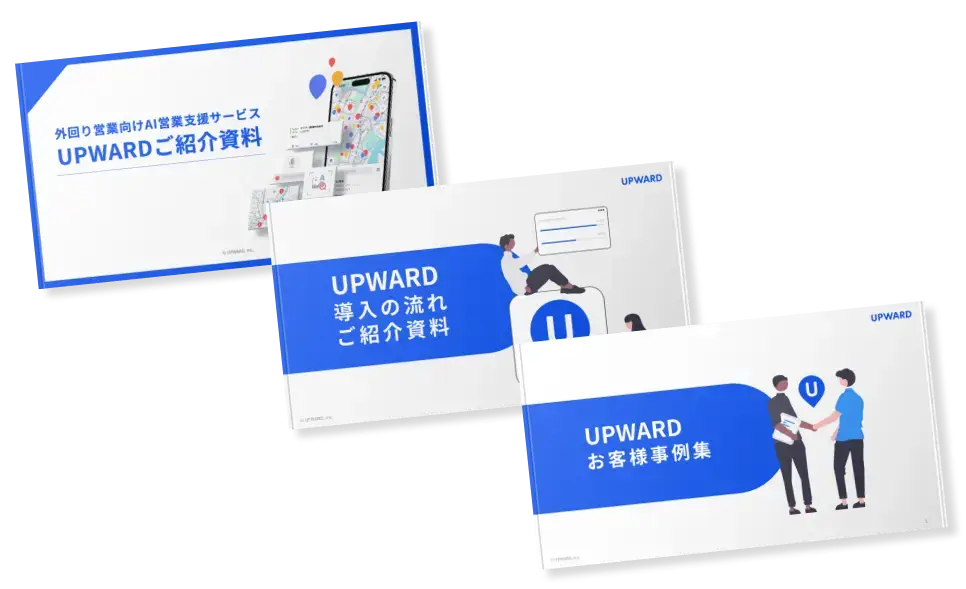
Click here to download the service introduction document of "UPWARD," a mobile CRM for outside sales and door-to-door sales
SUCCESSFUL CASE STUDY OF IMPROVING CUSTOMER SATISFACTION BY USING "UPWARD
Mitsumore Corporation
Mitsumore Corporation operates Mitsumore, a platform that matches service providers and clients for everyday problems such as moving and house cleaning. The platform requires daily communication with a large number of customers, and communication with each customer often crosses departments. Nevertheless, prior to the introduction of "UPWARD," each department managed their communication history individually, and the lack of sharing was a problem within the company. However, after the introduction of "UPWARD," the communication tools used by each department were linked to "UPWARD. The UPWARD system is now in operation as a storage location for the communication history with both businesses and clients that utilize Mitsumoa. By storing the large amount of communication that occurs daily on UPWARD, it is possible to extract the history in a batch when a problem occurs. This has resulted in fewer problems with customers due to overlooked communication history, leading to improved customer satisfaction.
Case Study>> Mitsumoa Corporation
Cook Deli Co.
CookDeli is a manufacturer of ready-to-eat meals mainly for senior care facilities. Cookdeli develops its products under the supervision of cookery researchers. Prior to implementing UPWARD, the company used Salesforce as a tool for sharing customer information. However, problems with customers were occurring due to insufficient data input. For example, when a customer made an inquiry to the customer center regarding a sales action, the lack of necessary information in Salesforce delayed the response to the customer and caused a sense of distrust. After the introduction of "UPWARD," customer and business meeting information can now be easily entered in data during spare time via "UPWARD's" mobile app. In addition, by answering phone calls to customers via "UPWARD," a screen for entering activity reports appears immediately after the call ends, successfully preventing information from being omitted.
Case Study>> Cookdeli, Inc.
Japan Media Systems, Inc.
Japan Media Systems, Inc. is a trading company specializing in telecommunications equipment and environmental products. Prior to the introduction of UPWARD, there were no rules on how to manage sales activity history, and each department possessed data in different ways. This made it difficult to share sales activity history among departments, and it took time to respond to inquiries from customers. However, after the introduction of "UPWARD," business activity history, contract details, and transaction history can now be checked all at once, reducing the time required for checking and enabling quicker responses, leading to improved customer satisfaction.
Related Articles>> Japan Media Systems, Inc.
Kubota Corporation
Kubota Corporation is engaged in the business of selling and maintaining agricultural machinery and providing farming management proposals to farmers throughout Japan. By introducing "UPWARD," the company has reduced the need to carry around thick map books and catalogs and to write information on printed maps for management purposes. Instead, customer information can be referenced based on the location information on "UPWARD's" app. As a result, when farmers suffer agricultural damage due to natural disasters that occur frequently these days, they can quickly share the damage situation with the entire company on "UPWARD" and follow up on restoration efforts, thereby realizing efforts to improve customer satisfaction.
Case Study>> Kubota Corporation
Miyazono Import Car Sales Co.
Miyazono Import Car Sales Co., Ltd. is an authorized Mercedes-Benz dealer that provides comprehensive services ranging from new car sales to maintenance and other after-sales services. Before introducing UPWARD, each sales representative was managing customer information on their own computer using Excel or paper-based data, making it difficult to refer to the information and making them "memory dependent. This made it difficult to conduct sales activities that were tailored to the customer's needs. However, with the introduction of "UPWARD," centralized management of customer information was realized. Sales activities can now be tailored to the needs of customers according to the timing of vehicle maintenance and replacement. This has increased the value of the customer experience and led to improved customer satisfaction.
Case Study>> Miyazono Import Car Sales Co.
summary
Improving customer satisfaction is not something that can be achieved by the efforts of only a few departments. The entire company must work together to sincerely address and improve all customer information, opinions, and complaints received through daily sales activities, in order to develop products and services that are loved by many customers. Let us aim to improve customer satisfaction by referring to the information presented in this issue.
A full overview of the benefits and best practices of the introduction of the system
Download a free set of 3 documents