26
.
04
.
22

CRM Security Guide: A Checklist for Selection and Strategies for Mitigating Risks

“Is it really safe to entrust our customer data—a corporate asset—to the cloud?” “What if a data breach were to occur? Wouldn’t the consequences be irreversible…?” When considering the implementation of a CRM (Customer Relationship Management) system, such concerns crossing your mind are proof that you are committed to protecting customer information responsibly. As digitalization advances, cyberattacks and internal fraud schemes are becoming increasingly sophisticated, so it’s only natural to feel a sense of unease.

However, security risks can be managed effectively if they are properly understood. In this article, we provide a comprehensive overview of the specific risks associated with CRM systems, the key points you must verify during the selection process, and how to meet financial institution-level standards.

Why CRM Systems Need Robust Security Measures

CRM contains critical business information, including customer purchase histories, sales processes, and sometimes even individual preferences. Protecting this data is no longer just a challenge for the sales or IT departments—it is a core business priority.

The Personal Information Protection Act and Legal Liability

Since the full implementation of the revised Personal Information Protection Act in 2022, companies’ responsibilities regarding the handling of information have increased dramatically. In the event of a serious data breach or similar incident, a corporation could face fines of up to 100 million yen. Furthermore, the risk of business suspension resulting from administrative guidance cannot be ignored, in addition to the obligation to pay damages to victims.

Reference: Act on the Protection of Personal Information, Article 184, Paragraph 1, Item 1

Damage to Corporate Brand and Social Reputation

Even more damaging than the financial loss is the collapse of the "brand" that has been built up over many years.

Once a company is labeled as having “sloppy information management,” it not only risks losing existing customers but also faces an extremely high barrier to acquiring new ones.

The Risks of Shadow IT Posed by "Hidden Customer Data"

In fact, it could be argued that the greatest vulnerability lies not in the CRM system itself, but in “individual management on the front lines.”

  • A pile of business cards on the desk
  • Excel files on your PC
  • Backing up to a personal USB flash drive

Data breaches caused by this “shadow IT” (the use of IT systems unknown to the company) continue to occur. Implementing a robust CRM system and centralizing data management serves as a defensive measure to eliminate these vulnerabilities in the workplace.

The Three Major Security Risks in CRM

Here’s a breakdown of the three major risks to watch out for when implementing CRM.

External cyberattacks (unauthorized access, malware)

Examples include attacks that exploit app and "ransomware," a type of malware that encrypts data and demands a ransom. This is particularly true for cloud services, which are constantly exposed to the internet, making the application of the latest patches and multi-layered defense essential.

Unauthorized disclosure of information due to internal misconduct

Surprisingly common are instances of data being taken out by employees planning to resign or by malicious insiders. It is crucial to determine whether the system can restrict or detect actions such as “copying data to a USB drive” or “exporting the entire list as a CSV file.”

Human error or poor management

These incidents are caused by human error, such as accidentally setting the visibility to "Everyone" or reusing the same username and password. No matter how advanced a system is, if the door is left unlocked, a thief can easily break in.

Standard security features that a CRM should have

Here are the essential features you should look for when choosing a secure CRM.

Function CategoriesOverview and Significance
Data EncryptionIs the data encrypted not only during transmission (SSL/TLS) but also when stored on the server?
Multi-factor authentication (MFA)Is there a way to require authentication using additional factors, such as app or email, in addition to a username and password?
Detailed permission managementCan you configure detailed settings regarding who can view, edit, or delete which areas?
Operation Log (Audit Log)Can we log every instance of "when," "who," and "which data" was accessed so that it can be traced later?
SLA and BackupsIs there a service level agreement (SLA) in place, and is there a system in place to recover data in the event of a disaster?

Certifications and Track Record for Evaluating the Security of Cloud CRM

Since you can’t gauge “reliability” just by looking at a list of features, use the following metrics to evaluate it.

International third-party certifications to obtain (ISMS, SOC 2, etc.)

Don’t be misled by the word “secure” on websites or in materials; instead, verify whether it has been certified by a third-party organization.

  • ISO 27001 (International Standard for Information Security Management Systems): An international standard for information security management.
  • SOC 2 Report: A more specialized audit report regarding a service provider’s internal controls. Vendors that maintain these reports can be said to have management systems of the highest standard.

A track record of successful implementations that speaks to our strong reputation

A key factor in making a decision is whether the solution has a proven track record of implementation in organizations with extremely strict security requirements, such as financial institutions, government agencies, and healthcare facilities.

[Essential Guide] Security Checklist for Selecting a CRM System

When considering implementation, please use this table to verify details with the vendor.

  • [ ] Is multi-factor authentication (MFA)provided as a standard feature?
  • [ ] Is it possible to restrict access based on the source IP address (restricting access from outside the company)?
  • [ ] Can data export permissions be finely controlled on a per-user basis?
  • [ ] Are operation logs retained for at least one year and can they be viewed or printed at any time?
  • [ ] Is the data backed up redundantly (stored at multiple locations)?
  • [ ] Do you have a strong track record of successful implementations in Japan, particularly with major corporations and financial institutions?

Safety recognized by financial institutions. "UPWARD"

If you’re looking to visualize your sales activities but are hesitant about managing critical customer information in the cloud, please consider implementing UPWARD.

A proven track record of successful implementations that meet stringent security standards

UPWARD boasts a proven track record of successful implementations in industries with extremely strict data handling requirements , such as the financial, insurance, and pharmaceutical sectors. The fact that major life insurance companies and financial institutions have adopted our solution speaks volumes about its high level of security.

Related Article>> "Structural Challenges" Hindering digital transformation in Regional Banks and Approaches to Solving Them | UPWARD

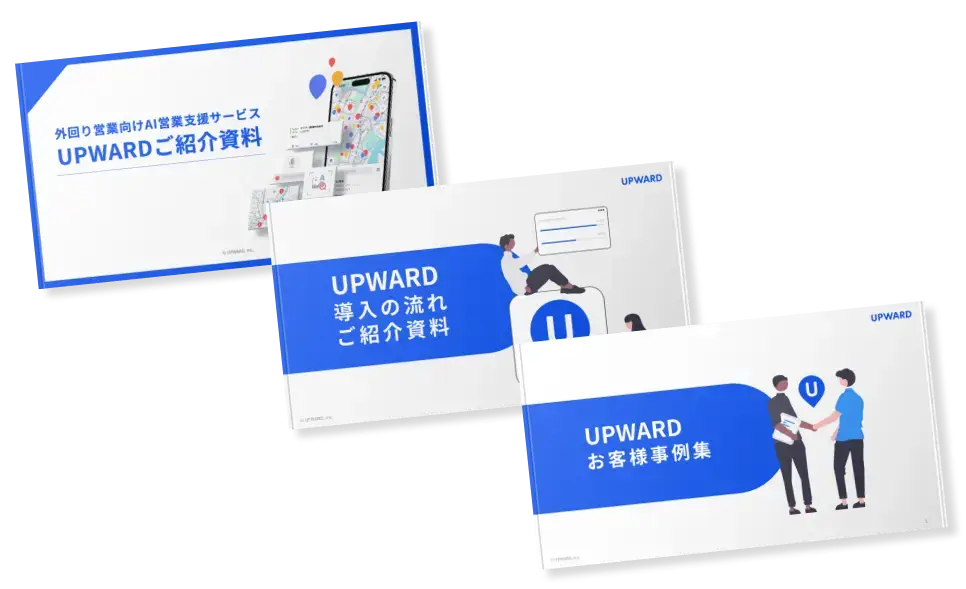
Download a free set of 3 documents

A full overview of the benefits and best practices of the introduction of the system

Download a free set of 3 documents

Frequently Asked Questions (FAQ)

Q: Is an on-premises (in-house server) solution more secure than the cloud?

A: It’s not that simple. Maintaining up-to-date protection against the latest vulnerabilities in-house involves enormous costs. In today’s world, major cloud service providers—which continuously update their world-class security measures 24 hours a day, 365 days a year—are often safer in the end.

Q: Won’t improving security make the system less user-friendly?

A: It’s true that the login process may become more cumbersome. However, by choosing tools designed to strengthen security while reducing the data entry burden on the front lines—such as UPWARD, which “automates reporting by leveraging location data and AI-generated meeting minutes”—it is possible to achieve both safety and efficiency.

If you would like to learn more about the specific specifications of UPWARD, please download the materials below.

Download a free set of 3 documents

A full overview of the benefits and best practices of the introduction of the system

Download a free set of 3 documents

summary

It is impossible to eliminate all risks associated with CRM implementation. However, it is possible to minimize them by selecting the right tools.

  • Does it include all the necessary features (encryption, logging, and access control)?
  • Have you obtained third-party certification (such as ISMS)?
  • Do you have a track record in industries with particularly strict standards, such as the financial sector?

Please use these criteria as a guide when making your selection. With UPWARD, which has a proven track record of successful implementations at numerous financial institutions, you can proceed with confidence.

Feel free to request a demo or request materials. Our representative can provide an overview of industry case studies in about 30 minutes.

Download a free set of 3 documents

A full overview of the benefits and best practices of the introduction of the system

Download a free set of 3 documents

If you have any questions, please feel free to contact us.

TEL: 03-6897-3683
*Open hours: 10:00-17:00 (except Saturdays, Sundays, national holidays, and year-end and New Year holidays)