24
.
12
.
18

WHAT IS SALESTECH? EXPLANATION OF TOOLS SUCH AS "CRM" AND "SFA" AND EXAMPLES OF THEIR USE!

WITH THE SPREAD OF THE INTERNET, IT TECHNOLOGY IS NOW USED IN ALL KINDS OF BUSINESSES. ESPECIALLY IN THE PERSONAL/HOME DOMAIN, TECHNOLOGY HAS BECOME VERY FAMILIAR, ESPECIALLY IN THE AREAS OF SMARTPHONE OWNERSHIP AND THE USE OF VARIOUS APP, CONNECTING TELEVISIONS TO THE INTERNET, AND USING CASHLESS PAYMENT SYSTEMS. SO WHAT ARE SOME OF THE TECHNOLOGIES THAT CAN BE USED IN THE REALM OF BUSINESS, ESPECIALLY SALES ORGANIZATIONS? IN THIS ARTICLE, WE WILL DISCUSS IT TECHNOLOGIES THAT ARE USEFUL FOR SALES ORGANIZATIONS, SUCH AS "CRM" AND "SFA," AND PROVIDE EXAMPLES OF ACTUAL APPLICATIONS.

What is SalesTech?

Sales Tech," which has begun to attract attention in recent years, is an indispensable method and tool for companies in the coming era. The term was coined by combining the words "sales" and "technology," and the market is rapidly expanding due to the spread of online conferencing and the trend toward greater work efficiency in reforming work styles.

(Chaos Map 2020 visualising sales tech, adapted from Interpark Corporation press release ).

Many companies may not be familiar with the term "sales tech," but may already be using online conferencing tools such as "Zoom," "Skype," and "Teams," as well as groupware such as "G Suite.
In this article, we will discuss "CRM (Customer Relationship Management System)" and "SFA (Sales Force Application)" as typical sales tech.

What is a 'customer relationship management system' (CRM)?

CRM is an abbreviation for "Customer Relationship Management," but in Japan it refers to a system for managing customers.
Specifically, CRM accumulates, centrally manages, and shares all kinds of customer information, including not only quantitative information such as customer age, location, past transaction history, number of website visits, and inquiry history, but also qualitative information such as customer needs, requests, opinions, and sometimes complaints.
Based on the managed information, we analyze the issues and requests of each customer according to their attributes, and provide services and products that meet the needs of each customer, thereby increasing their satisfaction. Raising the LTV (customer lifetime value) of each customer will ultimately lead to maximizing profits.
*LTV (customer lifetime value)...a projection of the value that a given customer will contribute to the overall future relationship for a company.

The strategy of analyzing customer information and providing services and products tailored to each individual customer is not a recent development. In the Edo period (1603-1868), there was already a customer ledger that contained information on customers, and business was conducted based on this ledger as a matter of course.
CRM is a modern version of this. Of course, today's IT technology allows for more sophisticated and accurate analysis, but the emphasis on customer relationships is the same in both cases.
The true purpose of CRM is not simply to maximize profits. Maximizing profit is only the result; it is the process that is important. This is what it means to place customer relationships, not products, at the center of your business.
A good relationship with customers will never be created by making phone calls in the dark, or by making sales dives without researching the customer's needs. Rather than trying to keep customers in the fold, it is important to think of customers as equal partners, so that CRM can be effectively utilized for the first time.

What is a 'sales force automation (SFA) system'?

SFA, often mentioned alongside CRM, is the acronym for Sales Force Automation. It reads "SFA. In Japanese, it is translated as "sales support system" or "sales management tool.
SFA is a system to support operations related to sales activities log, progress status, and management of customer information. It is one of the systems introduced to strengthen the company's sales organization, and its purpose is to provide thorough sales support through an IT system.
At the same time, the role of SFA is to "visualize" and manage the sales department members' negotiation processes and the progress of sales projects. Visualization" of sales activities can improve the productivity and efficiency of the sales department.
The difference between SFA and Excel is the ease of sharing information. However, SFA uses a common system to manage information, which facilitates information sharing and reporting.
If there is a difference in information and know-how among salespeople, sales activities will become more individualized. To improve such a situation, SFA is necessary to share information and know-how within the company. One of the roles of SFA is to improve the performance of the entire sales department.

What is the difference between a 'sales force automation (SFA) system' and a 'customer relationship management (CRM) system'?

The difference between SFA and CRM in a nutshell is as follows: SFA is "a tool to support sales activities (sales support system)"
CRM is "a tool to manage customers (customer relationship management system)"

In other words, SFA is a tool focused on the company's "sales activities," while CRM is a tool focused on the company's "customers. From the viewpoint that customers are created through daily sales activities, SFA can be described as a system that is more focused on the sales process by extracting some of the functions of CRM.
To explain in more detail, SFA is a management tool to centralize the company's sales activities, forecast daily meetings and sales, review the allocation of time spent on sales, and facilitate sales actions and activities.
CRM manages customers who contribute to sales and profits, and helps them to achieve results such as repeat purchases CRM is a customer-oriented management tool that expands the company's business performance by managing customers who contribute to sales and profits, leading to repeat purchases, high value purchases, and other results.
While the overarching goal of "increasing corporate performance" is the same, the application scenarios for each are different.
Related article>>What is the difference between CRM and SFA? Explanation of which one to choose based on differences in functions and roles

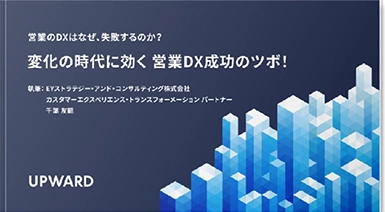
SALES THAT WORK IN TIMES OF CHANGE. DIGITAL TRANSFORMATIONPOINTS OF SUCCESS!

In times of shortage
How should sales organizations respond?

PDF (18 pages)

Success stories of companies that have actually used CRM/SFA

Here are some success stories of actual cases where SFA has improved the efficiency of case management, resulting in higher sales, an increase in the number of sales per day and a significant increase in the speed of work.

Daihatsu Motor Co.

Daihatsu Motor Co., Ltd. introduced "UPWARD" to improve the sales force of new salespeople who propose their company's nursing care vehicles. However, the introduction of "UPWARD" enabled us to visualize the market, and we realized a sales organization with high reproducibility.
In addition, the ability to share information on sales destinations with team members in real time has led to increased motivation for the entire team. Furthermore, by sharing the know-how of activities with team members, individual sales capabilities improved, and sales performance increased 5.5 times in just one year after the introduction of UPWARD.

(UPWARD Case Study: Daihatsu Motor Co.)

Asahi Field Marketing Corporation Success Stories

UPWARD" is being used in the rounder department for displaying the company's products to supermarkets and other retailers and creating sales floors.
Prior to the introduction of UPWARD, the company faced two issues: "smooth coordination between headquarters and rounders" and "efficient visitation. As a result of introducing "UPWARD," it became possible to create efficient visitation routes. In addition, instructions from headquarters can now be color-coded and marked on a map, enabling timely and clear instructions to be issued.
As a result, the company has been able to create attractive sales floors in accordance with instructions from headquarters. In addition, sales capabilities have been strengthened by the fact that headquarters is now able to monitor the status of each store via "UPWARD" and provide instructions to staff and answer questions.

(UPWARD Case study: Asahi Field Marketing, LTD.)

We have prepared materials that summarize the success stories and features of companies that have implemented SFA. (29 pages)
Download "UPWARD Customer Case Study" now

Conclusion

Amidst the changing work styles and labor shortages, the global trend toward digital transformation is expected to continue. Sales organizations, which until now have been managed mainly by paper and Excel, are no exception.
We recommend that you learn about the respective strengths of CRM and SFA as useful IT technologies for your sales organization, and consider implementing a sales tech that meets your company's challenges.
While there are a variety of CRM/SFA tools out there, we particularly recommend "UPWARD" as the first sales tech to be introduced.
UPWARD" can almost automatically standardize, formulate, and quantify salespeople's phone calls and field activities log. It is an SFA tool that has been very well received by the approximately 300 companies that have introduced it, mainly major corporations, for its easy data entry and easy-to-understand reports.
For details of "UPWARD" functions and case studies, please download the document. Please take a look.

Download a free set of 3 documents

A full overview of the benefits and best practices of the introduction of the system

Download a free set of 3 documents

If you have any questions, please feel free to contact us.

TEL: 03-6897-3683
*Open hours: 10:00-17:00 (except Saturdays, Sundays, national holidays, and year-end and New Year holidays)