field-sales-prospecting Featured Image
26
.
05
.
26

How to Find New Customers as a Field Sales Representative | 5 Steps to Boost Your Closing Rate Using ICP and Area Analysis

To achieve results in field sales, before you try to increase the number of visits, start by rethinking who you visit.

In this article, we outline a five-step framework for customer acquisition in field sales, covering everything from ICP definition to area analysis and visit scoring. Drawing on our experience providing specialized support for field workers, UPWARD shares insights into the challenges faced by field workers and the solutions we’ve developed to address them.

Common Mistakes in Customer Acquisition for Field Sales

In field sales, the accuracy of prospect selection—rather than the sheer number of prospects—is what determines productivity. Teams that focus solely on meeting volume targets tend to fall into a cycle where they continue to spend time on visits that do not lead to closed deals.

The causes can be summarized into three categories.

Cold calling focused on volume

The number of cold calls is often used as a performance metric because it makes it easy to quantify sales activity. However, this approach has a fundamental flaw. Unless sales representatives narrow down their targets, they will repeatedly experience rejection and continue working without increasing their chances of closing a deal.

While increasing the number of leads may temporarily boost your activity metrics, it does not improve your closing rate or conversion rate. Furthermore, it often leads to burnout across the entire organization, which frequently results in sales representatives leaving the company.

The Inefficiency of "Anyone Will Do" Targeting

Without clearly defined targets, you risk getting stuck in a cycle where you keep spending time on customers with a low probability of closing a deal. The cost of acquiring new customers is generally considered to be higher than that of engaging existing customers.

Visiting companies that do not match the "Ideal Customer Profile" (ICP) not only wastes time but also saps the motivation of the sales representative.

The problem of long travel times reducing time spent with customers

While route optimization is often used to reduce travel time, it is not enough on its own. The root of the problem lies in the stage of selecting which locations to visit.

As long as companies that don’t meet ICP criteria are included in the visit list, productivity won’t improve even if you take the shortest route. By reevaluating who to visit starting from the planning stage, you can simultaneously resolve the issue of travel time.

5 Steps to Finding Prospects for Field Sales

You can systematize customer acquisition for field sales in five steps. These steps are not independent tasks; rather, they form a chain where the accuracy of the previous step determines the quality of the next.

We’ll start with the foundational ICP definition and proceed in the following order: data analysis, area design, map utilization, and scoring.

Step 1: Define the ICP (Ideal Customer Profile)

An ICP is a profile that articulates the "ideal customer profile"—the type of customer for whom a company’s products and services deliver the greatest value. It is defined by combining factors such as industry, company size, geographic area, and challenges faced, tailored to the specific business . This concept is primarily used in B2B contexts to enhance the precision of targeting in sales and marketing activities.

As a basic template for defining ICPs, it is practical to narrow down the criteria using the three axes of "industry × company size × region."

For example, by specifying criteria such as “companies in the Tokyo metropolitan area with 50 to 300 employees in the manufacturing sector that have a field sales team,” you can significantly narrow down your list of potential prospects. The thought process of segmenting the market to select targets is structurally identical to the process of selecting prospects for field sales.

For more details on the relationship between ICP and 3C analysis, please see the following article:
Related Article >> 8 Sales Strategy Frameworks: How to Choose and Use Them Based on Your Objectives

Step 2: Identify winning patterns from existing customer data

The most reliable source of information for defining your ICP is your company’s own order history. Identifying the industries, company sizes, job titles of key contacts, and challenges faced by customers who have high retention rates or who converted into orders quickly serves as the starting point for developing a winning strategy.

It is effective to log stored in SFA or CRM systems to create a checklist of customer attributes that indicate a high probability of winning a deal. Examples of checklist items include industry code, number of employees, geographic area, number of contacts before the deal is formalized, and keywords identified during the initial needs assessment.

Teams that define their ICP based on an analysis of existing customers see an improvement in their deal conversion rates compared to teams that do not. This difference is likely due to the higher quality of prospects, which allows sales representatives to spend more time focusing on deal preparation.

Step 3: Set Priority Zones Using the Area × Industry Matrix

Once the ICP and winning strategies are clearly defined, the next step is to use a matrix combining geographic areas and industries to identify priority visit zones.

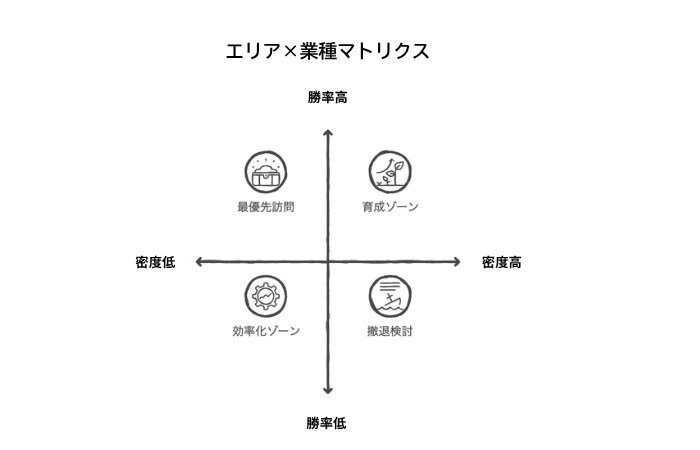
Plotting "order win rate by industry" on the vertical axis and "density of target customers within the area" on the horizontal axis creates a four-quadrant matrix.

The action guidelines for each quadrant are as follows.

Area × Industry Matrix
  • Quadrant 1 (High Win Rate, High Density): Top priority visit zone. Include as Tier A in the weekly visit plan.
  • Quadrant 2 (High Win Rate, Low Density): Development Zone. Include as a candidate for area expansion in the medium-term plan.
  • Quadrant 3 (Low Win Rate, High Density): Efficiency Zone. Change your approach or switch to inside sales.
  • Quadrant 4 (Low Win Rate, Low Density): Zone to Consider Withdrawal. Do not allocate staff resources to this area.

We update this matrix on a quarterly basis and reassess the quadrant classifications in response to changes in order data.

Step 4: Identify white spaces (high-potential customers who have not yet been visited) on the map

"White space" refers to companies or areas that match the ICP but have not been visited or have not been contacted for a long time. Areas surrounding zones where existing customers are concentrated often contain companies that match the ICP but have not been visited, making them priority candidates for prospecting.

It is effective to plot existing and prospective customers on a map to visually identify ICP-dense areas with low visit frequency. For example, when examining areas adjacent to commercial districts where existing customers are concentrated, you may find clusters of unvisited companies in the same industry.

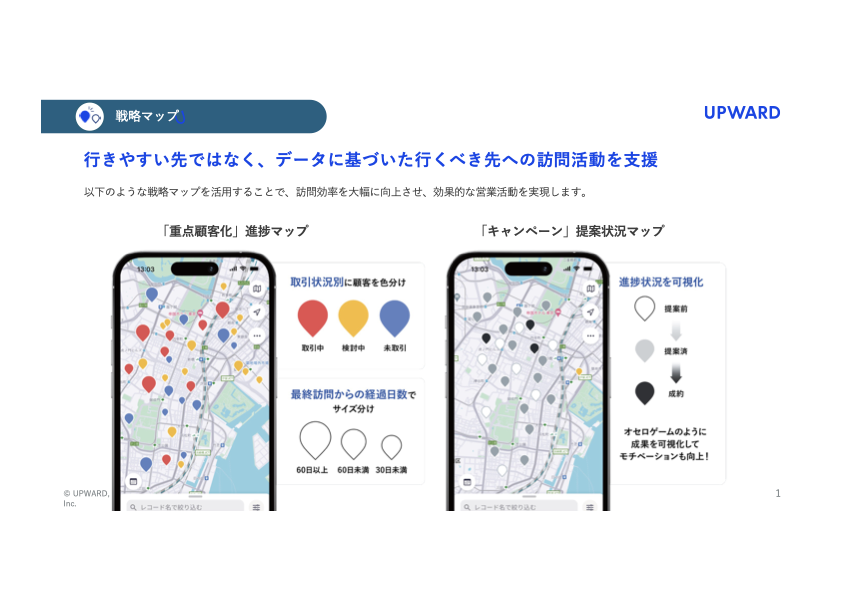
UPWARD, which utilizes a map-based UI, overlays customer data onto a map, allowing users to instantly identify previously untapped markets—which were previously analyzed during monthly regional meetings—the moment they open the map.
This enables managers to visually determine where sales resources are lacking, thereby eliminating both missed opportunities and delays in decision-making.

In fact, at Toyota Corolla Akita, we use a system where companies we haven’t visited yet are marked with yellow circles on a map, and the size of the circles increases based on the number of days that have passed since our last visit. This has allowed us to shift from sales activities that depended on “whim” to a more planned approach to new business development.

Related Case Studies >> Toyota Corolla Akita Co., Ltd. Case Study | A Complete Shift from Haphazard Cold Calling: Balancing "Offensive" and "Defensive" Sales Strategies log Map-Based Customer Visualization and log

Step 5: Classify visits into Tier A, B, or C based on their visit scores to determine the order of visits

Once you’ve identified white spaces, don’t visit all potential candidates equally; instead, prioritize them using a scoring system.

Examples of scoring criteria include ICP match (number of matches for industry, company size, and region), days since the last visit, frequency of contact, and whether there are any potential deals. Points are assigned to each criterion, and leads are classified into three tiers based on their total score.

By organizing accounts into three categories—Tier A (to be visited this week), Tier B (to be visited this month), and Tier C (to be visited this quarter)—it becomes easier for sales representatives to create weekly visit plans. The scoring sheet is updated monthly to reflect visit results and the progress of sales negotiations.

By regularly comparing the conversion rates for Tier A and Tier B, you can continuously improve the accuracy of your scoring.

For more details on customer management and route optimization for field sales, please see the following article:
Related Article >> Field Sales Visit Planning Guide: 5 Steps You Can Start Using Today

Download a free set of 3 documents

A full overview of the benefits and best practices of the introduction of the system

Download a free set of 3 documents

Common Pitfalls in Customer Acquisition and How to Overcome Them

The reasons why field salespeople struggle with customer acquisition can be boiled down to three main patterns. Each of these patterns shares a common structure: the more you strive for a perfect plan, the longer it takes to get started. The basic approach to addressing this is to “start small and refine as you go.”

The ICP definition is vague, making it impossible to narrow down the results

The most common pitfall is getting bogged down in trying to perfect the ICP definition. Once you start second-guessing the definitions of industry and company size, you won’t be able to move on to creating a list of potential prospects.

The solution is the minimum definition approach. Start by looking only at the top five companies that have placed orders in the last six months, and identify the common industries, company sizes, and geographic areas. Once these three elements are identified, they can serve as your initial ICP.

It’s more important to maintain an “iterative cycle of refinement” than to strive for a perfect ICP definition. Providing monthly feedback on visit results to the ICP and reviewing it quarterly will lead to greater accuracy.

There is insufficient existing data to identify patterns

If you’ve just launched a sales team or recently changed personnel, you may not have enough order data. Trying to strictly follow the winning pattern extraction process in Step 2 under these circumstances will lead to a dead end.

The approach involves setting a provisional ICP and updating it based on the results of your visits—a hypothesis-testing loop. If you don’t have order data, you should set your ICP by assuming the industries and company sizes most likely to face challenges that your product can solve.

log the results of each visit (whether it led to a sales opportunity, was put on hold, or is scheduled for a follow-up visit) log the SFA system, and update the data three months later by comparing the hypothetical ICP with the actual results.

If you set priorities, new business development tends to get put on the back burner

If we prioritize following up with existing Tier A and Tier B customers, we run into the problem that visits to new Tier C white spaces get put on the back burner. This is a scenario where sales representatives become overwhelmed with handling existing customers and are unable to set aside time for new business development.

The solution is to establish a weekly schedule for Tier C visits. For example, you can block off "every Wednesday morning" on the calendar as "reserved for Tier C visits" to ensure that other tasks don't fill that time slot.

By making regular visits to white space a habit, you can establish a system that ensures a continuous flow of leads into your pipeline.

Customer Prospecting Checklist

Phase-by-phase checks are an effective way to ensure consistent customer prospecting for field sales teams. Even if you design a five-step process, the accuracy of your prospecting will decline if the process becomes merely a formality. By establishing checklists for each phase, you can maintain consistent practices across the entire team.

Checklist for the ICP Definition Phase

We will review the following points to establish a system that ensures definitions are continuously updated.

  • Are the three criteria—industry, size, and region—clearly defined in writing?
  • Are you referring to the order data from the past six months, which serves as the basis for the definition?
  • Is the quarterly ICP review cycle marked on the team's calendar?

Checklist for the Area Analysis Phase

Check the following to ensure you keep track of unvisited zones.

  • Does the area-by-industry matrix reflect the latest order data?
  • Is the mapping of existing and prospective customers on the map kept up to date?
  • Do you conduct a monthly analysis of white space?

Checklist for the Ongoing Operation Phase

  • Are the Tier A/B/C classifications updated on a monthly basis?
  • Have weekly targets been set for the number of Tier C visits, and is the system set up so that managers can track progress?

We continuously improve scoring accuracy by verifying on a quarterly basis whether feedback from site visits is being incorporated into ICP updates.

For more details log daily log, please see the following article:
Related Article >> What Is a Daily Sales Report? A Complete Guide to Its Purpose, How to Write It, and Sample Templates [2026 Edition]

Automating Customer Acquisition Using Maps and SFA

When it comes to consistently implementing the 5-step process, the main hurdle many teams face is the "cost of maintaining the system."

If managers have to manually review ICP definitions, compile matrices, plot data on maps, and update scoring sheets every month, the time spent on these tasks alone can easily amount to several to over ten hours per month. As the number of staff members increases, this workload grows across the entire team, and before long, the system tends to become a "mechanism that was designed but has become a mere formality."

UPWARD solves this challenge in field sales with its map-based SFA. By overlaying customer data on a map, identifying untapped opportunities shifts from a time-consuming task during monthly meetings to something that can be done the moment you open the map.

Image of the UPWARD Strategy Map

By generating visit routes based on tier classifications, log post-visit log, and enabling two-way integration with Salesforce, we can ensure that the five-step process—which had previously become a mere formality due to operational burdens—continues to function as a standard procedure in the field.

In particular, the system includes standard features designed to address operational challenges specific to field sales—such as managers wanting to get an overview of each representative’s coverage but finding that SFA report aggregation takes too long, or the delay in entering visit results into the SFA system causing the list of “priority customers” to become out of sync with reality.

As an example of how young staff members are putting this to use in the field, there are cases where a game-like approach—turning unvisited locations (black) on the map into visited ones (white)—is being used to boost the motivation of new employees.

Related Case Studies >> Case Study : Sansei Landic Co ., Ltd . | Visualizing sales activity results fosters a sense of accomplishment. By displaying "must-visit" clients on a map, sales activity has increased significantly.

Download a free set of 3 documents

A full overview of the benefits and best practices of the introduction of the system

Download a free set of 3 documents

summary

When it comes to prospecting for new customers in field sales, accuracy matters more than quantity, and having a systematic approach is what makes or breaks your success. By rethinking how you plan your visits before chasing numbers, you can maximize results within your limited time with each client.

Here is a summary of the key points of the 5-step process.

  • ICP Definition: Create a minimum definition based on three criteria—industry, company size, and geographic area—and update it quarterly.
  • Area × Industry Matrix: Identifying Top-Priority Visit Zones by Multiplying Win Rate by Customer Density
  • Tier A/B/C Scoring: Determines visit order based on a combination of ICP match, contact frequency, and days since last visit
  • Uncovering White Spaces: Plot existing customers on a map to visually identify high-potential areas that haven’t been visited yet
  • Ongoing Operations: Ensure the system remains effective through monthly updates and weekly calendar blocks

Frequently Asked Questions

Q. How can I find new customers while out on sales calls?

Defining an ICP (Ideal Customer Profile) and using the common attributes of existing customers as a starting point to identify similar companies in the area that have not yet been visited is an effective approach.

First, we’ll start by analyzing the top five companies in terms of orders received over the past six months and identifying commonalities in their industries, sizes, and regions.

Q. What is the difference between a potential customer and a prospect?

Potential customers are companies that match the ICP but have not yet been contacted, while prospects are companies that have been contacted and have expressed an intention to purchase.

The basic process of customer acquisition involves identifying potential customers and nurturing them into prospects through engagement.

Q. How should I define ICP?

First, we’ll start by identifying the industries, company sizes, and regions common to the top five companies in terms of orders received over the past six months.

Once these three elements are in place, they will serve as your initial ICP. Rather than striving for a perfect definition, starting small and iterating based on visitor data will lead to greater accuracy.

Q. Is it more important to improve the accuracy of customer selection than to increase the number of visits?

To maximize results within a limited timeframe, the accuracy of selection is a more effective lever than the sheer number of cases.

Simply increasing the number of visits won’t improve your deal conversion rate if the quality of the prospects is low, so the first priority is to reevaluate who you’re targeting.

Q. What is white space? How is it used in sales?

"White space" refers to companies or areas that meet the ICP criteria but have not been visited or have not been engaged with for a long time. By plotting existing customers on a map, you can visually identify high-potential zones with low visit density.

In many cases, areas surrounding regions with a high concentration of existing customers are also home to a cluster of unvisited companies in the same industry and of similar size, making them ideal starting points for systematic new business development.

Download a free set of 3 documents

A full overview of the benefits and best practices of the introduction of the system

Download a free set of 3 documents

If you have any questions, please feel free to contact us.

TEL: 03-6897-3683
*Open hours: 10:00-17:00 (except Saturdays, Sundays, national holidays, and year-end and New Year holidays)