

Case Studies | Hanamaru Co., Ltd.

Building a Data-First Organization to Address Information Loss in Daily Reports and Drive Business Performance Improvement Through AI Adoption
Recommended Documents
-

SUCCESS STORIES OF COMPANIES THAT HAVE ACHIEVED RESULTS WITH UPWARD
Click here to download the document

Company Name
Type of industry
Business Scale
Problem
Areas of Application
Head Office Location
URL


-
results
- Improved Business Performance Due to an Increase in Unique Visitors
- Monetizing Field Activity Data
Table of Contents
Using Data to Mitigate the Risk of Customer Churn Caused by Individual Instincts
—Please tell us about your company’s business activities and challenges.
Mr. Kanda: Under the service name “Sokokara,” a used car buying and sales platform, we purchase used cars, accident-damaged vehicles, and vehicles with mechanical issues from both corporate clients and individual customers, and sell them both domestically and overseas. Our sales team visits new and used car dealerships, as well as body shops, repair shops, and leasing companies, to source vehicles.Since it is particularly difficult to predict when accident-damaged vehicles will become available, it is important to maintain relationships with customers—even during periods when there are no deals—so that they will think of us the moment such a situation arises. That said, visiting the same customers too frequently is not very effective. To ensure customers reach out to us when they need our services, it is important to visit at an appropriate pace.
Until now, we’ve mostly relied on cold-calling sales tactics, such as “roller campaigns.” While this approach sometimes yields results, it lacks consistency. Sales representatives also tended to focus their visits on places where they felt comfortable talking, which meant they sometimes failed to follow up at the optimal time. As a result, “gaps”—areas or periods where no one visited—would emerge, and during those times, deals would sometimes slip away to our competitors.
"Car Buyback Sokokara": https://www.hanamaru870.net/

—What did you think was needed to make improvements?
Mr. Kanda: Collecting and accumulating data on field activities.To avoid gaps, we need to move away from inefficient fieldwork—where we go out without a plan and rely on intuition for cold calls—and instead adopt a strategic and efficient approach. This involves using data to determine the optimal timing for visits and the appropriate decision-makers to meet, and then scheduling accordingly. To achieve this, it is essential to collect and accumulate activity data from the sales field—such as when visits took place, who was met, and what was discussed.
In terms of data collection, we had daily reports, but in a busy environment where employees make about 10 field visits per day, it was difficult to submit them every day without any omissions, and the content varied from person to person. Therefore, we needed a system to collect and store data as an organization.

A system for increasing the number of qualified visits: transforming daily reports—which generally become little more than a formality in over 50% of cases—into “sales territory data” that drives results
—Given that situation, why did you decide to implement “UPWARD”?
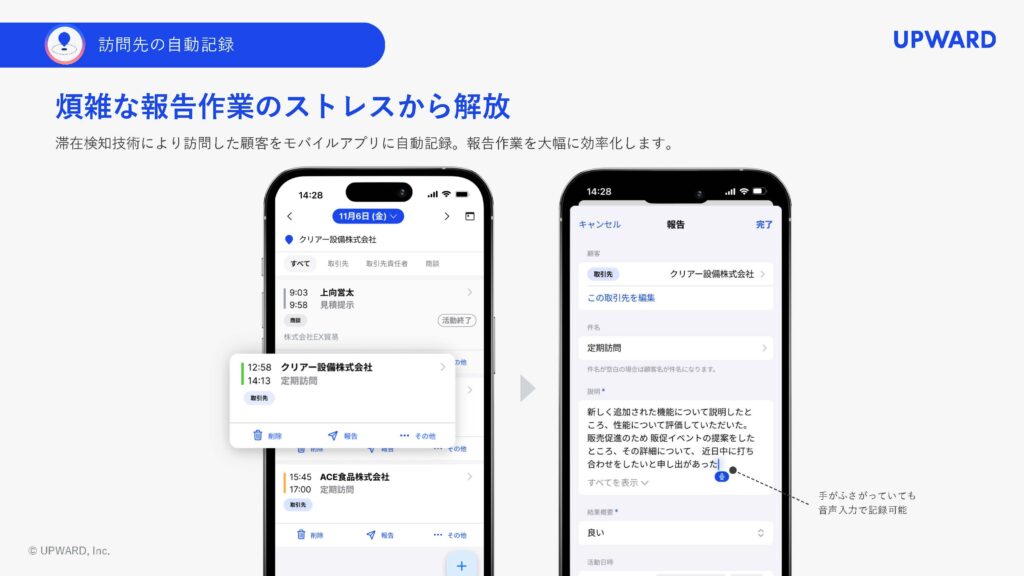
Mr. Kanda: We believed that by using mobile location data to automatically generate draft daily reports that reflect the locations visited and the times spent there, we could reduce the data entry burden on our sales team while collecting more detailed field data. Another appealing feature was the ability to integrate with Salesforce—which we had already been using—and reliably store the collected data.
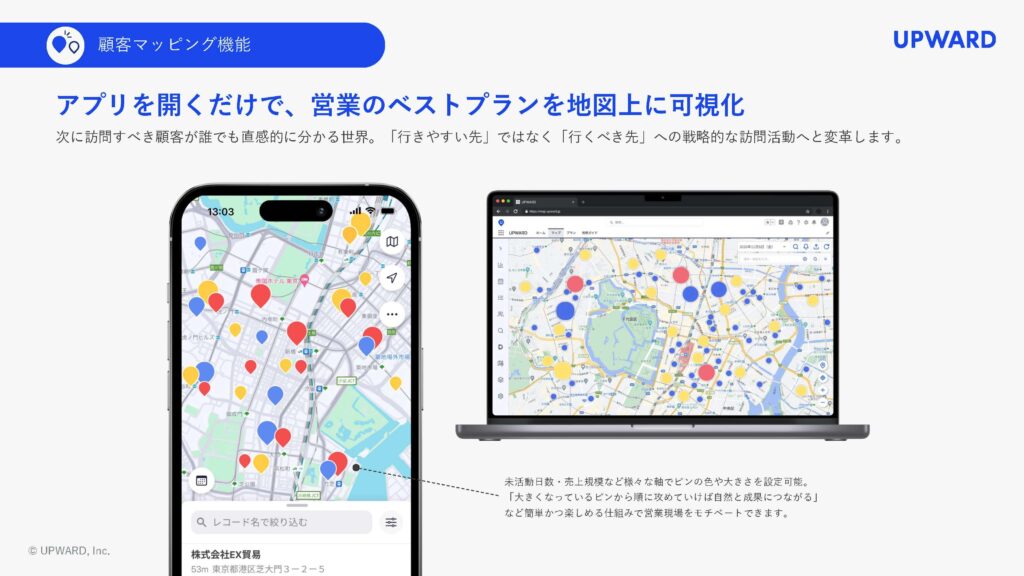
app had previously app map-based app to check the locations of clients I was visiting, but updating the information was time-consuming, and the app didn’t display a wide range of data. With “UPWARD,” information such as the date of the last visit and transaction history is displayed on the map in real time, making it easier to identify where I should go next. One of my goals was to use this to increase the number of productive visits.
—How are you using “UPWARD”?
Mr. Kanda: First, we plan our visit schedules. We select locations by referring to a map and considering factors such as their relative positions and the last scheduled visit date. We also make use of daily reports. By filling out a draft of the daily report and submitting it immediately after each visit, we’ve been able to collect highly accurate data that meets our expectations. Since the map is easy to view even on a mobile device while out in the field, if a visit finishes early, it’s easy to make “stop-by visits” to nearby locations, which helps increase the total number of visits.
—What strategies do you use to ensure staff retention on the job?
Mr. Kanda: Since app before, there wasn’t much resistance from the field staff. However, we aimed to establish an operational system that would allow us to improve the quality of field data more easily while making reporting less time-consuming. Specifically, we set it up so that field staff could select and enter activity types from a list of options, such as “Greetings,” “Proposals,” and “Business Meetings.” While it’s possible to include detailed information, by making it easy to enter even just the minimum required information, I believe we’ve established a system that allows for the smooth collection of field data.
"Clear visit criteria" derived from data are the key to improving business performance
—What changes and improvements have you noticed as a manager?
Mr. Kanda: As we’ve accumulated more data, we’ve been able to visualize metrics such as coverage area, transaction history, and the number of days since the last visit. By combining these factors, we’ve been able to establish clear criteria for prioritizing visits.
As a result, I get the impression that the number of productive visits has also increased. In fact, our business performance has improved, and both our sales team and the number of client visits have grown. Furthermore, since we’re now able to collect highly accurate data—such as the number of sales activities and the geographic areas of client visits—we’ve been able to make better use of our analytics tools.
—How has your attitude toward data changed?
Mr. Kanda: I feel there is a growing awareness that sales data is a company asset. In the past, sales data was viewed as “individual records” in the form of paper daily reports, but now there is a shared understanding that it is “essential for the company,” and the cycle of data collection and utilization is beginning to run smoothly.
With a View to Utilizing AI, Moving Toward a More Data-First Organization
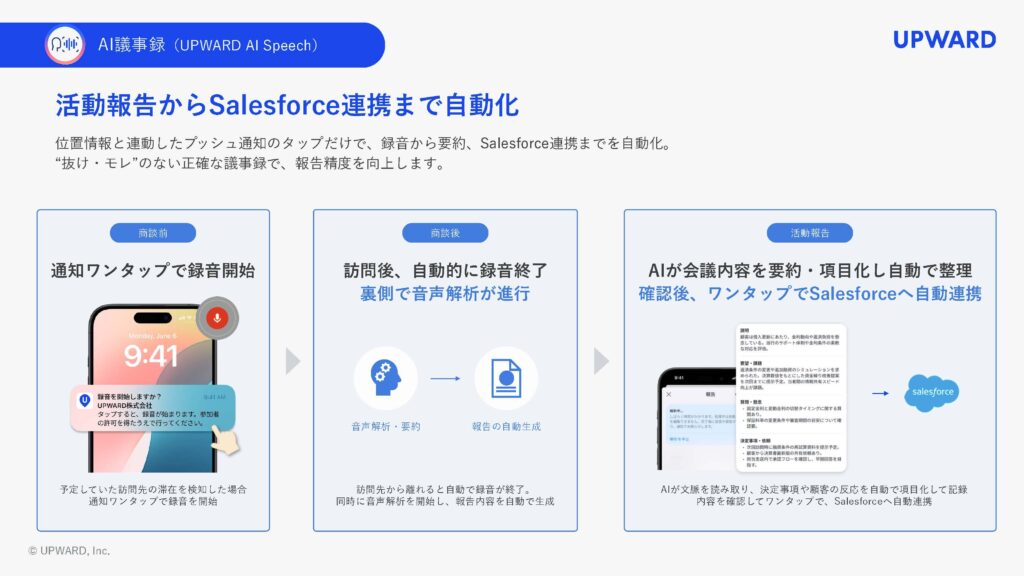
Mr. Kanda: The volume of data we’re collecting has been steadily increasing. However, when we look closely at the content, there are inconsistencies in quality—for example, something labeled as a “proposal” in a report might actually be just a “greeting.” Going forward, we want to improve these quality aspects. The ideal system would be one where sales reps simply keep their mobile devices in their pockets, and all their daily activity data is automatically collected in its entirety. In that regard, we have high hopes for “UPWARD’s” AI meeting minutes.It uses AI to organize and summarize the content of conversations. If the AI can automatically and objectively categorize items such as proposals and sales meetings, the accuracy of the data will improve, making it usable as a basis for decision-making. When that happens, I believe it will also become easier for managers to provide advice and follow-up support.
These days, convenient services are emerging one after another, and our sales team is exposed to this kind of information on a daily basis. Naturally, this leads to requests from the field asking, “Can’t we make this even more convenient?” As we address these requests and actively leverage AI, we will continue to strive to become an “organization that makes data-driven decisions.”








A full overview of the benefits and best practices of the introduction of the system
Download a free set of 3 documents