

Case Studies|Akira Co., Ltd.
Sales activities doubled through efficient visits enabled by information sharing Sales digital transformation underpinned record-high sales
Recommended Documents
-

SUCCESS STORIES OF COMPANIES THAT HAVE ACHIEVED RESULTS WITH UPWARD
Click here to download the document

Company Name
Type of industry
Business Scale
Problem
Areas of Application
Head Office Location
URL

-
results
- All sales personnel achieved their performance targets, setting a new record for highest sales ever.
- Sharing information doubled the number of activities
Table of Contents
―Please tell me about your company's business activities.
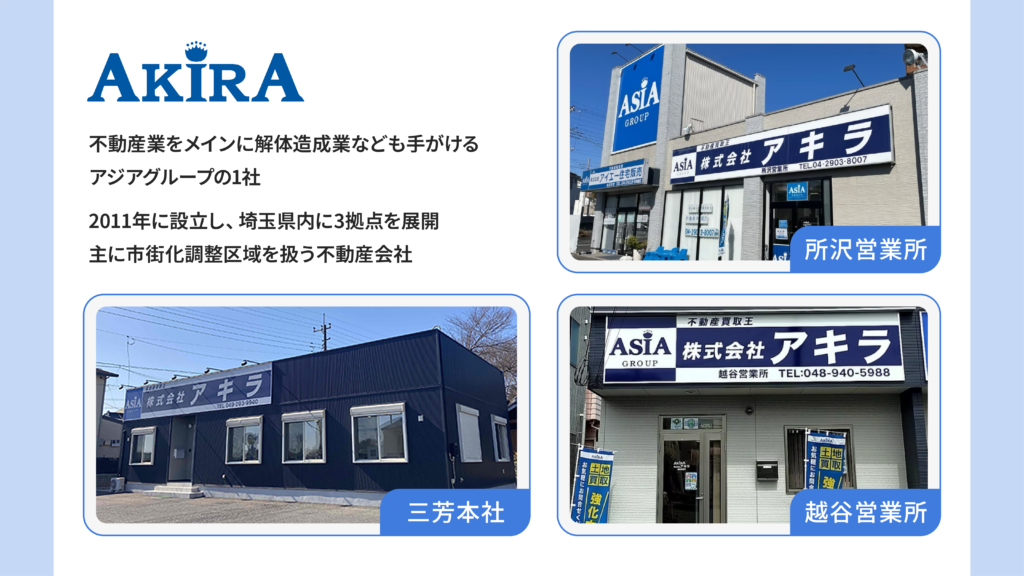
Mr. Takayanagi: We operate three offices within Saitama Prefecture. In addition to general real estate transactions, we specialize in the sale and purchase of agricultural land, forests, and other properties within " Urbanization Control Zones, " as well as land utilization.
Handling urbanization control zones requires advanced expertise. Particularly when selling farmland, complex conversion permits and development approvals are often required, making it difficult for many real estate companies to handle such transactions. In recent years, many landowners have been struggling with land utilization due to a lack of successors.
Drawing on years of experience and proven results, we work to create new value for land from multiple perspectives—not only through residential development but also by repurposing sites for material storage yards and business operations. We strive daily to maximize the value of land lying dormant in our communities, serving as a bridge to connect it to the next generation.
※Urbanization Control Zone... Areas where urbanization should be restrained. Development activities are permitted only when there is a special necessity to allow them, such as activities that do not risk promoting urbanization, or facilities necessary for the healthy daily lives of residents already living in the surrounding areas.
Source: https://www.toshiseibi.metro.tokyo.lg.jp/bosai/takuzou/pdf/tohsikisei_tebiki_04.pdf
―Please tell me about your sales approach.
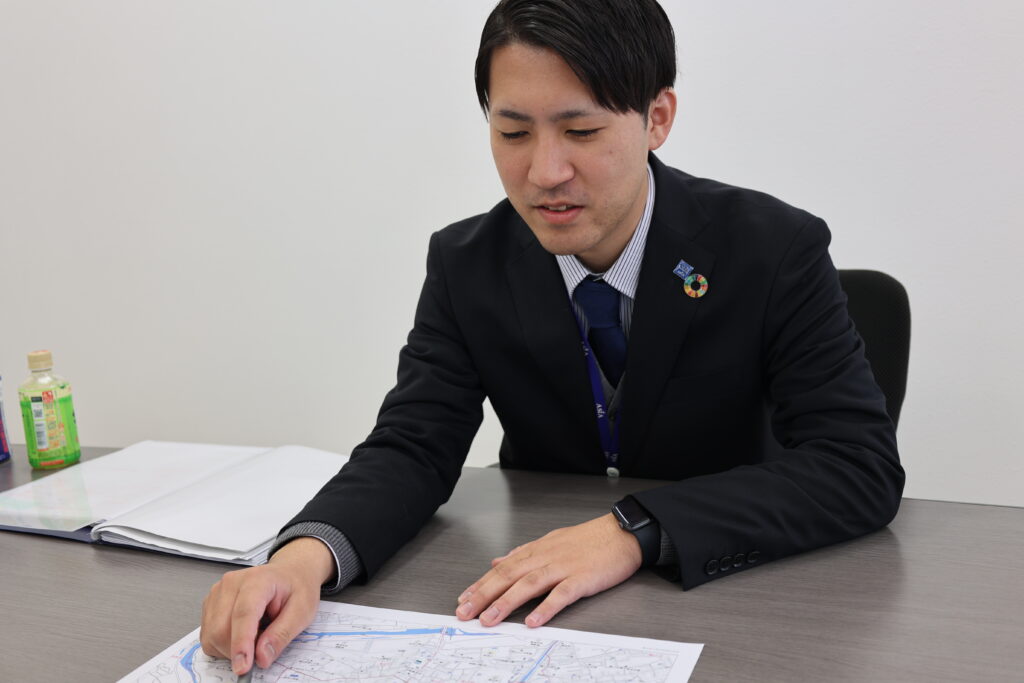
Mr. Umezawa: Our sales activities are primarily field-based. Every day, we walk the streets of the community, personally inspecting every corner of the land with our own eyes. That's where our work begins.
We trace property records and visit landowners directly. On busy days, it's not uncommon to visit around 20 properties. Sometimes we send a letter in advance before visiting, while other times our relationship begins through an introduction.
Procedures related to urbanization control zones take considerable time, and in the case of farmland, the size of land that can be sold at one time may be restricted by the municipality. In such cases, the land is sold off in stages, so we develop long-term relationships with many landowners, making continuous and careful communication essential.
Trigger digital transformation: Eliminating the personalization of information
―What were the challenges before implementing "UPWARD"?
Mr. Takayanagi: Before implementation, land survey data and customer information were often managed individually by each responsible staff member. This led to the challenge of "personalization of information," where valuable insights remained confined to individuals. The relationships with landowners cultivated over many years and the detailed history of each property are vital assets for the company. We wanted to establish a system where these assets could be shared and passed down across the entire organization, rather than relying on individual management. This way, even when personnel change, we can deliver consistent peace of mind.
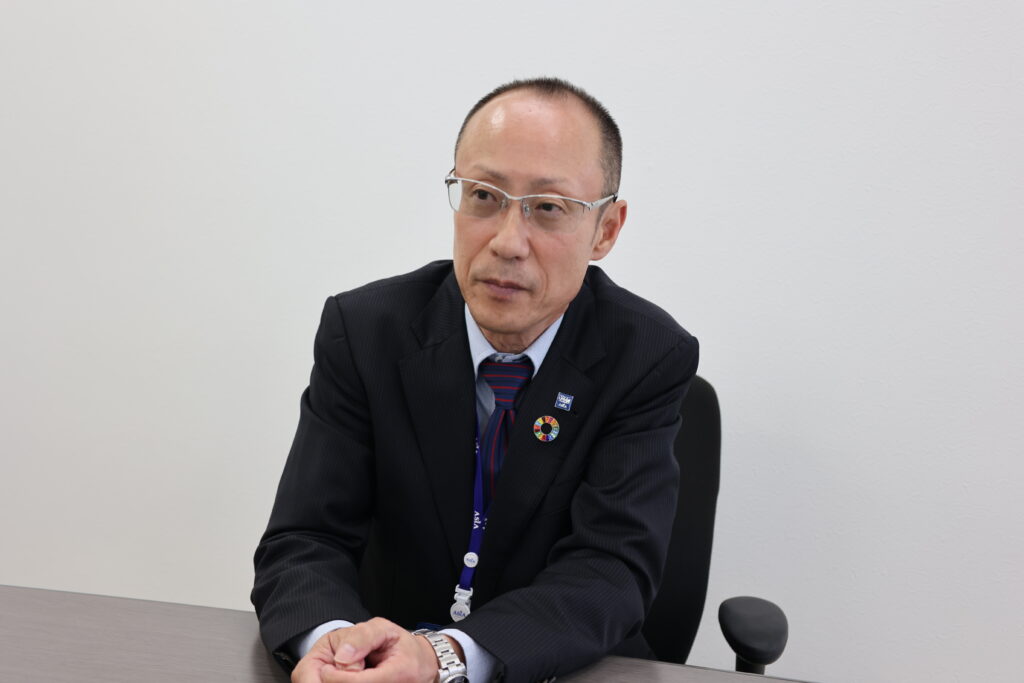
Mr. Umezawa: Furthermore, information about lost deals was not shared, and there was no system in place to learn from past failures. Lack of coordination between sales representatives led to unnecessary re-approaches, reducing sales efficiency.
Mr. Takayanagi: Furthermore, due to insufficient sharing of survey information, duplicate property surveys were conducted for the same cases, resulting in unnecessary man-hours and costs. Optimizing these operational costs also became an urgent priority.
―Please tell me the background for the introduction.
Mr. Umezawa: Until now, there was no concept of systematically managing information; operations were essentially conducted based on custom. It was within this context that discovering "UPWARD" digital transformation became the catalyst for initiating our consideration.
Given the nature of our industry, land parcel numbers are essential for obtaining registration information, making Zenrin's Blue Map indispensable for daily operations. The ability to integrate this Blue Map with our company's sales data proved highly compatible with our workflow.
From "worried about whether I can master it" to "a tool I take for granted"
―Were there any concerns about the introduction?
Umezawa: While the ability to check various information on the map was very appealing, within the company, there were differences in individual understanding and familiarity with IT tools. Honestly, there was some anxiety about whether we could actually master it.
We also didn't have a dedicated IT staff member, and I was concerned about how much of our operations—which had been managed on paper up until now—could actually be transitioned to digital.
―How did you address the concerns?
Umezawa: During the initial setup phase, we were very conscious of "not making it too complex." Since our organization has a wide range of ages and experience levels, if people found it difficult to operate, it wouldn't catch on. On the other hand, there was the challenge that if we limited the available functions too much, it wouldn't lead to operational improvements.
Therefore, we gathered requests and opinions from a wide range of people, from management to frontline members. From these, we carefully discerned what was truly necessary, selecting and discarding features and items one by one.
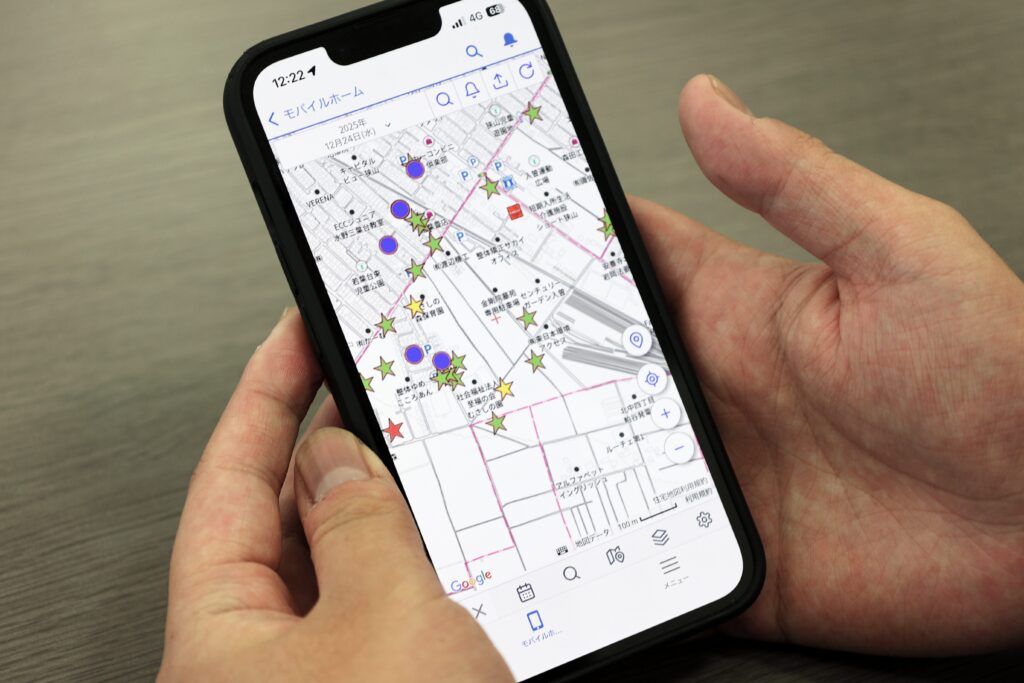
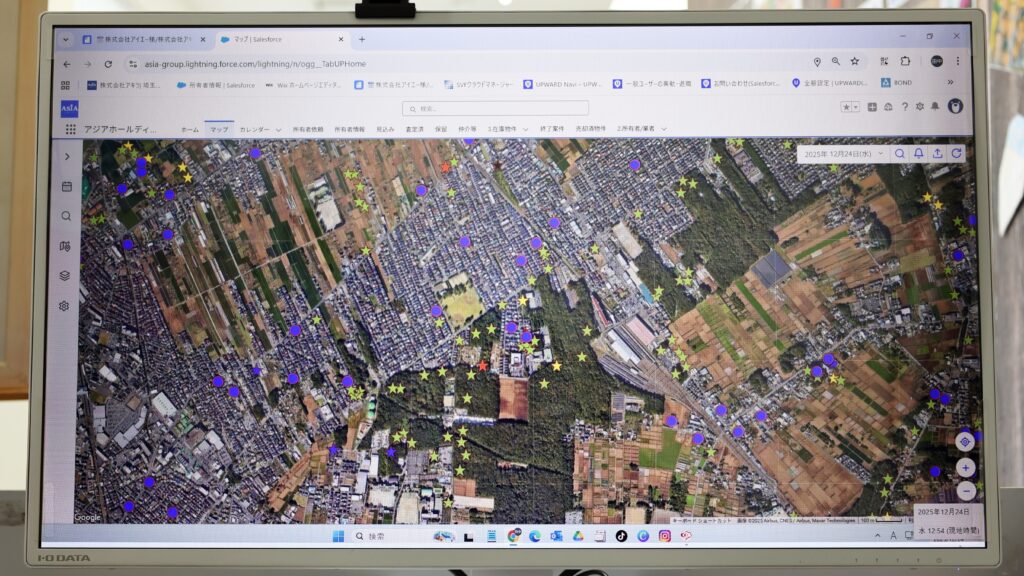
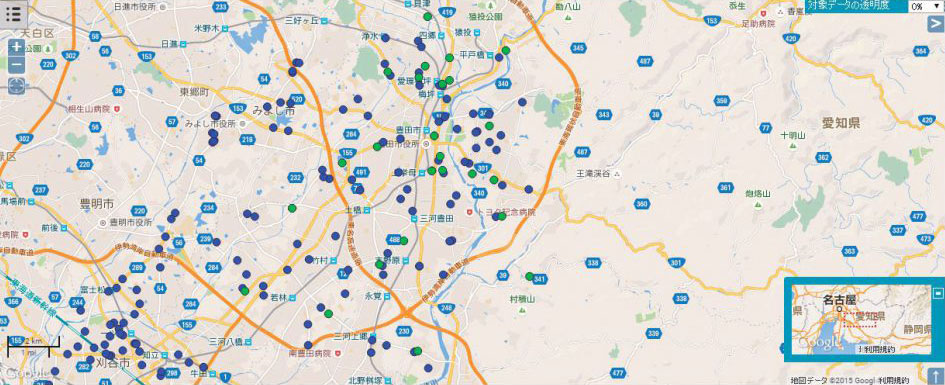
Mr. Tanaka: Specifically, we considered the feature allowing users to mark properties on the map via smartphone to be essential, so we decided to prioritize its thorough implementation first. By color-coding the marks on the map according to each salesperson's progress, we ensure that who is approaching which properties and what the current status is can be grasped at a glance.
―What kind of reactions did you get from the field?
Mr. Tanaka: At the initial rollout, there were concerns like, "Won't this just add more work?" and "Aren't we just being micromanaged?" So we took the time to carefully explain that this tool wasn't for management purposes, but solely to support sales activities.
Rather than expecting everyone to master all features perfectly from the start, we proceeded with the rollout based on the idea that "we just want people to use the parts they find useful, even if it's just a little, to boost sales efficiency even slightly." During internal training, we focused on the key point: "At the very least, we want everyone to use the map feature," and we repeated this message over and over.
As a result of this gradual accumulation, usage steadily expanded. About three months after implementation, it became a natural part of daily operations. Recently, people instinctively look at "UPWARD" to confirm locations or start discussions, and I truly feel it was the right decision to introduce it.
Sharing information doubled the number of activities Speed became our weapon
―How has introducing "UPWARD" changed things?
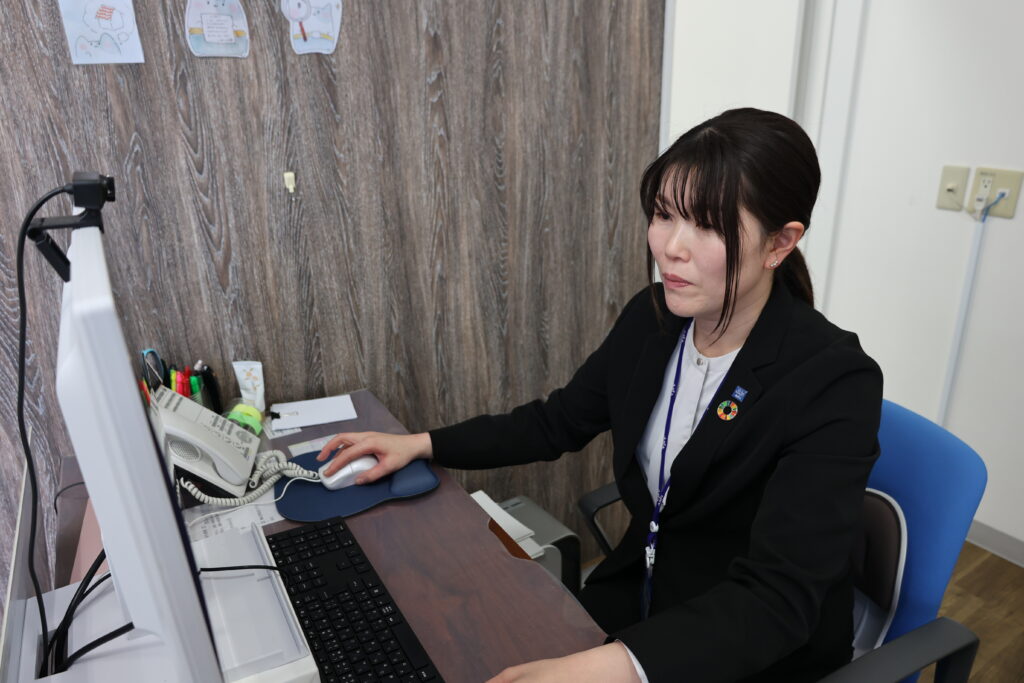
Mr. Takayanagi: By marking land parcels with star symbols on the map, we can instantly see which areas our sales reps are approaching. This has eliminated duplicate visits among sales staff. It also naturally draws attention to unmarked areas, leading to actions like, "Let's try covering this region next."
As a result of these cumulative changes in field behavior, the number of activities has more than doubled compared to before implementation.
Mr. Umezawa: Another major advantage is that I can now instantly check information about landowners and properties while out in the field. Previously, even for minor checks, I had to return to the office to search through documents. Now, I can access everything immediately on my smartphone. The moment I feel "this land looks promising" on-site, I can start approaching the landowner before my enthusiasm cools. This speed has become the most powerful weapon in my sales activities.
Mr. Takayanagi: As I mentioned earlier, we now retain lost deal information as critical data. Whether it was a matter of timing or a mismatch in the proposed amount, we can now understand the background and re-approach the client. As a result, we are steadily seeing more opportunities to reconnect and secure business.
Enhanced motivation and revitalized communication foster organizational unity
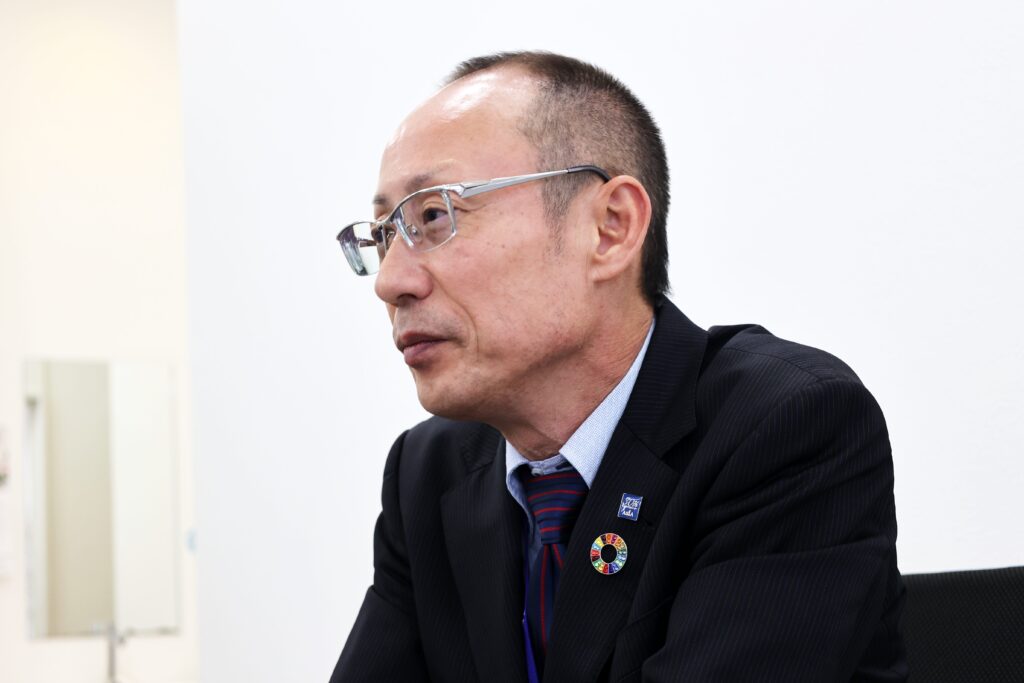
Mr. Takayanagi: I feel that boosting the motivation of our sales team is one of the major changes. Visualizing success stories—such as acquiring prime land at favorable terms and closing deals—has provided excellent motivation, leading to more active sales efforts in surrounding areas. Sharing effective pricing strategies and sales techniques has fostered a healthy, positive mindset among our field staff, who now compete to expand the market.
Mr. Umezawa: From a sales perspective, having supervisors keep track of our daily activities also helps maintain high motivation.Previously, I would prepare all materials for reporting before explaining. Now, necessary information is entered into Salesforce, allowing other members and supervisors to check it immediately. If there's a case that concerns them, supervisors themselves can go to the site right away. Feeling that "my supervisor is properly watching our movements" and "they are checking the cases I've secured and actually taking action" is very encouraging for us as subordinates.
Real-time sharing of activity information also enables supervisors to provide advice early on, such as "This point should be investigated further." This has accelerated on-site decision-making and subsequent actions.
Mr. Tanaka: Previously, there was a gap in the information held between administrative and sales teams. However, as information sharing has improved and administrative staff have gained deeper insight into sales processes, we've achieved a mutually complementary collaboration. Even for a single inquiry, we can now grasp the property's status in real time, enabling smoother responses than before. This has significantly enhanced the entire organization's responsiveness. We strongly feel that the entire organization—not just field sales members, but including administrative staff—is "selling together."
All sales staff achieved their performance targets, setting a new record for highest sales ever. Leveraging "UPWARD" for further sales transformation.
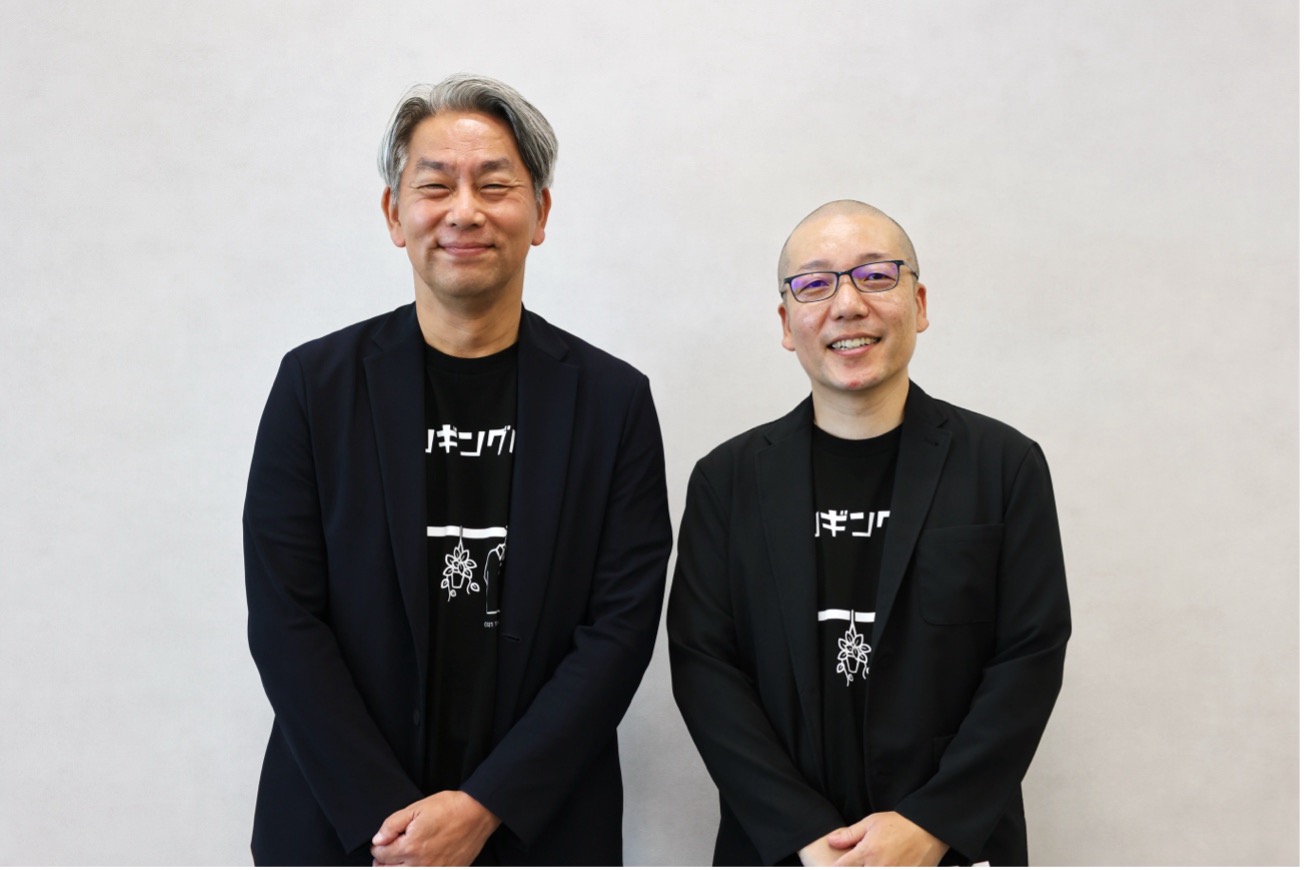
Mr. Takayanagi: The cumulative effect of these initiatives has yielded results, with last year's sales reaching a record high. Furthermore, we achieved a milestone unprecedented since our founding: every single sales team member met their performance targets.
Our activity levels have increased, and the number of cases we can approach has steadily grown. Going forward, I believe the challenge lies in how we can improve the conversion rate from these opportunities. Moving forward, we also want to focus on the sales phase, leveraging "UPWARD" to enhance sales awareness and streamline sales operations. By improving the overall quality of our sales activities, we aim to drive further sales growth.



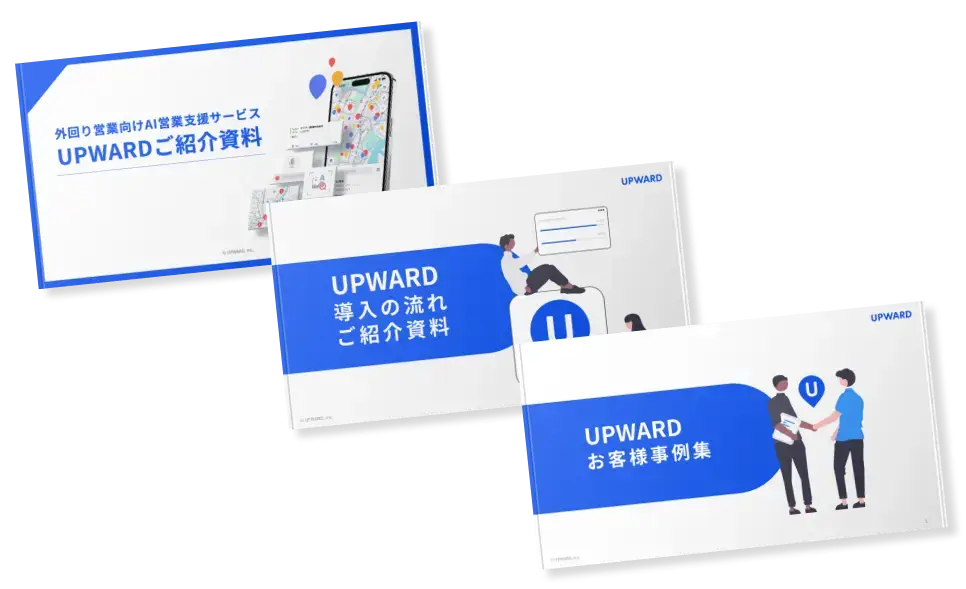
A full overview of the benefits and best practices of the introduction of the system
Download a free set of 3 documents