What Are Sales Skills? An Explanation of the 9 Essential Abilities, How to Develop Them, and Tips for Improving Them
The difference between salespeople who consistently deliver results and those who struggle is not a matter of innate talent, but rather whether or not they possess certain skills that can be learned. In other words, by breaking down sales skills into their constituent parts and understanding them, you can identify the abilities you lack and map out a path for organizational development.
In this article, we’ll clearly explain what sales skills are, the nine essential competencies, how to develop them individually, and how organizations can establish systems to improve them across the board.
Recommended Documents
SUCCESS STORIES OF COMPANIES THAT HAVE ACHIEVED RESULTS WITH UPWARD
Sales skills refer to the comprehensive set of abilities required to identify a customer’s challenges, guide them toward solutions, build trust, and ultimately secure an order. They are not merely about eloquence or aggressiveness, but rather a combination of multiple skills, including active listening, proposal development, relationship building, and self-management.
Definition of Sales Skills
Sales skills refer not to individual techniques, but to the comprehensive ability to execute effectively throughout the entire sales process—from the initial approach to post-sale follow-up. For example, even if you can create excellent proposal materials, you won’t close the deal unless you’ve properly identified the customer’s challenges.
Rather than developing individual skills in isolation, if you focus on how each skill interacts within the process—from identifying customer challenges to resolving them—you’ll acquire skills that directly lead to results.
Sales Job Responsibilities and Situations Where Specific Skills Are Required
Sales work covers a wide range of tasks, from identifying potential customers and conducting initial consultations to making proposals, negotiating quotes, closing deals, and following up after an order is placed. The skills required vary depending on the situation: during the initial visit, active listening and relationship-building are essential, while logical reasoning and negotiation skills are crucial during the negotiation phase.
In field sales in particular, the ability to manage your own schedule—including efficiently scheduling visits that involve travel and balancing travel time with office work—is a key factor in determining your success.
List of Sales Skills | The 9 Essential Skills Organized into 3 Categories
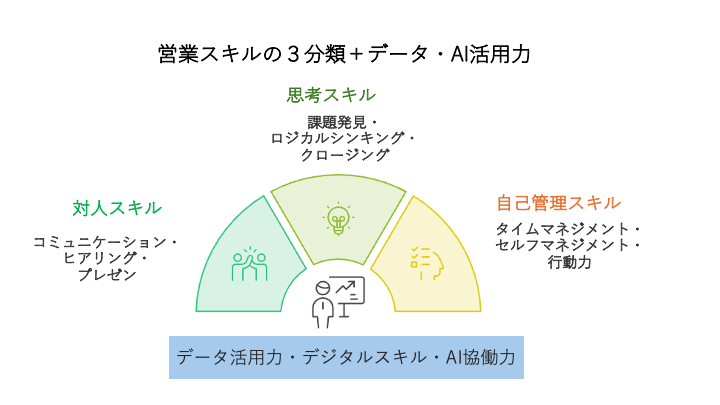
It’s easier to get a clear picture of your sales skills if you categorize them into three areas: interpersonal skills, analytical skills, and self-management. By classifying these nine competencies, you can identify which areas are your strengths and where you have room for improvement.
After reviewing the big picture in the table below, we’ll take a closer look at each category.
category
Sales Skills
summary
Interpersonal
Communication skills
The ability to communicate effectively with others and build relationships
Listening skills
The Power of Active Listening to Identify Customer Challenges and Needs
Presentation Skills
The ability to clearly communicate proposals and facilitate decision-making
Thoughts
Problem-identification skills
The ability to identify problems that customers themselves are unaware of
Logical Thinking
The ability to think logically and make proposals more persuasive
Closing
The ability to successfully close deals
Self-management
Time Management
The ability to optimize the allocation of time for visits and administrative tasks
Self-management
The ability to maintain motivation and health and sustain results
Initiative
The ability to put plans into action and see them through to completion
Interpersonal skills consist of three fundamental actions required when interacting with customers. However, while interpersonal skills are a prerequisite for achieving results, we no longer live in an era where they alone are enough to set you apart from other sales representatives.
Communication skills involve the ability to adapt your delivery to the other person’s level of understanding, while listening skills involve the ability to actively listen in order to uncover the true issues underlying what the customer is saying.
Empathy is essential during client interviews. We draw out information to build trust and make proposals that truly meet the client’s needs. When it comes to presentation skills, we help clients clarify their challenges and clearly communicate the benefits tailored to their specific situation, thereby facilitating their decision-making process.
Furthermore, in situations such as price negotiations, multiple interpersonal skills work in tandem—for example, rather than simply accepting a request, you might first ask about the other party’s budget constraints and then propose adjustments to the payment terms.
Furthermore, our sincere approach and strong presentation skills help us build a network of contacts, including referrals from existing customers to new ones.
Thinking skills are the logical abilities that drive business negotiations forward and lead to securing orders. The ability to identify issues involves uncovering problems that even the customer hasn’t been able to articulate; if this skill is lacking, proposals will miss the mark.
We use logical thinking to structure our proposals and encourage decision-making during the closing stage. Rather than leaving a customer’s “I’ll think about it” hanging, we set deadlines or confirm the next concrete steps to help them make a decision.
Hypothesis-driven thinking also serves as the foundation for identifying business challenges. Before a visit, I might formulate a hypothesis based on industry trends and past transaction history, such as: “While this industry’s market is growing, job postings suggest a labor shortage. This could lead to inadequate follow-up with existing customers and result in contract cancellations.” I then test this hypothesis during the sales meeting.
With a hypothesis-driven sales approach, even within limited meeting times, your questions will be on point, allowing you to quickly get to the heart of issues that the customer hasn’t yet been able to articulate.
Self-Management and Foundational Skills (Time Management, Self-Management, Initiative)
Self-management and foundational skills form the basis for consistently achieving results. Time management determines how you allocate your limited time between client visits and administrative tasks, and it has a particularly significant impact on performance in field sales.
Through self-management, we maintain motivation and health, and use our initiative to put plans into action and achieve results. For example, in field sales where travel time is significant, simply optimizing the visit schedule to increase the number of daily visits can make a real difference in results.
Skills that will become increasingly important in 2026 (data literacy, digital skills, and the ability to collaborate with AI)
In addition to the nine core skills, digital proficiency is essential for today’s sales professionals.
Data utilization skills refer to the ability to analyze log sales meeting histories to determine the next course of action; digital skills refer to the ability to effectively use tools such as SFA and CRM; and AI collaboration skills refer to the ability to leverage generative AI for proposal preparation and customer analysis.
AI is increasingly taking over tasks such as drafting meeting minutes and creating draft proposals, making interpersonal skills—particularly active listening and empathy—all the more important. What will set future success apart is the analytical ability to interpret customer status and determine the next steps based on activity data.
A full overview of the benefits and best practices of the introduction of the system
Sales skills aren’t a matter of talent. They can be developed consistently through reflection, shadowing, standardization, and the use of tools. The key is not to attribute the success or failure of a sales meeting to luck or personal chemistry, but to articulate the causal relationship between actions and results so you can apply those insights to future opportunities.
Make it a habit to review business meetings and client visits and evaluate your own performance
The key to growth is making it a habit to reflect on what went well and what could have been better after every sales meeting. If you jot down any gaps in your client’s feedback or discrepancies in your proposal while the details are still fresh in your mind, you’ll avoid repeating the same mistakes.
For example, if you adopt a system where you simply check three items immediately after a visit—such as “Did I confirm the customer’s budget?” and “Did we agree on the next steps?”—you’ll be able to maintain this practice without it becoming a burden.
Learn the ropes by shadowing top salespeople and practicing role-plays
Shadowing successful senior colleagues is the fastest way to master the unspoken nuances of sales. The order of questions during a sales meeting and how to use silence effectively are things you can’t learn from a manual—you can only pick them up on the job.
If you reenact the situation through role-playing after observing it, the actions you thought you understood will become second nature to you. The key to improving the quality of your role-playing is to use specific customers and scenarios.
Supplement your learning with books, training, and certifications
Since relying solely on practical experience can lead to a lack of balance, we supplement it with systematic knowledge gained from books and training. Learning negotiation theory and logical thinking frameworks provides a framework for organizing your on-the-job experiences. It is also effective for reflecting on your own sales style and your company’s sales approach.
Use SFA/CRM to visualize your activities and implement the PDCA cycle
For field sales representatives, visualizing their activity data significantly improves the accuracy of their performance reviews. By log in an SFA/CRM system, they can use the data to compare the differences between deals that resulted in orders and those that were lost.
With a map-based SFA/CRM system like UPWARD, your visit locations and log are recorded along with location data, allowing you to see at a glance which areas and customer segments you spent your time on. This provides a foundation for implementing the PDCA cycle without relying on intuition.
A full overview of the benefits and best practices of the introduction of the system
How to Improve Sales Skills Across the Organization
Rather than relying on individual effort, it is important to raise the overall level of the organization through knowledge sharing and the visualization of skills. If the tacit knowledge of top salespeople remains unshared, the organization’s strength will decline the moment that person is transferred or leaves the company.
Visualizing Sales Skills
The siloing of know-how is not an individual problem, but an organizational issue stemming from a lack of systems. Unless we can see who is achieving what results in which situations, we cannot leverage strengths across the board or address weaknesses.
By linking activity data to results and visualizing them, you can identify specific areas that need improvement.
Achieving Reproducibility Through Process Standardization
By formalizing successful sales approaches into standardized processes, even new hires can consistently conduct sales meetings at a certain level. Record role-playing sessions featuring top salespeople in various scenarios, and develop conversation scripts and proposal templates.
The first step is to make them accessible to everyone.
Driving the Development Cycle Through 1-on-1 Sessions and Training
Based on visualized data, we conduct one-on-one sessions to identify individual challenges and address any skill gaps through training. In new areas such as data utilization and AI collaboration, we provide reskilling opportunities to raise the overall skill level across the entire organization.
With data-driven 1-on-1s, you can identify specific areas for improvement rather than offering vague advice.
Automated Activity Logging and Data-Driven Development
Automating log serves as a solid foundation for the development cycle. If you spend all your time creating reports, you won’t have the bandwidth left for reflection and development.
For example, using UPWARD log sales meetings semi-automatically, which significantly reduces the number of missed or forgotten entries. This is because the system automatically generates a summary using AI and syncs it log once the meeting is over.
Managers can simply check log to confirm whether the interview questions have been addressed and whether next steps have been determined.
Examples of Sales Skill Development
Daihatsu Motor Co., Ltd.'s Corporate Business Division is an organization dedicated to developing new business opportunities for corporate clients. By leveraging UPWARD to eliminate reliance on individual sales representatives, the division achieved a 5.5-fold increase in sales within one year of implementation.
Challenge: Reliance on individual salespeople and a lack of knowledge sharing
The results of new business development and the number of client visits depended on individual ability, and there was no system in place for sharing best practices.
Initiative: Eliminating daily reports and visualizing activities using voice input and maps
log visit histories using voice input on smartphones, have eliminated daily reports, and are focusing on visualizing activities on a map.
To analyze best practices, we looked at maps to objectively determine why this person was able to visit 15 locations a day without any difficulty. With the goal of “replicating” this approach, we aimed to create a system that would yield the same results no matter who implemented it or where they were located.
Results and Reproducibility: 5.5-fold increase in sales in one year, with zero failures
One year after implementation, sales had increased 5.5-fold. We have successfully implemented sales management using the system without leaving anyone behind, creating a highly reproducible sales organization that does not rely on individual talent.
We use UPWARD not to have managers make decisions and force people to act, but to naturally inspire sales representatives to feel that "it’s in their best interest to do it."
For those who want to visualize their field sales skills
UPWARD is an SFA/CRM solution that uses log location log and log to provide visibility into field sales skills. If you’re interested in eliminating reliance on individual expertise and implementing data-driven training, please feel free to download our materials or contact us for a consultation or demo.
Summary: Developing Sales Skills Through Both Individual and Organizational Efforts
In this article, we categorized sales skills into nine competencies across three categories—interpersonal, cognitive, and self-management—and explained how individuals can develop these skills and how organizations can improve overall performance.
Individuals master best practices through reflection and peer coaching, while organizations ensure consistency through knowledge sharing and skill visualization. In field sales, the automation log serves as the foundation that connects these two elements.
The quickest way to improve sales skills is to get a broad overview by reviewing a list of them, and then to advance both individual skill development and the institutionalization of these skills within the organization. Start by identifying where you and your team have room for growth, and begin by leveraging data rather than relying on personal experience.
Frequently Asked Questions About Sales Skills
We’ll address common questions from the field regarding the definition of sales skills and how to acquire them.
Q: What exactly do you mean by "sales skills"?
This refers to the comprehensive set of skills required to identify and resolve customer challenges, ultimately leading to the successful acquisition of an order. It combines interpersonal skills such as communication and active listening, cognitive skills such as problem identification and logical thinking, and self-management skills such as time management.
Q: If I have no prior experience, where should I start to develop my sales skills?
It’s effective to make reviewing sales meetings a habit and start by shadowing top salespeople to learn the ropes. By supplementing your foundational knowledge with books and training, and repeatedly practicing and evaluating your approach, you’ll develop skills that you can consistently apply.
Q: How can sales skills be quantified?
By storing log for visits and sales meetings in your SFA/CRM system and analyzing them in relation to results, you can gain valuable insights. By leveraging location data, you can use analytics to determine which areas and customer segments yielded the best results.
Q: What skills should salespeople focus on developing in the age of AI?
These are data literacy, digital skills, and the ability to collaborate with AI. While interpersonal skills remain essential, sales representatives who can interpret data and adjust their actions accordingly will see a greater difference in their results.
A full overview of the benefits and best practices of the introduction of the system