PROGRESS MANAGEMENT IN SALES MEANS MANAGING THE PROGRESS AND PLANNING OF PROJECTS AND DEALS. PROGRESS MANAGEMENT PREVENTS WORK OMISSIONS AND PROBLEMS, AND AIMS TO ACCURATELY FORECAST SALES AND IMPROVE EFFICIENCY. THIS ARTICLE EXPLAINS THE MEANING OF PROGRESS MANAGEMENT IN SALES AND WHY IT IS NECESSARY. THE PURPOSE AND ISSUES OF PROGRESS MANAGEMENT WILL ALSO BE EXPLAINED. >[PDF FREE DOWNLOAD] SHORTCUT TO SUCCESS IN SALES DIGITAL TRANSFORMATION! CAUSES OF FAILURE AND SOLUTIONS.
What is sales progress management, and a thorough explanation of the importance of the four and how to manage them!
Recommended Documents
-
SUCCESS STORIES OF COMPANIES THAT HAVE ACHIEVED RESULTS WITH UPWARD
Click here to download the document
Pickup Articles
Table of Contents
What is Sales Progress Management?

Sales progress management involves checking and managing the progress of projects, deals, etc., and the differences between the plan and the progress of the project. It also includes checking for any omissions or problems in the work and taking countermeasures if there are any problems. In the field of sales, they are required to identify the difference between the set goals and the current status, and to manage progress while communicating with customers.
Why is it important to manage sales progress?
Sales requires accurate sales forecasting and efficient schedule management. Here are four reasons why progress management is important.
1. To accurately forecast sales
By implementing sales progress management, you will be able to understand the current status of your business. A more precise sales forecast is possible when an accurate status can be ascertained. Progress management provides a real-time grasp of overall progress and the status of business negotiations. This makes it easier to develop necessary actions and improvement measures. For example, even if sales targets are difficult to achieve, if progress is properly managed, problems can be identified at an early stage and remedial measures can be considered.
2. For efficient scheduling
By linking progress management to the sales process, you will be able to manage each stage of the sales process, such as initial appointment, follow-up, and closing. By linking the sales process to progress management, the next steps for each customer will become clear. This makes it easier to know what needs to be done next for each customer, and allows for more efficient schedule management.
3. for early detection of problems and risks
Progress management allows you to check the overall progress in real time. This allows for early detection of any problems or risks. Without progress management, it would be difficult to notice any delays or problems in the schedule. In many cases, by the time a problem is detected, it is too late. Progress management makes it easier to identify risks and problems and to take action in advance.
4. Effective use of sales representatives' time
Sales representatives' duties include not only communication with customers, but also meetings and preparation of documents. In some cases, these tasks may be burdening their work time. By establishing a system that eliminates the need for meetings and document preparation through progress management, the burden on sales representatives can be reduced. Efficient use of time also has the advantage of making it easier to improve productivity.
Items required in sales progress management

There are seven major items for progress management. Here we will explain the seven items necessary for sales progress management.
1. Goal Management
Goal management is an item for checking and evaluating progress toward and achievement of goals. It is important to clarify and set specific goals for the organization and each sales representative to achieve. These items include the target amount of sales, number of new customers acquired, and profit margin.
2. Case management
Sales pursues a variety of business opportunities and projects in order to win new business or expand existing transactions. Deal management provides the information necessary to track the status of business negotiations and deals, set up the closing process, and lead to the final closing of the deal. This item represents a central element of the sales process.
3. Customer Management
This section is designed to effectively collect and organize information about customers and to make use of that information. In addition to basic information such as customer gender, age, and contact information, customer management collects and centrally manages information such as purchase history, interests, priorities, and inquiries.
4. Schedule management
Scheduling is the item that schedules sales representatives and ensures that their work is performed on time. Sales representatives perform many daily tasks such as customer visits, presentations, and meetings. Each sales representative works together as a team to maximize productivity and keep operations running smoothly.
5. Behavior management
Behavior management is an item designed to improve the performance of sales representatives. It identifies bottlenecks and issues by visualizing and quantifying the daily work of sales representatives. The content and time of sales activities are monitored and evaluated, and activities are modified and countermeasures are taken to address issues.
Related Articles>>What is sales activity management, including three benefits and specific methods !
6. Human Resource Development Management
Human resource development management is an item that aims to grow and improve the skills of sales representatives. Indicators for human resource development management include "building customer trust," "listening," "logical thinking," "data collection and analysis," and "solution proposals. By quantifying them as indicators, the skills and abilities of sales representatives can be evaluated objectively.
7. Motivation Management
Motivation management is an item that creates a goal-oriented work environment for sales representatives. Indicators for motivation management include "job evaluation and performance," "human relations," "dissatisfaction with the company or department," "health status," and "stress level. These indicators are difficult to quantify, but if they can be managed, countermeasures and support can be implemented as soon as possible in the event that a salesperson's motivation declines.
Appropriate measurement of sales progress

In order to properly conduct sales progress, it is important to measure and quantify sales progress. First, organize the sales steps. For example, identify the sales process, such as initial appointment, business meeting, and closing the deal. Next, set a percentage for each step. For example, 20% when the initial appointment is completed, 80% when the business meeting is completed, and 100% when the deal is closed. When communicating or sharing the progress with others, use the set figures.
Key points of sales progress management
There are three key points to keep in mind when managing progress in sales. Each point is explained here.
1. Unify management methods
If management methods are not standardized, there is a possibility that dissatisfaction will arise, such as "Only my team has too strict management methods" or "Other teams are operating efficiently. Under such a situation, the motivation of sales representatives will be lowered. When implementing progress management, it is important to standardize the management method so that there are no differences in items or rules among sales representatives or teams.
2. Introduce the tool
Progress management can be done with Excel, but it tends to be complicated. When implementing management using tools, it is a good idea to implement CRM or SFA. These tools can be integrated with smartphones, Excel, and external systems.
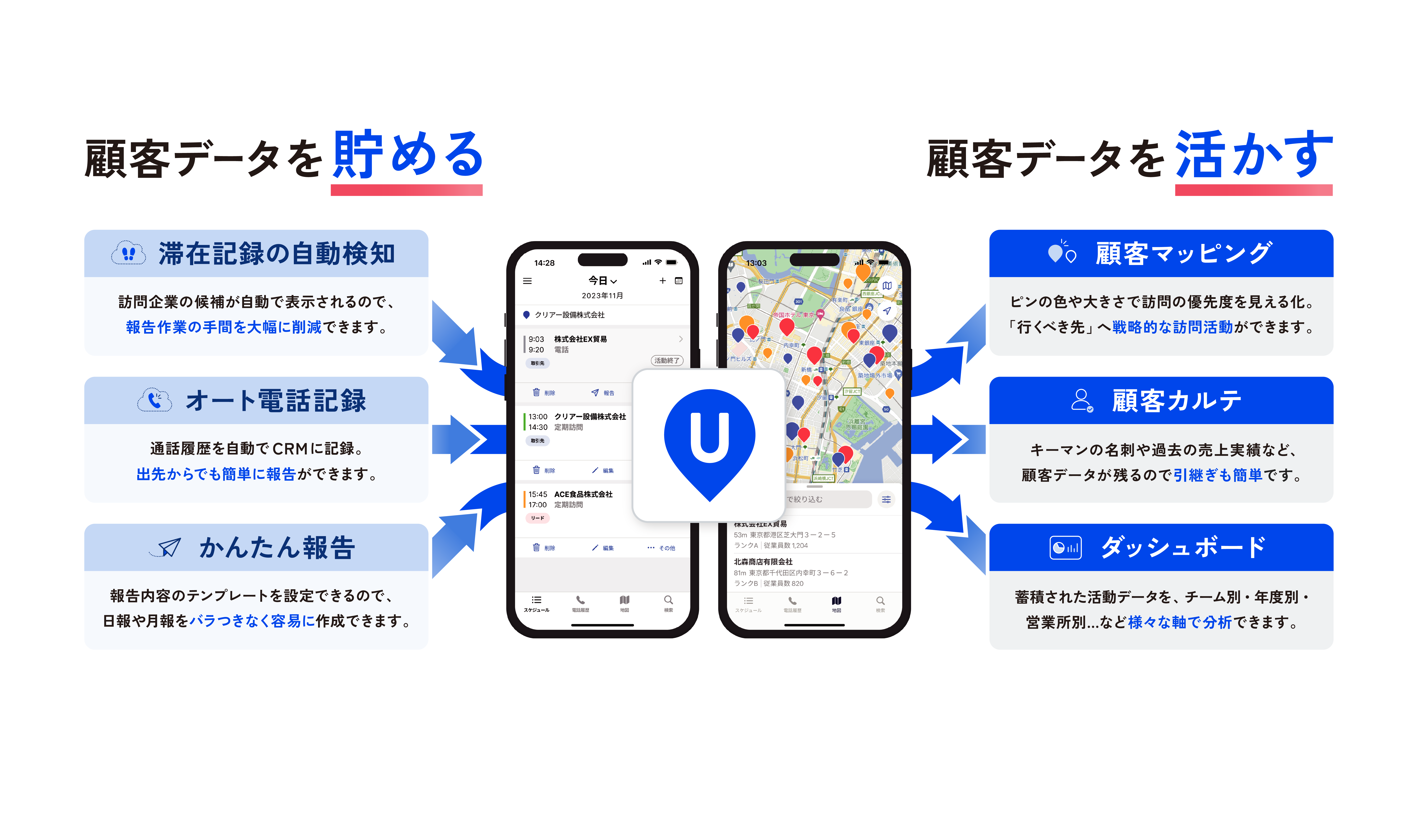
If you do a lot of outside or in-person sales visits, we recommend UPWARD, which can link maps and CRM. UPWARD semi-automates the visit history logas well as visualizes high-priority customers on a map. It is also intuitive and easy to use, making it easy to promote retention in the field.
Download "UPWARD Introduction Document"
Related Articles>>[ 2024 Edition] 16 recommended sales tools|Thorough explanation of how to choose and the advantages of introducing them.
3. Provide accurate feedback and advice
Progress management is only a means to understand the current status. In addition to progress management, you should listen to the concerns, situations, and issues of each sales representative and provide appropriate feedback and advice. Efficient progress management using tools is necessary, but communication with sales representatives is also important. To avoid a lack of communication, hold regular meetings with sales representatives and conduct surveys.
summary
Progress management in sales means checking the progress of a project or case to identify any omissions or problems. When implementing progress management, the management method should be unified and necessary items should be set. Tools can be introduced to efficiently manage and measure items.
We provide and develop a sales digital transformationtool " UPWARD " that maximizes the value of CRM and SFA.
By using "UPWARD," customer data such as customer profile information, business meeting history, and activity reports can be semi-automatically stored in CRM with a single smartphone. When the person in charge in the field creates a daily sales report or activity report, not only is the report format automatically created on "UPWARD," but also the report can be easily created in his/her spare time by voice input support. The data entered daily is visualized on a map, allowing users to intuitively know which customers to visit next.

For more detailed information, please download the service document from the URL below.
Download "Introduction to UPWARD" document
A full overview of the benefits and best practices of the introduction of the system
Download a free set of 3 documents