What Is Inside Sales? An Operational Guide to Maximizing Results Through Field Collaboration
Inside sales is a sales approach that generates sales opportunities without face-to-face contact, and its adoption is accelerating against the backdrop of the widespread adoption of online meetings and the increasing specialization of sales roles.
On the other hand, inside sales alone has its limitations when it comes to building relationships and closing major deals, so effective collaboration with field sales is a key factor in determining success.
This article is designed for managers who already have an internal sales organization and want to improve its performance, as well as sales planning and sales managers looking to enhance collaboration with field teams and refine their hybrid operations. It covers everything from definitions and key differences to KPI design and a roadmap for collaborative operations.
Recommended Documents
SUCCESS STORIES OF COMPANIES THAT HAVE ACHIEVED RESULTS WITH UPWARD
What Is Inside Sales? An Operational Guide to Maximizing Results Through Field Collaboration
Inside sales is a sales approach that generates sales opportunities without face-to-face contact, and its adoption is accelerating against the backdrop of the widespread adoption of online meetings and the increasing specialization of sales roles.
On the other hand, inside sales alone has its limitations when it comes to building relationships and closing major deals, so effective collaboration with field sales is a key factor in determining success.
This article is designed for managers who already have an internal sales organization and want to improve its performance, as well as sales planning and sales managers looking to enhance collaboration with field teams and refine their hybrid operations. It covers everything from definitions and key differences to KPI design and a roadmap for collaborative operations.
What is Inside Sales?
Inside sales is a sales approach that generates business opportunities without face-to-face interactions, and its adoption is accelerating due to digital transformation. Here, we’ll explain what it is and why so many companies are adopting it now.
Definition and Characteristics of Inside Sales
Inside sales refers to sales activities that involve approaching prospective customers through non-face-to-face channels such as phone, email, and web conferencing to generate sales opportunities. It is generally positioned as a bridge that nurtures leads generated by marketing and hands them off to the field sales team.
It should be noted that “web-based sales,” in which the entire sales process—including closing the deal—is conducted via web conferencing, is also a form of non-face-to-face sales. While this approach is sometimes defined as “inside sales,” the actual practices vary from company to company.
This article focuses on explaining "inside sales" in the narrow sense—specifically, the role of nurturing leads and securing sales opportunities—which serves as a bridge between marketing and the field.
Since it does not rely on in-person visits, it is less constrained by geography and allows for a significant increase in the number of daily outreach attempts. If field sales is defined as a role that involves deep, face-to-face engagement, then inside sales can be described as a role that involves establishing a wide range of contacts and assessing lead quality.
Three Key Factors Driving This Trend
The reasons behind the growing adoption of inside sales can be broadly categorized into three main factors.
First, there is the dilemma of labor shortages and sales productivity. According to an analysis by the Ministry of Health, Labour and Welfare, the percentage of companies reporting labor shortages remains high, and non-face-to-face systems are being adopted as a means to boost sales productivity without increasing headcount. With a limited number of sales representatives needing to cover large territories, there is a growing need for systems that allow field staff to focus on the deals that truly warrant a visit by conducting preliminary assessments remotely before making in-person visits.
Furthermore, according to a proprietary panel survey conducted by UPWARD in May 2026 (n=1,817 sales professionals), the proportion of employees primarily responsible for inside sales was 11.8% for women, compared to 7.5% for men, indicating a higher tendency among women. Since this work style involves less travel and physical strain, it helps support career continuity; from a talent acquisition perspective, the adoption of inside sales is also an effective strategy.
Source: UPWARD Original Panel Survey, “Survey on the Actual State of Field Sales Activities and Work-Related Challenges” (May 2026, sales professionals, n=1,817)
Second, the shift toward online purchasing. According to a survey on telework conducted by the Ministry of Internal Affairs and Communications, the transition of business operations to online platforms has become firmly established to a certain extent, and an increasing proportion of customers are making purchasing decisions based on online consultations and document reviews, particularly for relatively low-priced items.
Even for high-priced products, the process typically involves establishing initial contact online before a sales visit, which enhances the value of the inside sales team.
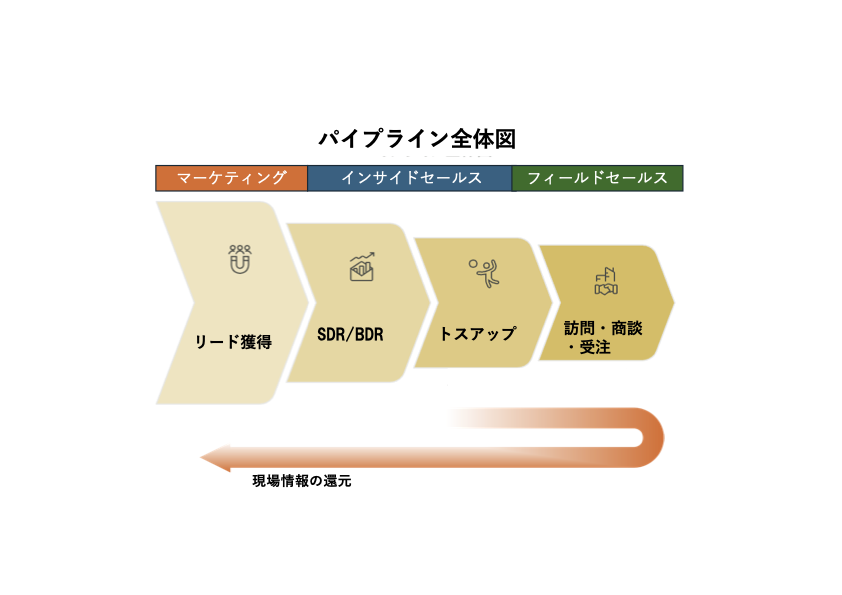
Third, the widespread adoption of specialized sales processes. The specialized sales model—marketing → inside sales → field sales → customer success (THE MODEL)—is gaining traction in Japan, and the premise that specialized organizational structures lead to better results is becoming firmly established.
By clearly defining roles and responsibilities, the "lead nurturing and deal generation" phase handled by the inside sales team has been established as a distinct function.
Adoption in the Japanese Market
According to a proprietary panel survey conducted by UPWARD in May 2026 (n=1,817 sales professionals), only 8.3% of sales professionals are primarily responsible for inside sales, while those focused on online meetings account for just 4.5%. On the other hand, 55.6% of sales professionals work primarily in a field-based, in-person sales role, indicating that Japan still maintains a field-sales-dominated structure.
When broken down by industry, there is significant variation in the proportion of sales activities conducted through in-person visits. The optimal sales structure differs greatly between industries where field sales are the primary method (such as finance and insurance, construction, and wholesale and trading companies, accounting for around 70%) and those where a higher proportion of sales is conducted through inside sales and online meetings (such as IT and other service industries, accounting for around 40%).
Given this structure, attention is shifting away from standalone inside sales models toward hybrid models that combine inside sales with field sales.
Type of industry
Proportion of in-person visits
Financial Services and Insurance
75.9%
Construction Industry
70.5%
Wholesale and Trading Companies
68.4%
Manufacturing (Other)
68.2%
Manufacturing (Food, Beverages, and Consumer Goods)
65.6%
Manufacturing (Machinery, Electrical Equipment, Automotive, and Parts)
63.4%
Transportation and Logistics
60.0%
Real Estate Industry
45.2%
Information and Communications Industry (IT, Software, and Telecommunications)
43.1%
Other service industries
38.4%
Source: UPWARD Original Panel Survey, “Survey on the Actual State of Field Sales Activities and Work-Related Challenges” (May 2026, sales professionals, n=1,817)
The Difference Between Inside Sales and Field Sales
Inside sales and field sales are complementary roles that differ in three key areas: responsibilities, KPIs, and methods of engagement. The fundamental approach is not to determine which is superior, but to design the structure based on a clear division of labor.
Differences in Roles
The primary roles of inside sales are lead nurturing and generating sales opportunities. They continuously follow up on leads generated by the marketing team and hand off high-potential opportunities to the field sales team.
In contrast, field sales representatives delve deeper into the leads handed over to them, handling everything from proposals and order acquisition to relationship building. Their core strengths lie in building trust through in-person visits and identifying challenges on-site. It is most appropriate to view these roles as a division of labor, with each team handling different stages of the customer journey.
The Difference Between KPIs and Performance Metrics
Performance metrics are also designed to reflect each role. The basic structure is that the Inside team prioritizes metrics that measure "volume and accuracy," while the Field team prioritizes metrics that measure "depth and revenue."
Comparison Criteria
Inside Sales
Field Sales
Key Responsibilities
Lead Generation and Deal Closure
Business Negotiations, Order Acquisition, and Relationship Building
How to Contact Us
Phone, email, and web conferencing
In-person visits
Key KPIs
Number of calls, conversion rate, number of SQLs
Number of visits, conversion rate, order value
Required Tools
MA, CTI, and Web Conferencing
SFA/CRM, Maps, and Location Data
Strengths
Efficiency and Quantitative Approach
In-depth Development and Major Deals
Problem
The Limits of Relationship Building
Travel Costs and Coverage
When KPIs are fragmented, the inside sales team tends to focus solely on "number of deals," while the field sales team focuses solely on "order value," leading to siloed operations. This is where the design of the KPI bridge—which will be explained later—becomes crucial.
Which One Should You Choose? | The Limits of Standalone Operation
Operating solely with an "inside-only" or "field-only" approach has its limitations. Relying solely on the inside team makes it difficult to build trust for large-scale projects or develop complex proposals, while relying solely on the field team limits the coverage per staff member.
In reality, as the volume of leads increases, the need for lead qualification becomes more critical, and as the value of each deal rises, the effectiveness of in-depth field development grows. This is why a hybrid model that combines both approaches is becoming increasingly common.
Types of Inside Sales and KPIs
Inside sales can be broadly divided into SDRs and BDRs, each with different KPIs and partners. If these roles are not clearly defined from the outset, performance evaluations will be ineffective and employees are likely to become burned out, so this is an important point to clarify at the beginning.
The Role of SDR (Reactive) and KPIs
An SDR (Sales Development Representative) is a response-oriented role that handles inbound leads generated by the marketing team. Starting from customer-initiated interactions—such as requests for materials, inquiries, or seminar registrations—the SDR works to turn these into sales opportunities.
Key KPIs include response speed (time to first contact after a lead is generated), qualified lead conversion rate, and the number of SQLs. Since the freshness of the response determines the outcome, the key is how quickly we can make contact after a lead is generated.
Roles and KPIs for BDR (Business Development Representative)
The BDR (Business Development Representative) is a business development role that proactively reaches out to prospects on a target list. Using an ABM approach, the BDR identifies key target companies and designs outbound outreach strategies aimed at decision-makers.
Key performance indicators (KPIs) include the number of companies approached, the key contact connection rate, the number of appointments secured, and the number of sales opportunities generated from target companies. Since these metrics have an impact over the medium to long term, it is best to evaluate performance based on cumulative quarterly results rather than just monthly figures.
Common KPIs (Opportunity Conversion Rate, Number of SQLs, Pipeline Contribution)
The KPIs we want to track for both SDRs and BDRs are the deal conversion rate, the number of SQLs (sales-qualified leads), and pipeline contribution. In particular, pipeline contribution is a metric that shows how much projected revenue the opportunities generated by the inside sales team have generated, and it is directly linked to the field sales team’s KPIs.
If you evaluate performance based solely on "number of calls made" and "number of emails sent," you tend to end up with approaches that generate high volume but do not contribute to securing orders. The premise for designing the subsequent KPI bridge is an evaluation framework that links performance to the pipeline leading to actual orders.
Inside × Field Operations
Hybrid sales is a system in which inside and outside sales teams work together through a single pipeline. As the core of this article, we will explain the key design considerations by breaking them down into five points.
Why do we need a hybrid rather than a standalone solution?
Many sales organizations have already come to realize the limitations of operating in isolation. Relying solely on inside sales makes it difficult to close deals and deepen customer relationships, while relying solely on field sales means there’s a physical limit to the number of accounts a salesperson can visit in a day.
The hybrid model is designed so that each component compensates for the other’s weaknesses. By having the inside sales team handle a broad range of leads to assess their quality, while the field sales team focuses on high-quality opportunities, the overall productivity of the organization increases. For companies with a large volume of leads, the presence or absence of a lead screening function can make a significant difference in results.
From securing a deal to handing it over to the field
The first hurdle for a hybrid model is designing the handoff (toss-up) from the inside sales team to the field. If the handoff criteria are vague, the field team will complain that they’re “only getting low-potential leads,” while the inside sales team will push back, saying, “They’re not making the most of the deals we’ve worked so hard to generate.”
The basic approach is to formalize criteria such as BANT (Budget, Authorization, Need, Timeline) and key discussion points, and integrate them with SFA systems.
Connecting to the Visit Plan
The key to turning qualified leads into closed deals is integrating them into your visit schedule. Even if the number of leads increases, your chances of winning the deal won’t improve unless you can keep up with scheduling visits.
In UPWARD, when a sales opportunity is secured, the customer’s location is displayed on a map and visualized as a target for visits in each area. Furthermore, AI automatically incorporates travel efficiency into visit plans, suggesting simultaneous visits to existing customers in nearby areas and optimizing routes based on estimated visit durations.
By linking sales opportunity status with location data, sales reps can adopt a practical approach, such as “efficiently visiting high-priority new sales opportunities while on the way to see existing customers.” As field sales efficiency improves, the sales opportunities generated by the inside sales team are not wasted, and the results of this hybrid approach continue to grow.
To make a hybrid model work, the design must link inside sales and field sales KPIs within a single framework. If the number of deals generated and SQL conversion rates on the inside sales side are managed separately from the number of visits, order conversion rates, and order values on the field sales side, it becomes easy for teams to pass the buck to one another.
UPWARD synchronizes lead and opportunity data from the inside sales team log visit and log from the field sales team in both directions through integrations with CRMs such as Salesforce. This enables you to track the entire process—from lead generation to order placement—using a single pipeline KPI tree.
For example, you can use the same dashboard to determine whether a decline in the SQL conversion rate is due to a drop in the accuracy of internal screening or a slowdown in field visits. Identifying the cause sooner allows you to take corrective action more quickly.
Another key to maximizing the effectiveness of a hybrid model is the reverse flow from the field to the back office. If the information flow remains a one-way street from the back office to the field, the insights gained in the field won’t be put to use in nurturing.
With UPWARD, you can compile information gathered during client visits—such as competitor activities, decision-makers’ concerns, the severity of challenges, and reasons for lost deals— log. By integrating with maps to efficiently log, the system reduces the data entry burden on field staff while preserving on-site insights as organizational assets.
The accumulated data is used to update inside sales scripts, proposal materials, and nurturing emails. First-hand information from the field improves the accuracy of inside sales, creating a virtuous cycle in which improved accuracy boosts the field’s order conversion rate.
[2026 Trends] The Evolution of AI SDRs and Hybrid Models
By 2026, the implementation of AI SDRs will have improved the speed and accuracy of hybrid inside sales. In particular, immediate responsiveness to leads and the automation of decisions on when to hand off leads to the field have become realistic goals.
What is AI SDR (Autonomous Outbound Agent)?
An AI SDR (AI Sales Development Representative) is a type of AI agent that autonomously handles everything from generating target lists to making initial contact with leads, conducting interviews, and assessing lead quality.
AI SDRs handle tasks such as personalized outreach to large lists, responding to leads 24/7, and repetitive follow-ups—areas that can be managed manually but offer significant efficiency gains.
Key Points for Utilizing AI in Hybrid Models
When implementing AI SDR, the key is not to rely entirely on AI, but to design a system that clearly defines the roles of both humans and AI. A practical three-tiered structure involves having AI handle initial responses and routine nurturing, with human inside sales representatives taking over when the lead’s quality has improved, and then passing the lead on to the field sales team.
3 Key Points for Getting Started with a Hybrid Model
When launching a hybrid system, start with three key elements: role definitions, KPI integration, and the tool infrastructure. Since getting the order wrong can easily lead to confusion on the ground, it is recommended to establish these three elements first.
Documenting Roles and Handover Procedures
The first step is to clearly define the roles and responsibilities of the internal and field teams, as well as the criteria for handing off tasks. We will document everything, including the definitions of BANT and screening, as well as the deadline for the field team’s initial response after a handoff.
Redesigning the KPI Tree
Next, we will redesign the KPI tree to create a seamless connection from lead generation to order placement. Rather than listing separate KPIs for inside sales and field sales, it is more effective to place metrics that measure their collaboration—such as pipeline contribution and order lead time—at the center.
Pipeline Integration via SFA/CRM
Once roles and KPIs have been finalized, we’ll set up the tool infrastructure to support them. By using SFA/CRM log leads, deals, log, and by integrating with existing systems—including CRM integrations like Salesforce—we can consolidate the sales pipeline while avoiding duplicate data entry. Since log in the field is particularly time-consuming, it’s crucial to implement mechanisms that reduce the input workload by utilizing map-based UIs and geolocation data.
We are currently distributing a guide that compiles specific designs for field-inside collaboration into a single volume. If you’d like to develop a plan for your company’s hybrid sales model by referring to the templates for role definitions, KPI integration, and tool infrastructure, please feel free to use this guide.
A full overview of the benefits and best practices of the introduction of the system
Inside sales is a sales approach that generates sales opportunities without face-to-face interactions, and results are maximized through a hybrid model that combines it with field sales.The key to success lies in systematically establishing three elements—role definitions, KPI alignment, and a tool infrastructure—and designing a single pipeline that spans the entire process from lead generation to follow-up. UPWARD can be utilized as the foundation supporting the field side of hybrid sales through the log location log, as well as integration with CRMs such as Salesforce.
If you are looking to review your company’s inside sales operations and explore ways to strengthen your field sales team, please take advantage of UPWARD’s one-on-one consultation. We will propose a collaboration framework tailored to your current structure and KPIs.
Frequently Asked Questions
What is the difference between inside sales and cold calling?
While telemarketing refers to one-off cold calling activities primarily aimed at securing appointments, inside sales involves the ongoing process of lead generation, deal closing, and lead nurturing. The key difference lies in the fact that inside sales involves managing records in a CRM system and designing KPIs, and is based on the premise of building an organized sales pipeline.
Which should I implement first: inside sales or field sales?
If you already have a field sales team in place, it makes sense to establish an inside sales team when the number of leads exceeds the field team’s capacity.
Conversely, when starting from scratch, it is more efficient to first establish an inside sales team capable of assessing lead quality, and then design a system where the field sales team focuses exclusively on high-potential opportunities.
How many people are needed to launch a hybrid sales team?
With the minimum setup, you can start with one inside sales representative and one to two field sales representatives. What matters more than the number of people is whether the role definitions and KPI linkages are working effectively.
The standard approach is to establish handover procedures and evaluation metrics while the team is still small, and then gradually expand the team as the volume of leads increases.
How should the criteria for a toss-up be designed?
Starting with the BANT framework (Budget, Authorizer, Need, Timeline), we customize the system to align with your company’s lead sources and deal characteristics. To ensure stable operations, it’s important to establish a deadline for the sales team to take initial action after handover, as well as rules for when the sales team can return leads for further review.
A full overview of the benefits and best practices of the introduction of the system