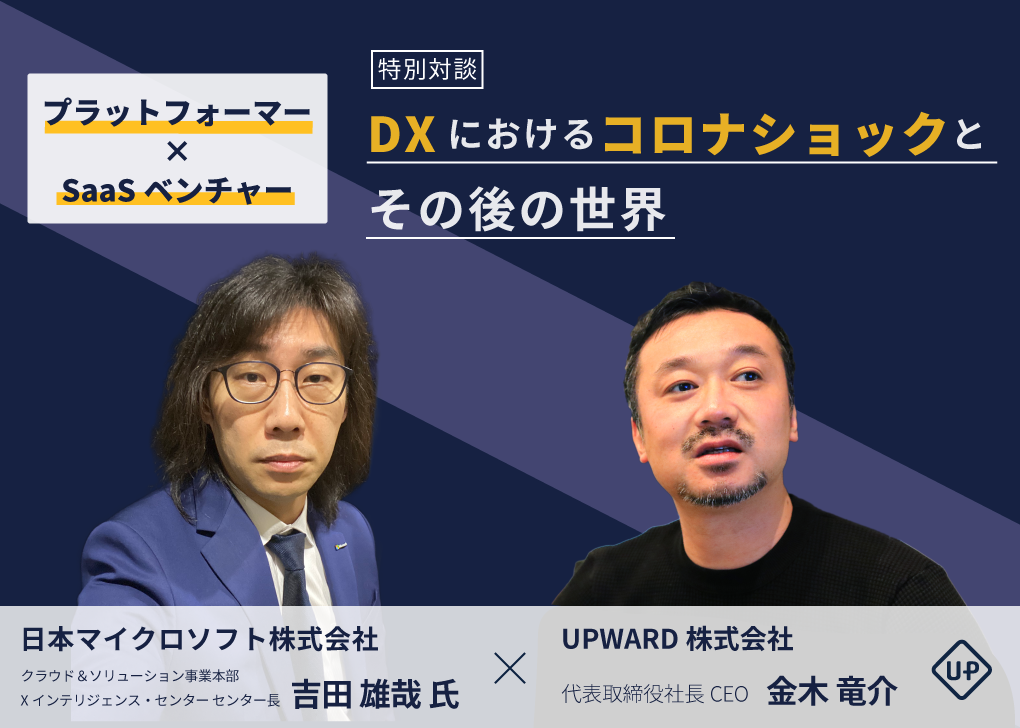
In the wake of the spread of the new coronavirus, corporate executives are being urged to respond to the rapid digitalization and digital transformation transformation of their companies. What impact will the coronary shock have on the promotion of corporate digital transformation, and how will the business scene change? How will the Corona Shock affect the promotion of digital transformation in companies, and how will the business scene change? UPWARD, which develops mobile CRM for field workers, held an online dialogue with Mr. Yuya Yoshida, General Manager of Cross Intelligence Center, Microsoft Japan K.K., and Mr. Kaneki, President & CEO, on the theme of "Corona Shock in digital transformation and the world afterwards. Online dialogue between the world's top-class platformer and S The three-part series will discuss the post-Corona Shock world and the keys to promoting digital transformation as seen by the world's top-class platformer and SaaS venture company.
Microsoft Japan x UPWARD Dialogue] The Corona Shock and the World After digital transformationVol. 1: The Corona Shock Transforms the Digital World
Recommended Documents
-
SUCCESS STORIES OF COMPANIES THAT HAVE ACHIEVED RESULTS WITH UPWARD
Click here to download the document
Pickup Articles
Table of Contents
The impact of the new coronavirus outbreak on companies in digital transformation
Mr. Yuya Yoshida, General Manager, Cross Intelligence Center, Microsoft Japan, Ltd:

We are in a situation where we are receiving a great deal of consultation, partly because Microsoft offers a variety of cloud services, with Teams at the top of the list.
My impression is that many of you had only the environment and rules that were based on going to the office to work or visiting customers' sites, although the situation has become such that it is no longer possible to "keep people close " in order to prevent the spread of the new coronavirus infection. The fact that as a result of the Corona Shock, those areas are now being put in place at a rapid pace is a major impact.
Then, what comes next is a situation where, as a result of trying to put things in place at a rapid pace, the existing issues have been exposed and we are unable to move forward.
For example, there is a VPN (Virtual Private Network) as a mechanism to connect from your home to the company network, but the VPN is rigidly connected with dedicated lines, and the number of VPN clients is not sufficient for the entire company. In many cases, the company has changed its assumptions, and although they are working on it, they are unable to move forward.

Kaneki, CEO of UPWARD:
We feel that the impact of Corona varies depending on the type of industry and regional characteristics, even among major clients.
For example, one of UPWARD's clients, a major manufacturing company, operates on a nationwide scale, and during this period, I heard that they are visiting clients mainly in the regions as needed. Also, when we visit financial institutions, we see that large financial institutions are still working in their offices, as they need to finance their business to survive.
On the other hand, in Tokyo, especially for IT companies, they were originally preparing for remote work and I think they are able to shift all over the place at once.
During March to May, which is called "After Corona," I was able to learn the reality that some companies can handle remote work and others cannot, depending on the industry and regional characteristics. I was able to learn about this.
If you can't digitise, you can't move on to digital transformation

Mr. Yoshida: With the Corona Shock, there have been major changes. Some changes are upswings and some are downswings. For example, in some industries, demand from customers has increased dramatically, while in others, we have lost our own jobs.
In general, one thing that can be said is that online is becoming more and more important because it is no longer possible to "keep the distance close". What used to be done onsite (onsite, on-site) is now being done online. What used to be done on-site is now being done online.

For example, since I can no longer go to the office, I can now do my work online. For example, if you say, "I can't go to the office anymore, so my work will be online." Then the company meeting room will have to go online as well, or if you say, "I used to draw POP in the store, but now I can't get customers, so let's do marketing. So, let's do marketing. I think that sales activities will also have to go online.
The bottleneck is the fact that we are behind in digitalization, which will ultimately be a drag on our business. Or, the existing systems are not well integrated with online activities. This is exactly what I was talking about earlier with VPNs, but now the issues caused by the change in assumptions are being exposed.
Assuming this, I think there are two phases when you think of digital transformation.

The first phase is digitalization, which means to be digitally compatible in the first place. The introduction of systems, efforts to improve operational efficiency, and process improvement are also digitalization. In the background, there is a conscious effort to reduce costs. As a result of that, I think we are trying to use digital technology. digital transformationis our view of the world, which is to use it to move forward.
Therefore, rather than talking about improving operational efficiency, we are talking about a more company-wide perspective, or rather than talking about business processes, we are first targeting the data handled by those processes, data obtained from sales and purchasing activities, and so on. digital transformationWe need todiscuss how to use the data and how to find the value of the data in order to move forward from there.
Those who say that their company's efforts are not well organized are at a loss when it comes to digitalization. Companies that have made rapid progress in digitization are now at the stage where they are ready to start digital transformation. My impression is that there is a clear distinction between these two groups.

What is the "Digital Feedback Loop" promoted by Microsoft?

Mr. Yoshida: First of all, if we digitize our business to make it more efficient, how can we distribute the data obtained from the system used there? How can we distribute the data obtained from the system used there? How can we make it available in various places? digital transformationIn order torealize this, we recommend that you introduce the concept of a digital FB loop.
![[resize output image].](https://uploads-ssl.webflow.com/658141e362c6b74fdc486b67/658141e362c6b74fdc48713f_606af3ee73bd5e84dfc721b8_ezgif-2-a2cb8b6ed603.gif)
There are four cutouts in this diagram, and the first one is "connecting with customers.
For example, in the case of us at Microsoft and UPWARD, we are the tool provider and UPWARD is the customer. Of course, there are customers beyond those who work on digital transformation, so we connect with them. It means that we learn information about our customers, such as what they have, what kind of reactions they have to our activities, and so on. We can often see how much they scrolled down on a web page, or where they clicked, and use that information in our marketing efforts. That's what I mean when I think about online.
The second is "power to employees. This is about increasing productivity as employees.
The top right, "Optimize operations," is about doing various things efficiently, as I mentioned in the digitalization section. I think this is something that many companies have been working on for some time.
The last one, "product innovation," refers to activities to make the products and services we deliver to our customers even better by incorporating digital technology.
If we think in terms of these four axes, data is generated from each of them, such as the volume of customer scrolling. By utilizing customer data obtained online, we can make inferences, make recommendations, analyze trends, and so on. By processing the collected data, we can gain knowledge. This is the sense that this knowledge is then returned to the four quadrants. In this way, something of value is delivered from the place where the data was generated.
At Microsoft, we call this the "digital feedback loop. By incorporating this kind of thing, we can create a world where digital transformationhas become a reality. This is the kind of thinking we encourage.
If we delve a little deeper into this digital feedback loop, for example, various types of data are obtained from products and services. As that data accumulates, it is statistically processed. By delivering this newly generated data to the customer, we can create a new sense of value.
![[resize output image].](https://uploads-ssl.webflow.com/658141e362c6b74fdc486b67/658141e362c6b74fdc48713c_606af4b673bd5e65dac72838_ezgif-2-686dd83f9bad.gif)
(Example 1: IoT data leads to new value provided to customers as predictive data for failure timing.
The recipients are not limited to customers, but can be delivered to a variety of places within these four quadrants, and by adding data generated from operations, different value can be created. By adding data generated from business operations, different values can be created.
For example, it can enable a different process in the development of a new product, or increase the amount of information that can be used as a reference.
![[resize output image].](https://uploads-ssl.webflow.com/658141e362c6b74fdc486b67/658141e362c6b74fdc48713c_606af4b673bd5e65dac72838_ezgif-2-686dd83f9bad.gif)
(Example 2: Business data reports, IoT data, and predictive data on failure timing are multiplied to improve the quality of products and services)
![[resize output image].](https://uploads-ssl.webflow.com/658141e362c6b74fdc486b67/658141e362c6b74fdc48713d_606af4890e67155a645432c1_ezgif-2-0c2aa9fb5cea.gif)
(Example 3: Adding employee information and communication history will lead to further business efficiency)
I think there is data that can be created by further centralizing the various data generated from the four quadrants, plus value that can be created by delivering that data to each of the four quadrants. In this diagram, each of the four quadrants is shown as a quadrant.
This diagram shows what information is in each of the four quadrants, but this story is not about processing. It's not about making business processes more efficient, but it's more of a story about bringing data that was generated somewhere, processing it, and passing it on to others, who will be somewhat happier.

Microsoft offers a wide range of services that are useful in each of these quadrants. For example, Teams is useful for employee communication, SharePoint is useful for employee information sharing, and the Azure platform can be used to run internal systems. Our products can be used for a variety of internal purposes, but when you combine them or think in terms of this kind of data, it becomes a bit more difficult. For our clients, it is very difficult to approach the story-based approach.
Therefore, at the Cross Intelligence Center, our members, who are well versed in all Microsoft technologies, can provide advice on the best way to utilize data in the customer's environment, such as how to create such an environment based on this kind of story, We are now working on giving advice, following up on the knowledge side, and doing workshops together to help people think a little more frankly about how to think this way and what would be useful to do in their companies.
Wehope that this approach will lead to the creation of more and more value from our services, which is also becoming a task for our organization.

Kaneki:
Was the term digital feedback loop first proposed by Microsoft?

Mr. Yoshida:
The term "feedback loop" itself has been used as a general term to describe the return of something from the destination of an action, but I think Microsoft was the first company to say that we should be aware of digitized things from now on.

Kim Ki:
It is very easy to understand.
Data entry and optimization through feedback loops

Kaneki: As a SaaS venture, we would like to work on CRM (customer information management) and SFA (sales support) in the world of"connecting with customers," which was mentioned earlier. I would like to realize IoH (Internet of Human), not IoT, by using CRM, location information, maps, and other location information, as well as sensor information from mobile devices.
The issue of"information not coming in from people" exists as a common problem among first-line workers. Information from sales people to customer touchpointdoes not come in in real time, so companies do not have a vivid sense of what the customer is feeling and what happened in the first place. Customer information is not being capitalized, and that's what we want to solve.

UPWARD is a mobile CRM tool that connects the customer information in the CRM to location information and links the visit, this time to the CRM, in real time, to enter qualitative information about who met with whom and what they talked about.
In the first place, when fieldworkers enter information after visiting a customer, it is difficult to do so digitally, because it is difficult to enter information from a smartphone, the system was originally designed to be entered from a PC, or the culture is such that daily reports are written on paper. Therefore, I would like to realize a world where necessary data is automatically entered using voice input and location-based services.
The entered data will be standardized and stylized, and eventually quantified. Once quantified, sales trends can be visualized. Based on the visualization, I want to run a feedback loop and give information such as, "If you go here next time, you will have a higher closing rate," to the data that has been individually optimized for each salesperson.
In other words, we would like to provide a personal sales assistant service digitally.


Mr. Yoshida:
Yes, that's right. In the context of conventional digitization, the activity is focused on one department or one business. If we think in terms of increasing the value of information, as Mr. Kaneki just mentioned, I think it is important to have a system in which the data that comes up in various ways is communicated not only to the person in question but also to others in a timely manner.
In a normal system, salespeople would have to manually input data or work hard to make it work, but if we can create a system that benefits them as well as others, this will be very useful for the company.
If we can create a system that benefits both the salespeople and others, it will be very useful for the company as well.
I think the key point of this theme is to do this through the power of digital technology.

Kaneki:
We have about 300 clients today, and one thing our clients often say is that they do not receive proper information from salespeople, and that they do not know the status of their customers in real time. The reason why they do not receive accurate information is that there is no benefit or incentive for the sales person to receive accurate and detailed information. And, for operational reasons, they want to include positive information, or perhaps they are trying to discern something positive from their supervisor's point of view, so they end up including positive, wishful thinking information in qualitative text. This kind of information is not "truthful information about the customer" for the company, so it is not feedback even if it is fed back. If there is an incentive, if there is a loop that the more data is included, the more likely it is to recommend a customer with a high probability of success, then I believe that more and more data will be included.
When we first promoted UPWARD, we said, "You will be able to make seven visits a day instead of the five you used to make a day," but in reality, salespeople don't want that. Instead, they want to make four visits, all of which will lead to orders and build good relationships. That way, they don' t feel like they are wasting their time, the quality of service they provide to each customer increases, and naturally, customer satisfaction rises as a result.
If we can create a worldview in which this data entry and its data is capitalized and optimized and fed back to the field, I think that is exactly what our customers are hoping for.


Mr. Yoshida:
By combining UPWARD's world view and solutions withMicrosoft's overall view, and by combining our position as a platform that includes customers, employees, products, and operations, I believe that the benefits of various solutions will spread to other areas. I believe that the benefits of our solutions will spread to other areas, rather than simply improving the efficiency of the solution itself.
Therefore, by connecting the value of the platforms and solutions that both companies have, I think there is value in delivering value in a broader sense to customers and users, and realizing digital transformation.

Kaneki:
The value that a platform can provide is that it can foster a quality of service that can be used by a wide range of users. From our perspective, we can focus on solving pinpoint problems.
I think this is a very good thing.
Profile of interlocutor

Yuya Yoshida, Director, Cross Intelligence Center, Microsoft Japan
After working as a SIer, in-company information system department, and founding a SaaS startup, he joined Microsoft Japan in January 2015. For about 9 years, he has been engaged in advising enterprises on the use of cloud computing, and is called "Pakue" for short, since he called himself "Public Cloud Eraser" in his previous job. Currently, as Director of the Cross Intelligence Center, he is focusing on supporting activities to promote digital transformationin Japanese companies.

Ryusuke Kaneki, President and CEO of UPWARD Corporation
Born in Tokyo in 1973, Ryusuke Kaneki is well versed in LBS (location-based service) and GIS (Geographic Information System) and has built more than 200 He has built more than 200 systems related to LBS (Location Based Service) and GIS (Geographic Information System). He founded "UPWARD," Japan's first next-generation sales support SaaS that highly integrates Salesforce with maps and location information. Currently, UPWARD is used by more than 300 companies, mainly major corporations, and boasts the top market share in Japan as a cloud service for field sales.
For the sequel, see:
Vol. 2: Two ideas on entering "the world no one knows."
Vol. 3: How companies can survive in a world of after-coronas
The video of the discussion on "The Corona Shock and the World After Corona at digital transformation".
A full overview of the benefits and best practices of the introduction of the system
Download a free set of 3 documents