21
.
11
.
29

Why is 'CRM' attracting attention in Sales digital transformation? What are the 'secrets' that only companies who have already implemented the system know?

Beginning with the Corona Shock of 2020, sales-related IT services have been introduced in all kinds of industries and sectors. Many companies may have seen their business scenes transformed by the rapid spread of IT in sales activities, led by the online meeting tool "Zoom" and the communication tool "Teams". Among them, "CRM (CRM)," a tool to manage customer information and support sales activities, is attracting attention, especially from the management and executive level. In this article, we will discuss the reasons and key points why "CRM" is attracting attention and being chosen among the various IT tools involved in sales digital transformation.

What 'CRM' can be used in the sales digital transformation?

IT tools that can be used for sales digital transformationare called " sales tech, " a term coined by combining "Sales" + "Technology " to support various tasks related to sales activities, such as the popularization of online meetings and work efficiency improvement in work style reform.
Communication tools such as Slack and Teams, which allow users to easily exchange messages online, and online negotiation systems such as video conferencing have already been introduced in many small and medium-sized companies. Therefore, "CRM" is attracting attention, especially from the management level, as the next step to further promote digital transformation.

We have heard that customer management by Excel is not secure enough.
"Will we be able to continue to use our own system while other companies are moving to a new system?

The number of people gathering information and making inquiries to IT comparison sites based on such information and opinions is increasing every year. It is also said that almost all major companies have either "Salesforce" or "Microsoft Dynamics 365" as their CRM, and it is gradually becoming an infrastructure.
Why is "CRM" the most well-known and important among the many sales techs? We will unravel the reasons and how to choose the right one for your company.

What is a 'customer relationship management system' (CRM) anyway?

CRM essentially means "a strategy that aims to expand sales by maintaining good relationships with customers. CRM aims to maximize customer satisfaction and profits by focusing not on products and services, but on the customer relationship, in other words, what can be done for customers.
In Japanese companies, customer relationship management systems are sometimes referred to as CRM.
Specifically, CRM accumulates, centrally manages, and shares all kinds of customer information, including not only quantitative information such as customer name, company name, department name, e-mail address, location, past business meeting history, number of website visits, and inquiry history, but also qualitative information such as customer needs, requests, opinions, and sometimes complaints. We accumulate, centrally manage, and share all types of customer information.

In other words, it refers to a system that consolidates, manages, and governs all sales information scattered throughout the company along the "customer axis.
Why is such a system necessary? The reason is to improve the "reproducibility" of management.
For companies that have yet to implement CRM, do you have any of the following management policies in mind?

They are leaving the external environment to the external environment
・Management with a "we'll get by" mentality
・It is left to people with good sense and the field
・Field behavior is the same as it was 10 years ago, and the status quo is maintained as a "culture" that is good for the company.

With this type of management, the time is quickly approaching when other companies will be dealing with hybrid online/offline work and industry restructuring, and we will be eliminated from the market because we will not be able to replicate our efforts.
Now is the time when both internal and external strategies and work styles need to change, so why not create a sales organization for the new era by emphasizing CRM?
Incidentally, the strategy of analyzing customer information and providing services and products tailored to each company is not a recent development. In the Edo period (1603-1867), there was already a " customer ledger " that contained information on customers, and business was conducted based on this ledger as a matter of course.

CRM is the modern version of the customer ledger. Both view the relationship with the customer as being of utmost importance, which is why today, with the help of information technology, more sophisticated and accurate analysis is possible.
The true purpose of CRM is not simply to maximize profits. Maximizing profit is only the result; it is the process
that is important. This is what it means to put the customer relationship, not the product, at the center of your business.

As hints on how to improve your products, services and sales style come from daily customer contact, CRM is a very important system in these uncertain times, as it turns customer contact into reproducible data.

Three benefits of CRM implementation and why they are important

The introduction and use of CRM produces the following three benefits.

1. to realize field actions that maximize business performance with current personnel
= Improvement in business performance can be anticipated without hiring new personnel!

2. Organizational management and new employee motivation unaffected by changes in responsibilities
= Shortens handover time when personnel are reassigned, enabling optimal and smooth personnel assignment. New employees can also be motivated through hybrid online/offline work, which should be nurtured by everyone!

3. Promote hybrid work styles
= The ability to work remotely is very important for employee motivation management/recruitment. The ability to promote the most appropriate work style for each employee!

Each of these reasons will be unpacked separately.

1. Realising field actions that maximise performance with current personnel

Sales performance can be broken down into sales activities: quantity x quality x luck. It is important to create a system that ensures quality and quantity for all salespeople, rather than leaving it to a few "people with good sense.
However, conventional daily reports and groupware focus only on individual salespeople. Even if they are working hard, when the actual status of their activities is revealed, it is often the case that they are concentrating on the places that are easy to get to or the places where they have placed the most recent orders.
By visualizing these activities based on "customers" through the introduction of CRM, it is possible to clearly see "where to approach now," and to build a system that ensures that you can go where you need to go.


In addition, to ensure the "quality" of sales, it is necessary to make proposals tailored to the issues and needs of each individual customer, but if information in the system is managed along a "product" axis, the thinking will be product-centric, and it will be difficult to see what should be proposed to each customer.
In order for all sales staff to recognize each customer as an "individual" and to clearly understand what to propose, and to ensure quality, a CRM organized along the "customer" axis is indispensable.

By shifting from a system based on "individual salespeople" and "products" to CRM, all salespeople will be able to clarify the contacts they should approach now and the means of contact, thereby ensuring quantity, and the contents of proposals will be clarified, thereby ensuring their quality.
One of the benefits of CRM is that the quantity and quality of "quantity" x "quality" x "luck" are maximized, allowing the current workforce to continue to improve business performance.

2. Organisational management and motivating new recruits without being affected by changes in responsibilities

As mentioned above, CRM is a system that consolidates, manages, and utilizes all sales information scattered throughout the company on a "customer axis. A daily sales report can tell you "whether you are doing well" and "what kind of deals you have right now," but it does not accumulate information that can be utilized in the future, and the sales person ends up with the information stored in his or her brain.
However, if CRM is introduced, customer and sales information will be tied to the "company" rather than to the "individual" in the sales person's brain, and it will be reborn as a company asset that can be used by everyone in the company at all times.
This will drastically reduce the risk of information loss and handover costs due to changes in assignments, resignations, and the hiring of new staff, and will enable appropriate personnel allocation.

The ability to proactively change responsibilities also helps to break the negative spiral of not being able to develop new business below.

By assigning companies to be in charge in a fair and proactive manner, appropriate personnel evaluation and personnel assignment/training based on transaction performance are also possible. In the past, there was a stereotype that "important customers must be held by veteran employees," but new business development is better handled by new personnel who are motivated to surpass their predecessors. The CRM also serves to prevent rigid relationships and black boxes of customer information, or so-called "gentrification" of the sales force.
In addition, having the base information in CRM makes handover easier, and passing opportunities to the younger generation improves the speed of growth. This will also lead to an increase in the sales force of the entire organization.

3. Promotion of hybrid ways of working

CRMs these days come standard with internal chat functions and aggregate/analysis functions. By entering customer and sales activity information, all necessary information for sales meetings can be automatically reported and graphed, and digital meetings can be held based on this information via chat, regardless of the location.
Instead of making the staff members create meeting materials, they can use reports and dashboards that everyone can see at a glance to grasp the current status and share information on future actions to be taken.
CRM can also be used as a basis for real-time training and motivating each other, regardless of location, by communicating on the same screen.

Example: In response to a salesperson's activity result that "the negotiation phase has increased"...
"That's a very good activity result. Are there any innovations you are implementing yourself for customers with these challenges?" (Manager)
"I was having a hard time getting new appointments, so please share the materials you are actually using and other information next time! (Colleague)
"Please share them with the members of Sales Department 2 for their reference!" (Manager of another department)

and so on, tied to facts and reports, enabling active cross-boundary communication even under remote working conditions. Sharing activities throughout the company is also extremely useful for training new employees. By actively exchanging encouragement, pointers and advice not only with managers but also from colleagues and other departments, relationships can be built even under remote conditions, leading to improved organisational capabilities.

SALES THAT WORK IN TIMES OF CHANGE. DIGITAL TRANSFORMATIONPOINTS OF SUCCESS!

In times of shortage
How should sales organizations respond?

PDF (18 pages)

What to look for when actually choosing a CRM

Next to understanding the effectiveness of CRM, it is important to know how to choose a CRM. There are various types of CRMs, such as "domestically produced with a polite inquiry desk," "free trial," and "easy to analyze. However, the key points that all CRMs must have in common are that they are simple, easy to use onsite, and well accompanied by a customer success team.
CRM is a tool that can provide significant benefits if successfully implemented and established, but it is not a simple process to that success. When choosing a company, you need to focus on whether it is easy to use and whether it has solid support, and you need to choose a development company that is committed to making sure it takes root.
UPWARD, which boasts a 98.7%contract renewal rate while developing a SaaS business model that gives customers the right to cancel every year, offers a service that specializes in "ease of use from the field's perspective" among CRMs.
UPWARD" can almost automaticallystandardize, formulate, and quantify salespeople's phone calls andvisit activities to log. The system has been extremely well received by the approximately 300 companies that have introduced the system, mainly major corporations, for its easy data entry and easy-to-understand reports.
In addition, "UPWARD" is capable of adding various functions. After CRM is firmly established first, requests for functional expansion, such as "business card management," "performance management," or "project progress management, " can be accommodated in the future.
Another feature of CRM is that it is sold at a low price for its functionality. Normally, CRM tends to be relatively expensive, exceeding 10,000 yen per user with a small number of licenses, but the UPWARD STARTER plan starts at 2,200 yen per user per month (excluding tax ). Because it is a cloud service/SaaS model, we can provide the same level of easy-to-use and customizable system as major companies at a lower cost.
How about UPWARD as a foundation that can grow with you and expand with your organization's direction, strategy, and on-site proficiency?

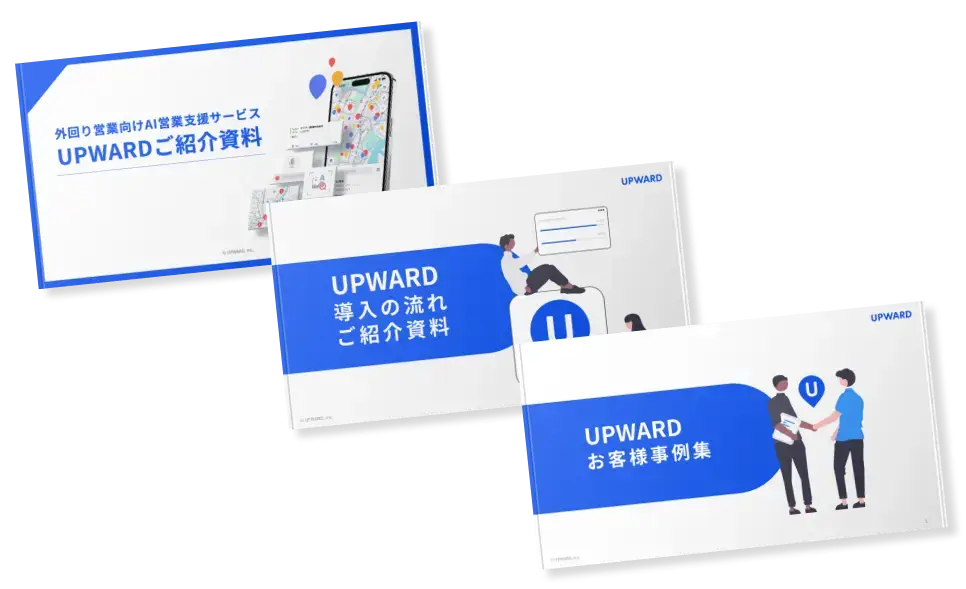
Click here for UPWARD introductory material

Conclusion

Amidst the changing work styles and labor shortages, the global trend toward digital transformation is expected to continue. Sales organizations, which have long been managed mainly by paper and Excel, are no exception.
While some may find it time-consuming to gather information and implement CRM, once successfully implemented and established, it will become a powerful weapon that will lead your competitors by a step or two and contribute greatly to gaining market superiority.
Why not take this opportunity to consider CRM implementation while keeping in mind the key points of success? For more information on UPWARD's functions and case studies, please download our brochure, and if you are considering CRM, please take a look at UPWARD first.

Click here for UPWARD introductory material

Download a free set of 3 documents

A full overview of the benefits and best practices of the introduction of the system

Download a free set of 3 documents

If you have any questions, please feel free to contact us.

TEL: 03-6897-3683
*Open hours: 10:00-17:00 (except Saturdays, Sundays, national holidays, and year-end and New Year holidays)