ONE OF THE ISSUES THAT MUST BE ADDRESSED WHEN AIMING FOR SALES EXPANSION AND ORGANIZATIONAL GROWTH IS THE ELIMINATION OF "GERRITIZATION" IN THE SALES DEPARTMENT. IN THIS ARTICLE, WE WILL FOCUS ON THE ISSUE OF SALES GERRYMANDERING AND PROVIDE A COMPREHENSIVE EXPLANATION OF ITS CAUSES AND COUNTERMEASURES. PLEASE REFER TO THIS ARTICLE IN ORDER TO REALIZE DE-PERSONALIZATION OF THE ENTIRE ORGANIZATION. >[FREE PDF DOWNLOAD] A GUIDEBOOK ON HOW TO AVOID MAKING MISTAKES IN DIGITAL TRANSFORMATION SALES IS NOW BEING DISTRIBUTED.
A thorough explanation of the causes of sales gerrymandering and seven solutions.
Recommended Documents
-
SUCCESS STORIES OF COMPANIES THAT HAVE ACHIEVED RESULTS WITH UPWARD
Click here to download the document
Pickup Articles
Table of Contents
What is sales gensets?

Sales gentrification refers to a situation in which processes and know-how related to customer negotiations and business activities are not shared with the team or organization, and rely heavily on individual skills and personal relationships.
This means that the unique skills and relationships possessed by a particular sales representative can have a significant impact on the sales activities of the entire company.
In an organization in which salespeople are highly individualized, sales results vary greatly depending on the skills and relationships of each sales representative, making it difficult for the team as a whole to achieve consistent results. In order to improve the sales force as an organization and stabilize results, it is necessary to eliminate the division of labor.
Causes of sales gerrymandering
First, let's sort out the causes of sales gerrymandering.
The causes of gerrymandering can be divided into two main categories: "organizational" and "individual" problems.
The "Organization" Issue
Sales style that leaves it up to the field
Organizations that leave sales methods to field salespeople are unable to create repeatability in their sales activities, resulting in sales gentrification. This creates dependence on top salespeople, resulting in difficulty in maximizing future sales and earnings.
Lack of awareness to achieve goals throughout the organization
If the entire organization has sales goals and a culture that emphasizes cooperation among members to achieve them, sales gerrymandering can be minimized. However, if there is no heightened awareness of goal attainment within the sales team, employees will not feel the need to proactively report customer information, resulting in sales gerrymandering.
The "individual" issue.
Reluctant to share sales know-how and successful patterns
The more incentive payments and salary increases and promotions depend on sales performance, the more employees are motivated by a desire not to lose out to internal members in sales performance. As a result, they will not think about developing sales know-how and best practices within the company, which will lead to the creation of sales gentrification throughout the organization.
Want to hide mistakes and protect their position.
Sharing information within the company means that mistakes and claims that occur in the course of sales activities are also shared.
However, if there is no corporate culture of sharing information, there will be a strong psychological need to protect one's position by hiding mistakes or complaints that lower one's reputation. As a result, the sales force will become more and more gentrified.
Problems caused by sales gensets

Often, when sales gerrymandering is left unchecked, it can have a negative impact on the organization as a whole.
Specifically, the following six problems can be considered
Variations in sales performance occur.
In a sales organization that is highly dependent on the skills and experience of each individual, sales performance tends to be highly variable. As a result, the organization as a whole may not be able to achieve stable profitability.
Become a sales organization that relies heavily on top salespeople.
When an organization is overly dependent on top salespeople with outstanding sales performance, there is an increased risk that the entire organization's sales force will be severely compromised when those salespeople leave the company. In addition, other sales members may not be able to fully demonstrate their capabilities.
Inability to utilize customer data
Customer data obtained through daily sales activities is a valuable asset to a company in its efforts to maximize sales and earnings.
However, when the sales force is highly individualized, customer information obtained from business negotiations becomes a black box. However, in a state where the sales force is highly individualized, customer information obtained from business negotiations becomes a black box, making it difficult to discover successful business negotiation patterns and formulate sales strategies by utilizing data across the entire sales organization.
This may reduce their competitiveness against competitors.
Customer information is siloed and cannot be approached appropriately.
If each employee manages customer information exclusively, customer information will become siloed.
For example, if one salesperson conducts a sales activity and receives a sales refusal, but another person from a different department conducts the sales activity again, this could cause problems such as undermining the trust of the company.
The siloing of sales information not only undermines corporate credibility, but can also lead to lost sales opportunities.
Increased burden of handover work
In this day and age when job changes are commonplace, it is important to establish a system that allows for efficient handover operations.
However, if the sales organization is divided into several individuals, the person in charge of the handover must conduct interviews with the person in charge of the case regarding the details of the handover, and then proceed with the work.
Not only does this result in an inordinate amount of time, but there is also a good chance that you will miss something that you should have heard before you left the company.
In the worst case scenario, the handover will not be adequate, resulting in customer complaints and lost opportunities.
New employees are not being trained.
IF PAST NEGOTIATION HISTORIES AND EXAMPLES OF SUCCESSES AND FAILURES CAN BE OPENLY VIEWED IN THE DATABASE AND CRM/SFA, NEW SALES REPRESENTATIVES CAN USE THIS INFORMATION TO DEEPEN THEIR UNDERSTANDING OF CUSTOMERS AND INCREASE THEIR CHANCES OF BECOMING AN IMMEDIATE ASSET AT AN EARLY STAGE.
However, if the sales organization is gentrified, newcomers are forced to rely on the intuitive advice of senior employees, which not only slows their growth, but also reduces their motivation.
Seven solutions to prevent sales people from becoming generational salespeople

The following seven methods are effective in solving the problem of sales gerrymandering and improving the sales force of the entire organization.
1. Establish a mechanism for information sharing
It is essential to share customer data obtained from sales activities within the organization in order to prevent the data from being assigned to a specific person.
Specific measures include the introduction of a system that facilitates information sharing and the establishment of regular team meetings. This will ensure that individual sales representatives do not have their own information and can share it with other members of the team.
In addition, information on sales techniques and talk scripts that improve closing rates can also be shared, thereby improving the sales capabilities of the entire organization.
2. Clarify the goals of the sales organization
By setting goals that are shared throughout the organization, a sense of team unity is created, leading to increased motivation to achieve sales results. In an environment where the entire team works hard to achieve goals, sales know-how and information on how to deal with problems are actively shared, strengthening the entire organization. When setting goals, it is important to set realistic and achievable goals and modify them flexibly according to the situation.
3. Molded sales process
Standardizing the sales process will prevent variation in approaches and knowledge among sales representatives.
In addition, by creating sales manuals and checklists and having all sales personnel conduct sales activities using uniform methods, it is possible to reduce unevenness in sales skills. Through these efforts, we can expect to eliminate the problem of sales personnel being assigned to a particular field and improve the sales force of the organization as a whole.
4. Visualization and sharing of sales process
To improve the efficiency and success rate of sales activities, it is important to clarify the sales process and share this process within the organization. By being able to see at a glance the activities of sales representatives and the progress of deals, problems and bottlenecks can be identified and sales operations can be de-personalized.
Specific situations may include the following cases
- When there is a variation in the rate at which deals are closed or orders are received among sales representatives
In such cases, it is highly likely that some problems lie within the sales process. By visualizing and sharing processes, problems can be addressed and remedial measures implemented to improve the sales force of the entire organization.
5. Review of evaluation system
Evaluation systems, which influence employee behavior and attitudes, play a major role in de-personalizing sales operations. By reviewing the evaluation system throughout the organization and establishing new evaluation criteria, better results can be expected.
In addition to quantitative indicators such as sales and number of transactions, the following qualitative evaluation criteria should also be considered
- Achievement of team goals
- Contribution to team growth
- Status of communication efforts within the team
This creates an environment in which employees work together to achieve goals and promotes de-personalization of sales operations.
6. Foster a corporate culture that emphasizes information sharing
A corporate culture that emphasizes information sharing is the key to fundamentally resolving the problem of sales attribution. If management and supervisors take the initiative to understand the importance of information sharing and actively engage in internal communication, sales representatives will develop the habit of sharing information.
7. INTRODUCTION OF IT TOOLS
The introduction of IT tools is expected to improve the efficiency of sales activities and eliminate genus problems.
For example, customer relationship management (CRM) systems and tools for managing and analyzing sales activities will enable efficient management of information and improve information transparency among sales representatives. This will result in de-personalization of sales operations.
Related article>[ 2024 Edition] 16 recommended sales tools|Thorough explanation of how to choose one and the advantages of implementing it.
EFFECTIVE SALES DIGITAL TRANSFORMATIONTOOLS TO DE-PERSONALIZE SALES, WHAT IS CRM?

A highly effective measure to de-personalize sales is the introduction of CRM, which can manage and share customer information in one place.
CRM stands for "Customer Relationship Management" and is a tool dedicated to customer management.
In Japan, it refers to so-called "systems for customer management.
CRM stores not only quantitative information such as customer age, location, past transaction history, number of website visits, inquiry history, etc., but also qualitative information such as customer needs, requests, opinions, and sometimes complaints, We accumulate, centrally manage, and share all types of customer information. Based on the managed information, we analyze the issues and requests of each customer according to their attributes, and provide services and products that meet the needs of each customer, thereby increasing their satisfaction. Raising the LTV (customer lifetime value) of each customer will ultimately lead to maximizing profits.

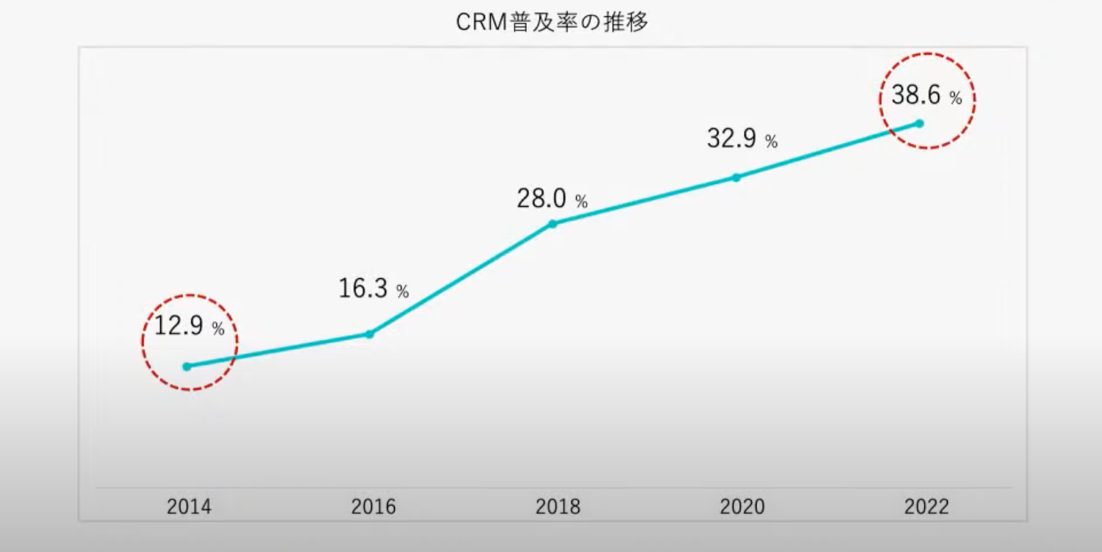
As you can see from the above graph, the penetration rate of CRM has tripled over the past 10 years, with companies in a variety of industries and business sectors promoting the adoption of CRM.
Click here to see examples of companies that have successfully implemented CRM.
Related article>>[ Mitsumoa Corporation] The key to improving customer satisfaction is efficient information sharing using UPWARD. CRM unifies communication history managed by each department.
Related Articles>>[ Daihatsu Motor Co., Ltd.] Evolving into a New Activity Management Style to Create Motivation through "Greening of the Desert ". Sales performance increased 5.5 times in one year.
CRM HAS BEEN IMPLEMENTED, BUT MANY COMPANIES HAVE NOT YET MASTERED ITS USE.
Although CRM is being implemented in more and more companies every year, the truth is that most companies are not making good use of CRM.

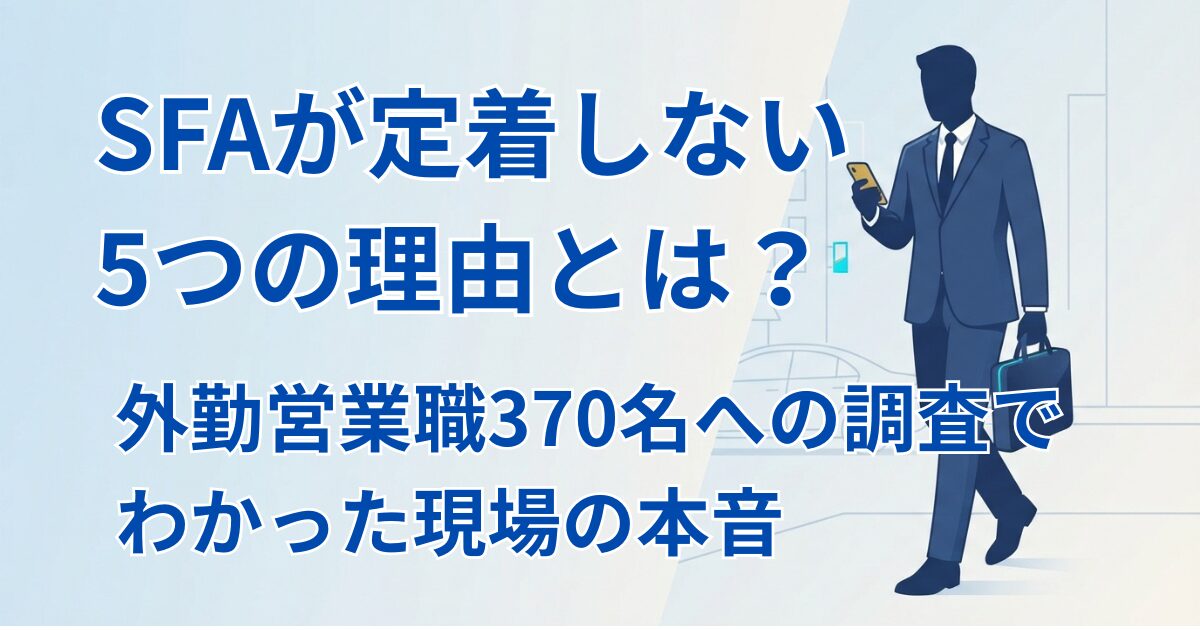
The above table is based on our own survey of "Reasons for not logconducting sales activities".
The reality is that, although CRM has been implemented, many frontline workers say that "it is time-consuming to input data" or "they do not feel the need to input data. If data is not entered, customer information is not stored in the CRM, so it cannot fully function as a CRM, and the sales force is not eliminated.
In addition, data entry is a process, not an objective.
Even if data entry is completed, it will not lead to maximization of sales unless customer data is utilized and on-site actions are changed before and after. Based on the above survey results, it is necessary to select a CRM that is not only rich in functions and capable of acquiring detailed marketing data, but also easy for on-site staff to input data, and easy for them to establish the data input process.
FOR CRM, UPWARD IS RECOMMENDED FOR EASY DATA ENTRY AND RETENTION.
WE PROVIDE AND DEVELOP UPWARD, A SALES DIGITAL TRANSFORMATIONTOOL THAT MAXIMIZES THE VALUE OF CRM AND SFA.

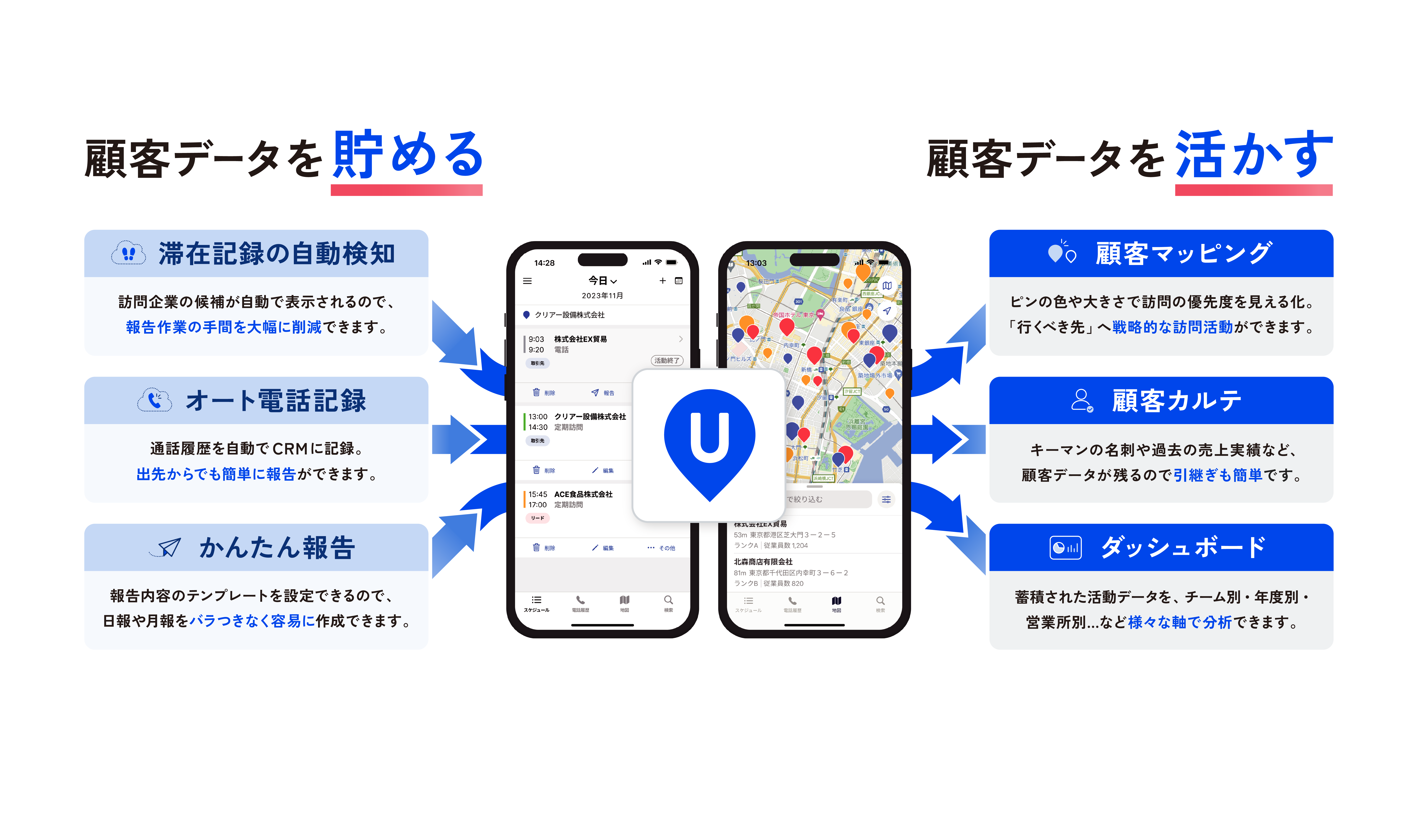
By utilizing "UPWARD", customer data such as customer profile information, business meeting history, and activity reports can be semi-automatically stored in CRM easily with a single smartphone. When the person in charge in the field creates a daily sales report or activity report, not only is the report format automatically created on "UPWARD", but also the report can be easily created in his/her spare time by voice input support.
The data entered daily is visualized on a map, allowing users to intuitively know which customers to visit next. Anyone can visit not only the usual "easy-to-reach places" but also the places that really "need to be visited" in a strategic manner.
For more detailed information, please download the service document from the following URL.
To download the document here (Japanese only)
Conclusion
Sales gerrymandering, if left unchecked, can have a variety of negative effects on an organization.
Please try to incorporate the solutions introduced in this article to help your company grow. If your organization is not making progress digital transformation, implementing digital transformationtools such as CRM to accumulate information will bring great results. We hope that you will take action to de-personalize your sales force by referring to this article.
A full overview of the benefits and best practices of the introduction of the system
Download a free set of 3 documents