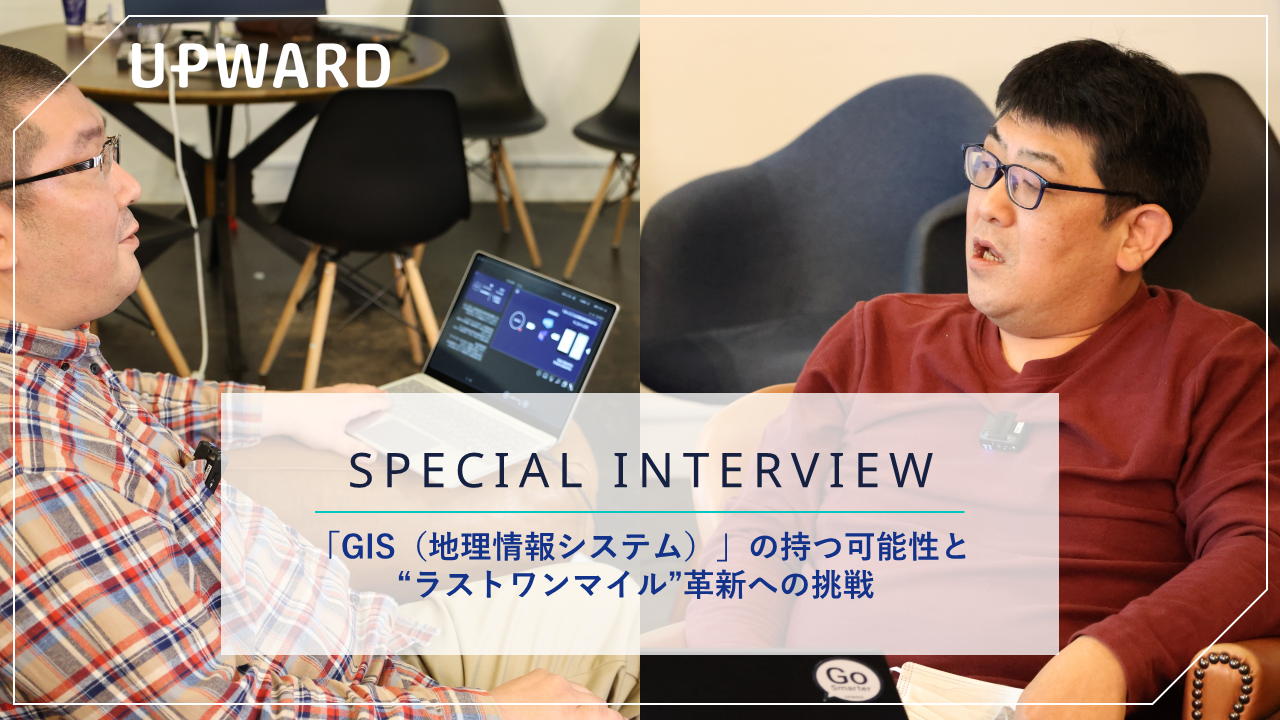
SYSTEMS THAT UTILIZE LOCATION INFORMATION ARE FAMILIAR IN OUR DAILY LIVES, SUCH AS MAP APP SMARTPHONES APP FACILITY SEARCHES ON TRAVEL WEBSITES. THESE TECHNOLOGIES THAT RESPOND TO REQUESTS SUCH AS "I WANT TO FIND A NEARBY RESTAURANT" OR "I WANT TO KNOW THE ROUTE FROM MY HOUSE TO A HOTEL" ARE PART OF WHAT IS KNOWN AS "GIS (GEOGRAPHIC INFORMATION SYSTEM). WHAT ARE THE POSSIBILITIES OF GIS AND HOW WILL IT CHANGE THE BUSINESS SCENE? TAKEYAMA, WHO HAS BEEN INVOLVED IN GIS DEVELOPMENT FOR MANY YEARS AND HAS LED UPWARD'S PRODUCT DEVELOPMENT, AND KAGAYA, WHO WORKS IN THE DEVELOPMENT DIVISION, INTERVIEWED THE DEVELOPERS TO LEARN ABOUT THE GRAND POTENTIAL OF GIS AND UPWARD'S GOAL OF CONTRIBUTING TO THE BUSINESS SCENE. THE INTERVIEW IS A GREAT OPPORTUNITY TO LEARN MORE ABOUT UPWARD AND ITS POTENTIAL FOR CONTRIBUTING TO THE BUSINESS WORLD.
The potential of UPWARD's core technology 'Geographic Information System'.
Recommended Documents
-
SUCCESS STORIES OF COMPANIES THAT HAVE ACHIEVED RESULTS WITH UPWARD
Click here to download the document
Pickup Articles
Table of Contents

The potential of UPWARD's core technology 'Geographic Information System'.

Takeyama: I have been involved in GIS development since 1996, and at UPWARD, I have walked with the evolution of technology for about 12 years since its predecessor. Today, I would like to tell you about GIS, its application scenarios in your daily life and its future possibilities.
GIS is an abbreviation of "Geographic Information System" and is translated as "Geographic Information System" in Japanese.
It digitizes and visualizes mountains, rivers, roads, buildings, and everything else on earth, making it possible to analyze and derive trends. The system developed in Canada in the 1960s for land management is said to be the world's first GIS.
In Japan, GIS was developed in earnest in response to the Great Hanshin-Awaji Earthquake of 1995, when people wondered whether damage could have been minimized if GIS had been utilized.
Today, GIS is used not only in the natural environment for disaster countermeasures, but also in a wide range of fields, such as urban planning and customer trend analysis in marketing.
A concrete example of a familiar application is disaster prevention hazard maps. The " Overlapping Hazard Maps " website produced by the Geospatial Information Authority of Japan (GSI) allows users to check flood and sediment disaster risk data provided by various related organizations by overlaying them on a map.
This is the area around UPWARD's Tokyo headquarters, and it shows that the area will be inundated by 0.5 to 3 meters when a river overflows. We encourage everyone to investigate what kind of risk there is at your home location.

Also available within the Government Statistics Portal site is a geographic information system called Statistics on a Map (Statistics GIS), which can display census and other statistical data on a map. The census contains a variety of attribute data, and it is possible to pick up and display only the data you need from the census.
The figure below shows the distribution of the population over 65 years old. The red areas have a high percentage of the population over 65 years old, so they can be used when you want to target seniors. This is effective for marketing to an area after finding out in advance what kind of area has a large number of targeted people.

In addition, the GSI's Geographical Survey Institute 's electronic national land web " GSI Map " also provides detailed elevation data. When I first became involved in GIS, I was very impressed to learn that administrative boundaries, or so-called municipal boundaries, are demarcated according to such mountain ridges and other features.

ONE THEORY SAYS THAT MAPS ARE A COMMUNICATION TOOL THAT EXISTED BEFORE LANGUAGE. GIS CAN REPRESENT ANY DATA FROM ANY ANGLE, AS LONG AS IT HAS LOCATION DATA. IT IS A VERY GOOD SYSTEM THAT CAN OUTPUT COMPLEX INFORMATION IN A FORM THAT IS INSTINCTIVELY EASY TO UNDERSTAND.
In-house development of high-precision location technology enables a higher level of UX / UI.

Kagaya: We've been developing our own GIS since our founding. Currently, our "UPWARD ENGINE" system runs app, enabling us to process and deliver geospatial information—such as geocoding (converting addresses to latitude/longitude) and data from third-party sources like open data—at high speed.
GEOCODING, THE FIRST FUNCTION OF UPWARD ENGINE, CONVERTS INPUT ADDRESS DATA INTO LATITUDE AND LONGITUDE. IN THE EXAMPLE BELOW, UPWARD RECOGNIZES THE ADDRESS OF UPWARD'S TOKYO HEADQUARTERS, THEN NARROWS IT DOWN STEP BY STEP UNTIL IT FINALLY PRODUCES A LATITUDE AND LONGITUDE.

We then convert this latitude and longitude into geospatial information by connecting it to various CRMs such as Salesforce and Microsoft Dynamics 365. Through this process, customer information in the so-called "virtual space" online is expressed in the offline real world through geocoding, and can be connected to the "last mile This process connects the customer to the "last mile" where the customer is actually located.
And then, we connect the geospatial information linked to CRM data via geocoding with other information. This is the second function of UPWARD ENGINE. In the future, by enabling integration with data from the Geospatial Information Authority of Japan and other relevant organizations, we can improve target areas based on the attribute information derived from that data and formulate the next plan...With UPWARD ENGINE, we believe we can help maximize the use of CRM information and formulate more accurate sales strategies.

UPWARD ENGINE's development commitment is to be "flexible and fast.
One of the first major features is our awareness of the use of de facto standards (manufacturing methods that are standard in the industry) and open source (source code that is free and open to the public) to enhance flexibility. By making the specifications such that anyone on the development team can improve the system, we can respond quickly to the ever-changing needs of the business market. In addition, addresses entered by hand can be quite ambiguous. We take into account such parts and try to plot them as accurately as possible.
Example: "Kita 23-jo Nishi 3-chome, Hokkaido" → Converted to "Kita 23-jo Nishi 3-chome, Kita-ku, Sapporo, Hokkaido
It is also essential to be able to process the data at high speed. As UPWARD is being introduced mainly by major companies, the number of data that our customers have is becoming extremely large. If we cannot geocode this data at high speed, the preparation period for using UPWARD will be prolonged, and we will not be able to achieve the "shortest time to value" of the " 6 UX Values " in our product vision.
We are developing UPWARD with flexibility and high speed. This is the goal of our development.

Kagaya: And the most important point for us to commit to our clients' success with GIS is that we continue to have our system developed in-house.
For example, Google Maps and other map services can do geocoding, but the cost, conversion time, specification changes, etc. are dependent on those services, so we cannot handle the shortest possible Time to Value. Also, if the service were to disappear, the UPWARD product itself would cease to exist. To avoid risk, we insist on developing our own products.
Another reason is that because we develop the data in-house, we can freely handle geospatial information obtained in-house. There are many cases where data from different sources can technically be linked by using geospatial information as a key, but cannot be linked due to restrictions within the underlying map service. This can be prevented.
UPWARD is, after all, a product that places the highest value on the field's perspective. We believe it is important to refine our services based on the needs of our customers and continue to provide good products by ourselves.
The availability of geospatial information is going into the business world with the widespread use of smartphones.
Takeyama:As Mr. Kagaya mentioned earlier, UPWARD now utilizes geospatial information obtained through geocoding to determine customer information based on attributes such as the frequency of recent visits and sales volume, which is then represented by pins on a map.
In the past, it was not practical to use geospatial information in the business field because it was very difficult to obtain the location information of each individual, but now that it can be easily obtained from smartphones, the data is being used in products.
At the current stage of development, I do not think that we have yet drawn out the full potential of GIS. As we continue to develop the system, we will make it easier to use and handle in the sales field, for example by using geographical information to "superimpose various statistical data on UPWARD maps".

Kagaya: Additionally, while it's not yet a feature, we envision a one-tap auto-check-in button that pulls nearby facility information and automatically registers the customer without any input from the staff. Assuming a hybrid work model, it could determine sales territories based on the nearest station to the salesperson. I believe UPWARD will enable such automation, and we aim to actively leverage it to support our customers' sales activities.
TAKEYAMA:THE AVAILABILITY OF GEOSPATIAL INFORMATION HAS REALLY EXPANDED GREATLY, NOW THAT IT IS POSSIBLE TO EASILY AND ACCURATELY OBTAIN PERSONAL LOCATION INFORMATION. WE HOPE TO CONTINUE DEVELOPING AND CHALLENGING OURSELVES TO INNOVATE THE LAST MILE IN THE FIELD USING GIS.
Aiming for the world with Made from Japan technology

Kaneki: Since our founding, we have always had the image of "connecting the real world and virtual space using location-based technology," but we have never been able to successfully express it as a appapplication. However, with the explosive spread of smartphones and the revolutionary evolution of cloud technology, I feel that we are gradually approaching my original image.
I believe that UPWARD can be the gateway or user interface for seamless connection between the digital space and the real world based on location information without any burden on the user, and we will continue to challenge to realize this world.
A full overview of the benefits and best practices of the introduction of the system
Download a free set of 3 documents